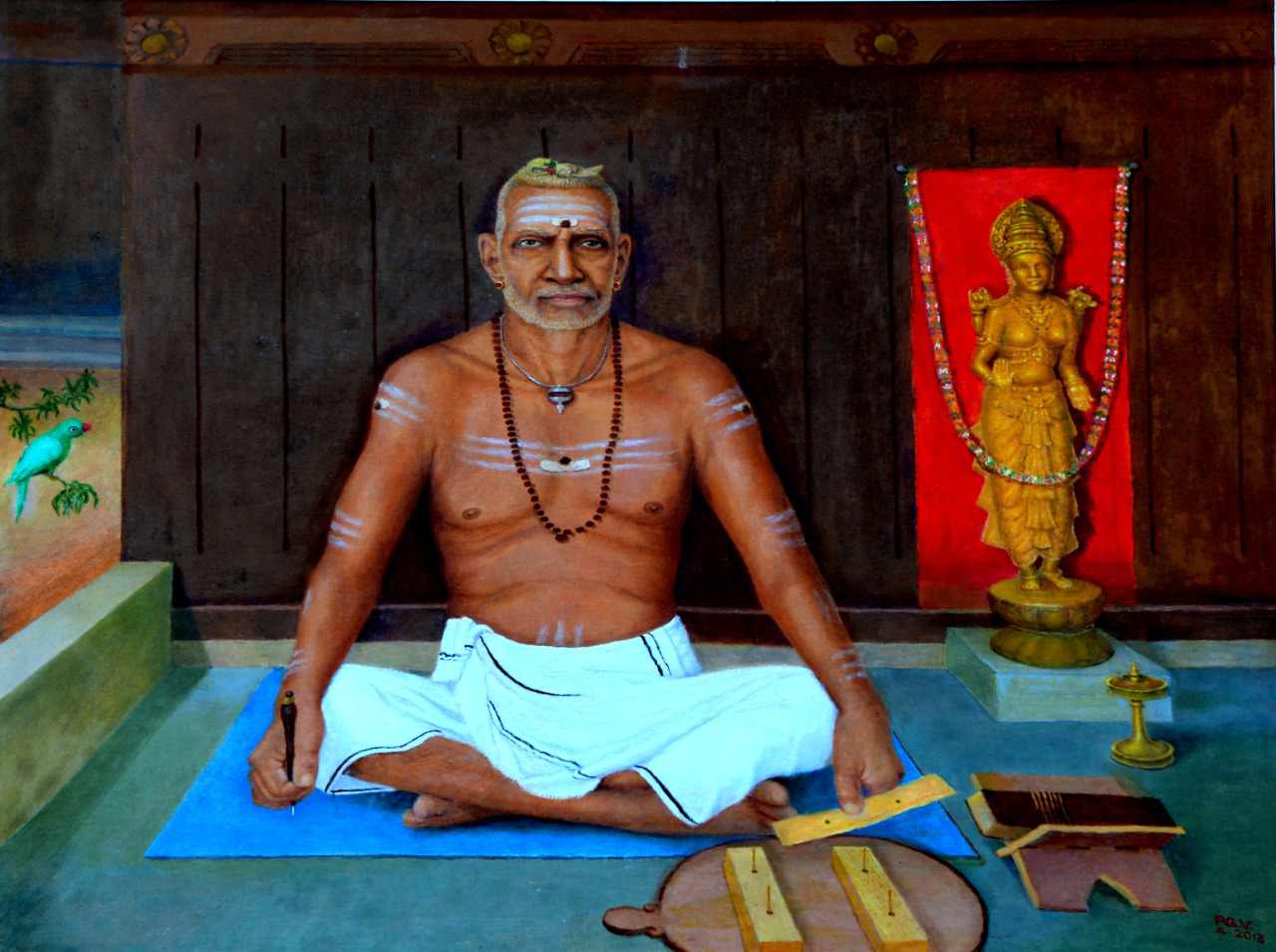
पूण्तानम् नम्बूदिरि
Pūntānam Nambūdiri
The grieving father
1547 to 1640
The poet whose grief became the Bhagavad-Gītā of the Malayali common people.
“Kṛṣṇa Kṛṣṇa Mukunda Janārdana. Kṛṣṇa Govinda Nārāyaṇa Hari.”
His pain was too urgent for formal Sanskrit. He poured his anguish into plain, broken Malayalam, and the Lord, the kṣetra holds, preferred his broken words over the perfect Sanskrit of the greatest scholars.
The Need
A simple Nambūdiri householder. He lost his only infant son. He walked to Guruvāyur half-mad with grief and stayed.
The Response
His grief became the Jñānappāna, the Song of Wisdom, written in plain Malayalam, not Sanskrit, because he did not have time for Sanskrit. The whole pana is the thought of a man who has accepted that this body will end, that this wealth will end, that this child has ended, and that the only thing that does not end is the name of the Lord.
The Teaching
When Mēlpattūr corrected Pūntānam's Sanskrit pronunciation in the temple, telling him not to say Maraprabhu (Lord of Trees) but Amaraprabhu (Lord of the Immortals), a voice from inside the śrīkōvil said: I am Maraprabhu. I am Amaraprabhu. I am Sarvaprabhu. Don't correct his love. After that, Mēlpattūr did not correct Pūntānam again. Bhakti is dearer to the Lord than vibhakti.
A surprising quantity of work, almost all of it in plain Malayalam, with a handful in simple Sanskrit and a few attributed in Tamil. The hallmark is always the same: rough metre, simple words, the name of God repeated past the point of literary good taste. He could write Sanskrit perfectly well; he chose not to.
Jñānappāna (Song of Wisdom)
Malayalam, pāṇa metre360 lines. The masterwork. The Bhagavad-Gītā of the Malayali common people.
Santāna-gopālam Pāṇa
MalayalamAlso called Kumāraharaṇam. The Bhāgavata story of Arjuna's failure to retrieve the Brahmin's lost children, composed after his own infant son died. He worked out his grief in the only Bhāgavata story about a man whose children come back.
Kuchēla Vṛttam Pāṇa
MalayalamThe story of Kuchela, the poor childhood friend of Kṛṣṇa, brought into Malayalam song.
Bhāṣā Karṇāmṛtam
MalayalamA Malayalam Karṇāmṛtam, in deliberate echo of Līlāśuka's Sanskrit one, written for Malayalis who could not read Sanskrit.
Vishṇugītā
MalayalamA Malayalam re-rendering of bhakti-Gītā material.
Rāghavīyam, Viṣṇuvilāsam, Sītā-rāghavam
Sanskrit kāvyasThree small Sanskrit poems. They prove he could have written Sanskrit perfectly well. The Malayalam was a choice, not a deficit.
ജ്ഞാനപ്പാന
Jñānappāna
Structure
- ·360 lines in the pāṇa metre native to Kerala folk-song.
- ·The pāṇa is the rhythm of working women singing while pounding rice or rocking a child to sleep. He wrote his theology in the metre of household labour.
- ·Three movements: transience, the Kali-yuga, the closing plea.
- ·At the end of nearly every verse, the same refrain: Kṛṣṇa Kṛṣṇa Mukunda Janārdana. Kṛṣṇa Govinda Nārāyaṇa Hari.
Themes
- ·The transience of life. Those people we keep seeing and seeing, and then suddenly they are not there.
- ·The simplicity of Kali-yuga sādhana. In this age, the Name alone suffices. Kṛṣṇa once is worth ten thousand Tretā-yuga horse-sacrifices.
- ·The closing plea: stay with me. Don't let the moment of my death be a moment of forgetting. Let the last syllable in my mouth be your name.
A Verse
Those people we keep seeing, day after day,
and then suddenly we do not see them.
What an illusion this is.
What a forgetting.
Krishna, Krishna, Mukunda, Janārdana.
Krishna, Govinda, Nārāyaṇa, Hari.
The opening kandu kandaṅṅirikkum janaṅṅaḷe. The same insight that opens the Vairāgya-prakaraṇam of the Yoga-vāsiṣṭha and Bhaja Govindam, but in the rhythm a Malayalam grandmother could absorb.
Says Pūntānam
The language closest to grief is the language closest to God. Pūntānam did not lose his Sanskrit when his son died. He decided, as a writer, that the room of his grief was a Malayalam-speaking room, and the Lord he was addressing in the room had to come in through the Malayalam door. He bet that the Lord could come through that door. The kṣetra held that the bet was won.
He came to Pūntānam as the ultimate comforter.