मेल्पत्तूर् नारायण भट्टतिरि
Mēlpattūr Nārāyaṇa Bhaṭṭatiri
The grammarian who became a healer
1560 to 1646
The scholar who took on his teacher's paralysis and wrote his way back to health.
“āyurārogya saukhyam. Long life, health, well-being.”
The most prolific of the Five and probably the most intellectually distinguished devotee Guruvāyur ever produced. He gave his polished Sanskrit because polished Sanskrit was his real medium. The Lord met him there.
The Need
His teacher fell ill with paralysis. Mēlpattūr, in an act of guru-bhakti the texts call almost reckless, performed the unheard-of yogic transfer: he took the disease into his own body and died for several years, slowly, inside it.
The Response
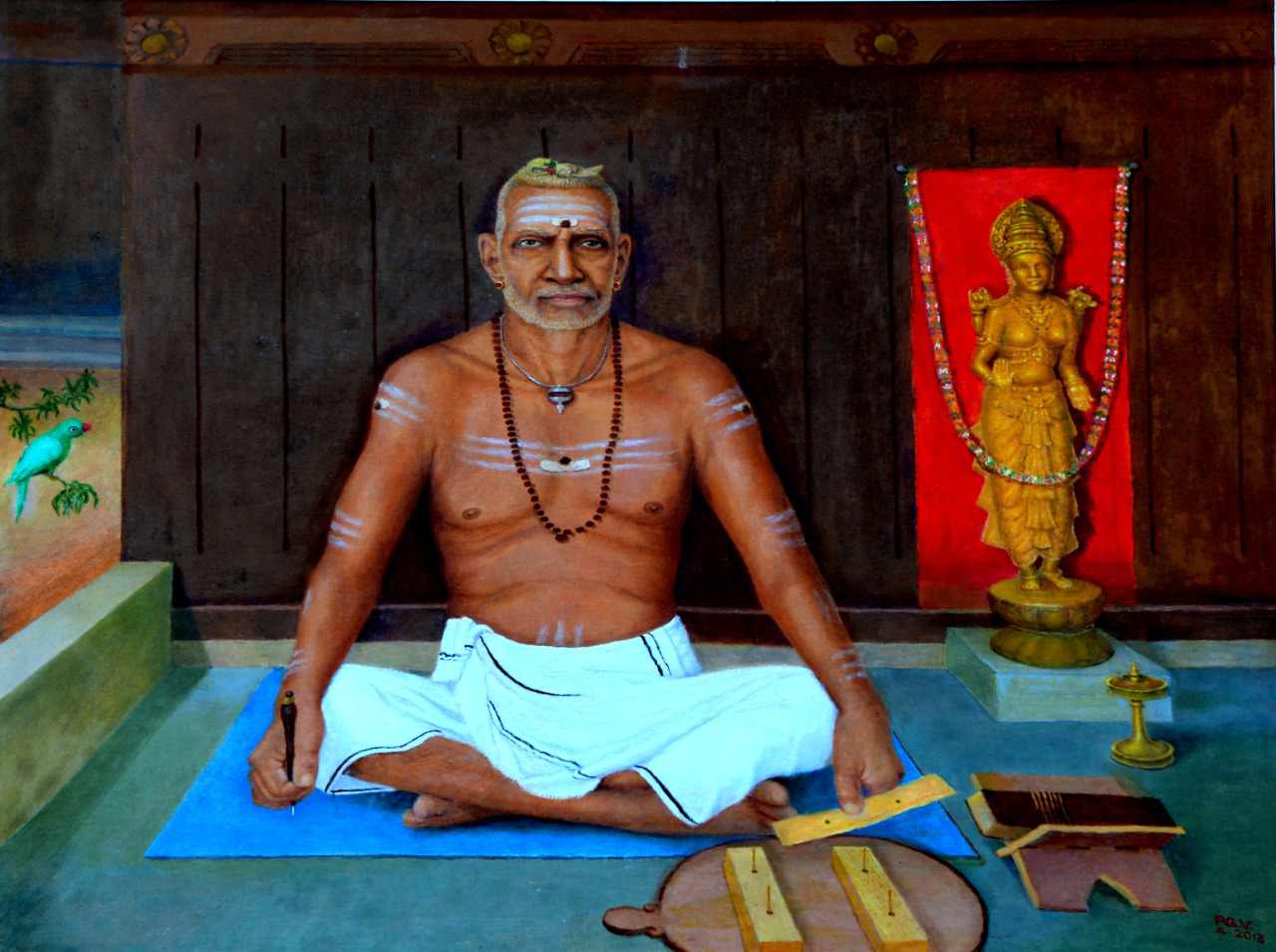
He went to Guruvāyur. He sat at the southern courtyard and resolved: I will write the Bhāgavata in condensed form, one daśaka per day, and I will not stop until I have finished or died. Each evening he composed ten verses. Each morning he submitted them, in his mind, to the Lord. On the hundredth day, after one thousand and thirty-six verses, he wrote the closing benediction: āyurārogya saukhyam. Long life, health, well-being. He stood up cured.
The Teaching
Vibhakti and bhakti are not enemies. Scholarship and devotion are not enemies. Mēlpattūr was a brilliant grammarian, and that brilliance is what gave him the discipline to write a complete śāstra in a hundred days while sick. The Lord did not despise his learning. The Lord used it.
Mēlpattūr wrote in many fields. The temple knows him for one work; the philological tradition knows him for several. He wrote everything in flawless Sanskrit. No one in Kerala history disputed his command of the language. He chose Sanskrit because Sanskrit was his hand-tool; he could carve in it without strain.
Nārāyaṇīyam
Sanskrit, 1586 CE100 daśakas, 1,036 verses. The condensation of the Bhāgavata Purāṇa. The temple's daily liturgy. The hallmark text.
Prakriyā-sarvasvam
SanskritA major treatise on Pāṇinian Sanskrit grammar in 19 chapters. One of the most important post-Bhaṭṭoji works in the field.
Mānameyodayam
SanskritA treatise on Mīmāṃsā epistemology, co-authored.
Apahāra-stotra, Pāñcāli-svayaṃvaram, and others
SanskritA long list of campū-kāvyas, prahasanas (satirical plays), and stotras. He wrote constantly.
नारायणीयम्
Nārāyaṇīyam
Structure
- ·100 daśakas, each containing roughly ten verses, totalling 1,036 verses.
- ·Each daśaka closes with a refrain-line addressed directly to the Lord of Guruvāyur, asking either for liberation or, more often, simply for one specific bodily cure.
- ·Composed at the rate of one daśaka per day for one hundred days, sitting on the south veranda of the temple while the disease ate through his body.
- ·Daśakas 1 to 10: Brahman in itself. The famous opening sāndrānanda-avabodhātmakam.
- ·Daśakas 11 to 24: Cosmology. The descent of the universe.
- ·Daśakas 25 to 36: The avatāras. Matsya through Vāmana through Paraśurāma through Rāma.
- ·Daśakas 37 to 88: The Kṛṣṇa-līlā. The bulk of the work, mirroring the bulk of the Bhāgavata's tenth canto.
- ·Daśakas 89 to 99: Philosophy and devotion. The Uddhava-gītā material.
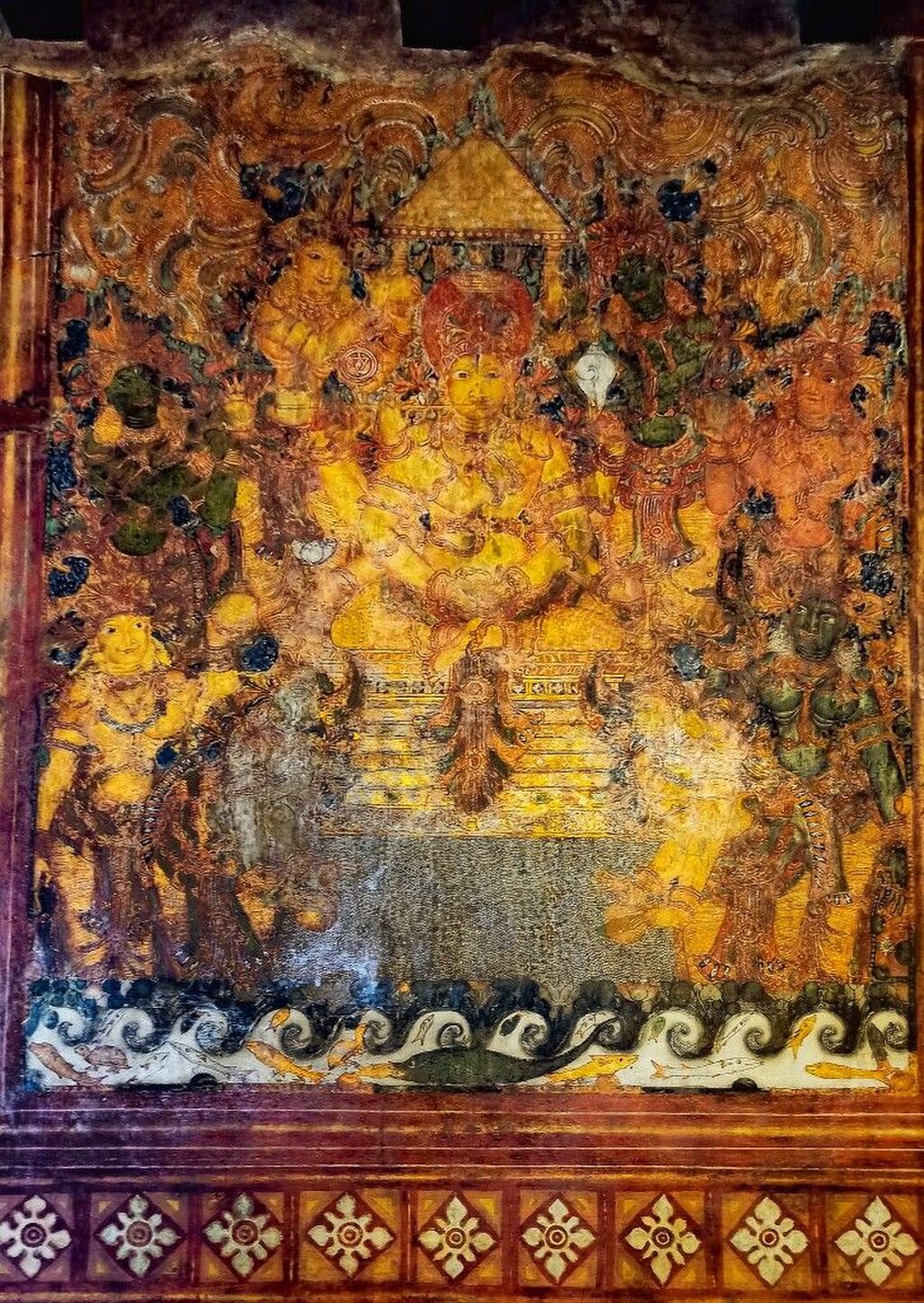
- ·Daśaka 100: The head-to-toe description of the murti at Guruvāyur as Mēlpattūr was actually seeing it. The most-loved daśaka.
Themes
- ·The nirguṇa Brahman the Upaniṣads point to is the saguṇa murti standing in the śrīkōvil at Guruvāyur. Vedānta and bhakti are not two paths.
- ·Each daśaka is both a Bhāgavata-summary and a hundred-day prayer for healing.
- ·Intellectual rigour and bhakti are tools of one another. The same brain that produced grammar produced this hymn-cycle.
A Verse
That whose nature is dense bliss and direct knowing,
beyond comparison, free from the limits of time and place,
eternally free, illumined by hundreds of thousands of scriptures
yet still indistinct;
that very Brahman, the moment it is seen,
becomes the supreme human goal.
Behold: it is shining in person right here,
in the city of Guru and the Wind.
What fortune for human beings.
The first verse of the first daśaka: sāndrānanda-avabodhātmakam. The entire program of the Nārāyaṇīyam in one verse.
Sings Mēlpattūr
For the modern seeker who is afraid that learning will weaken devotion, Mēlpattūr is the patron. Read the Nārāyaṇīyam one daśaka per day. Let the discipline of the daily reading itself be the practice. After a hundred days you will have read the entire Bhāgavata in compressed form, in one of the most beautiful Sanskrit ever written, and you will have done what Mēlpattūr did. The cure he received may or may not visit you. The discipline will.
He came to Mēlpattūr as the healer.