मानवेदन्
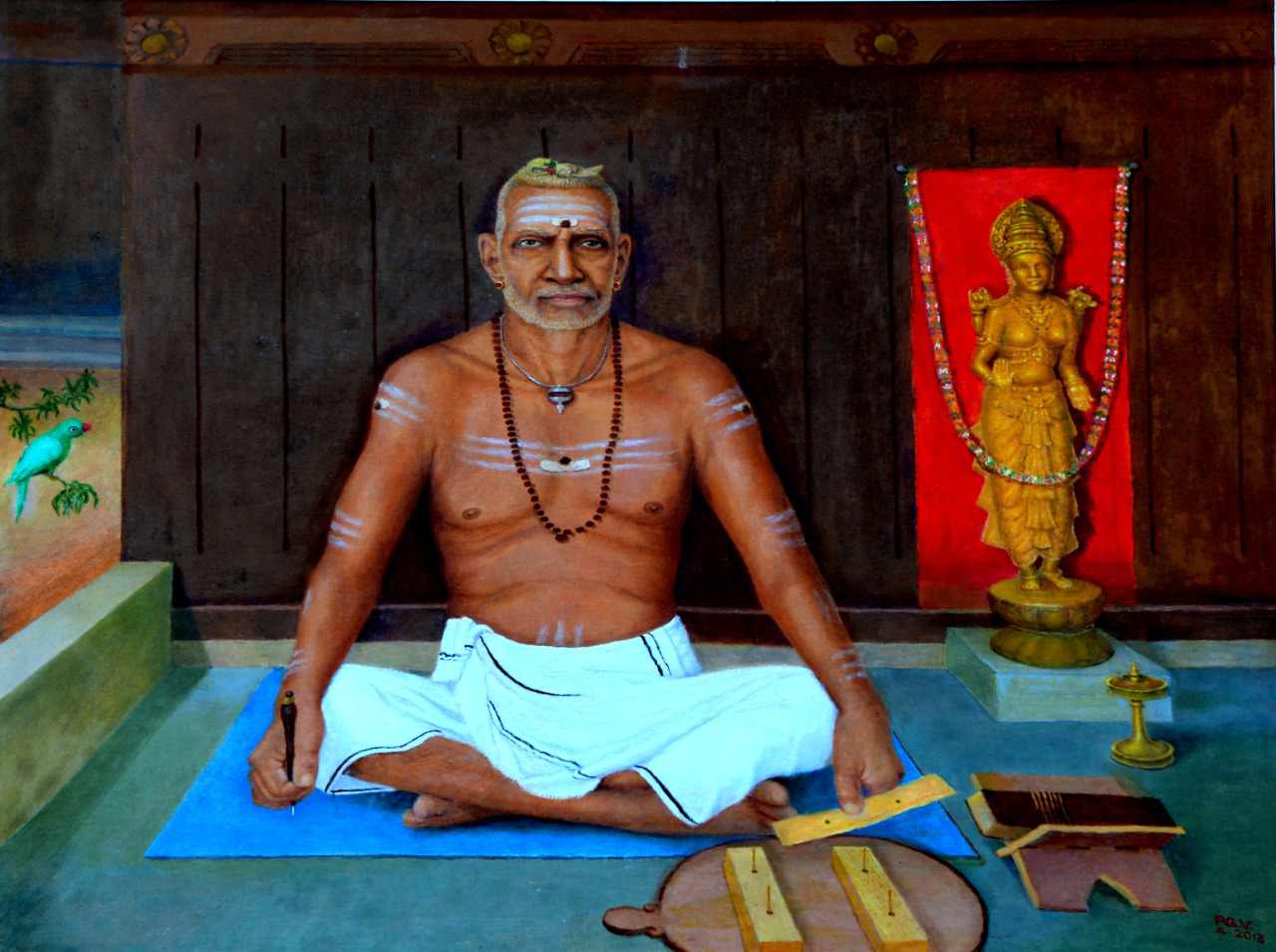
Mānavēdan, the Zamorin
King of Calicut, choreographer of the Lord
1585 to 1658, ruled 1655 to 1658
The king who asked to see Vṛndāvana and was given a peacock feather instead.
“I cannot give you what I saw. But I can stage it for you. Watch.”
He did not want philosophy. He wanted aesthetics. He begged to see the Lord exactly as the milkmaids saw him, dancing in the forests of Vṛndāvana. The Lord obliged.
The Need
The Zamorin king of Calicut. A scholar-poet of the seventeenth century. He went into a Kṛṣṇa-bhakti retreat at the Trikkaṇāmatilakam temple, hoping to see the Lord as the gopīs had seen him.
The Response
Under a banyan tree, the boy appeared and danced for him. When Mānavēdan reached out to embrace the vision, the Lord was about to vanish. The king grabbed at the peacock feather in his crown. The feather came off in his hand. The Lord was gone. The feather remained.
The Teaching
Mānavēdan kept the feather. From it, in poetic memory of what he had seen, he composed the Kṛṣṇa-gīti, choreographed it as Kṛṣṇanāṭṭam, the eight-night dance-drama performed only at Guruvāyur. Bhakti can be choreographed. The body's full visual and rhythmic vocabulary, costume and gesture and music and mime, is a legitimate form of theological speech.
Mānavēdan was a prolific royal author, but the work that matters here is one. He simultaneously did the playwriting, the composition, the costume design, the choreography, the percussion patterns, the order of the songs, the entire production. Without assistants. This is unusual even in Kerala's tradition of polymath kings.
Kṛṣṇa-gīti (Songs of Kṛṣṇa)
Sanskrit, 1654 CEThe libretto for Kṛṣṇanāṭṭam. 62 padams, 93 padyagītas, 321 ślokas, 2 daṇḍakas. Eight plays for eight nights. The hallmark text.
Pūrva-bhārata-campū
SanskritA campū-kāvya on the Mahābhārata's earlier books, in mixed prose and verse.
Smaller stotras and prabandhas
SanskritMost survive only in temple archives.
कृष्णगीति
Kṛṣṇa-gīti
Structure
- ·Eight plays performed across eight successive nights.
- ·Drawing on the Bhāgavata tenth canto, the Mahābhārata, and the Hari-vaṁśa.
- ·62 padams (devotional songs designed for dance), 93 padyagītas (lyrical verses set to music), 321 ślokas (metrical recitative verses), 2 daṇḍakas (rhythmic chants).
- ·Night 1: Avatāram, the birth.
- ·Night 2: Kāliya-mardanam, the subduing of the serpent.
- ·Night 3: Rāsa-krīḍā, the great circle dance with the gopīs.
- ·Night 4: Kaṁsa-vadham, the killing of Kaṁsa.
- ·Night 5: Svayaṃvaram, the wedding to Rukmiṇī.
- ·Night 6: Bāṇa-yuddham, the war with Bāṇa, the rescue of Aniruddha.
- ·Night 7: Vivida-vadham, the killing of the demon Vivida.
- ·Night 8: Svargārohaṇam, the ascent.
Themes
- ·Pure visual bhakti. No abstract teaching. No commentary. Just the events of the Lord's life, beautifully danced, exactly as the gopīs would have seen them.
- ·Performance as offering. The Lord's own image is the implicit silent audience. Humans watch the Lord watch his own life unfold.
- ·Līlā is not metaphor. The boy actually dances. The way to honour him is to dance him.
A Verse
Under the banyan tree, in the dim hour,
a small boy danced for the king who came alone.
When the king reached to embrace him,
only the peacock feather remained in his hand.
From that feather, the king made these eight nights.
The dance has been going on ever since.
Not a verse of the Kṛṣṇa-gīti itself. A summary of the genesis the kṣetra repeats. The text exists so the dance can keep happening.
Composed by Mānavēdan, danced by his troupe
The Kṛṣṇa-gīti is the only one of the Five Beloveds' works that you cannot read alone in a room. It demands a temple, a troupe, a night, and a Lord who is willing to watch. Mānavēdan's contribution is the kṣetra's standing affirmation that some bhakti is choreography, not commentary. If the text were ever lost and the dance survived, the kṣetra would say nothing essential had been lost.
He came to Mānavēdan, as the dancer.