तुञ्चत्तेऴुत्तच्छन्
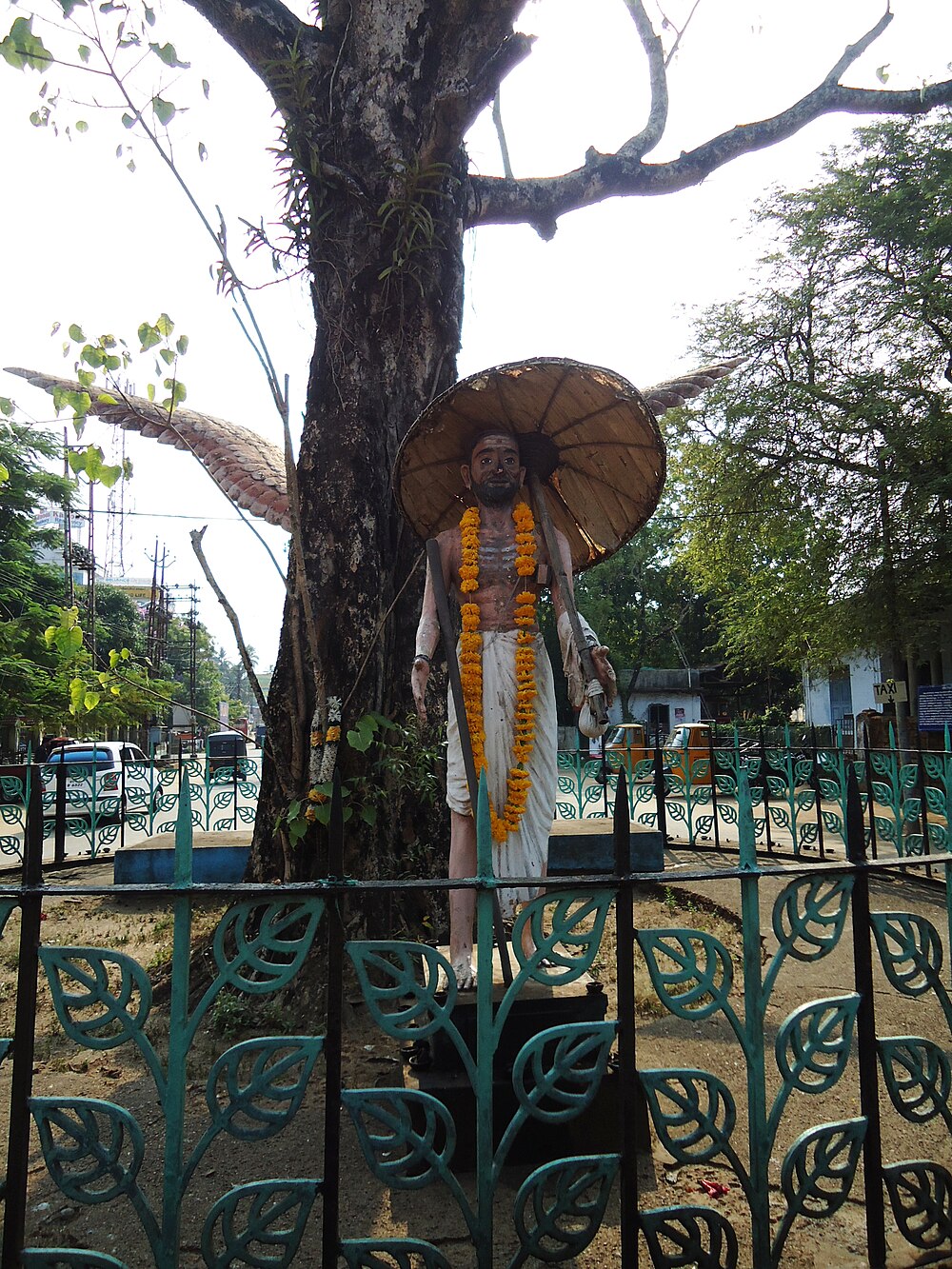
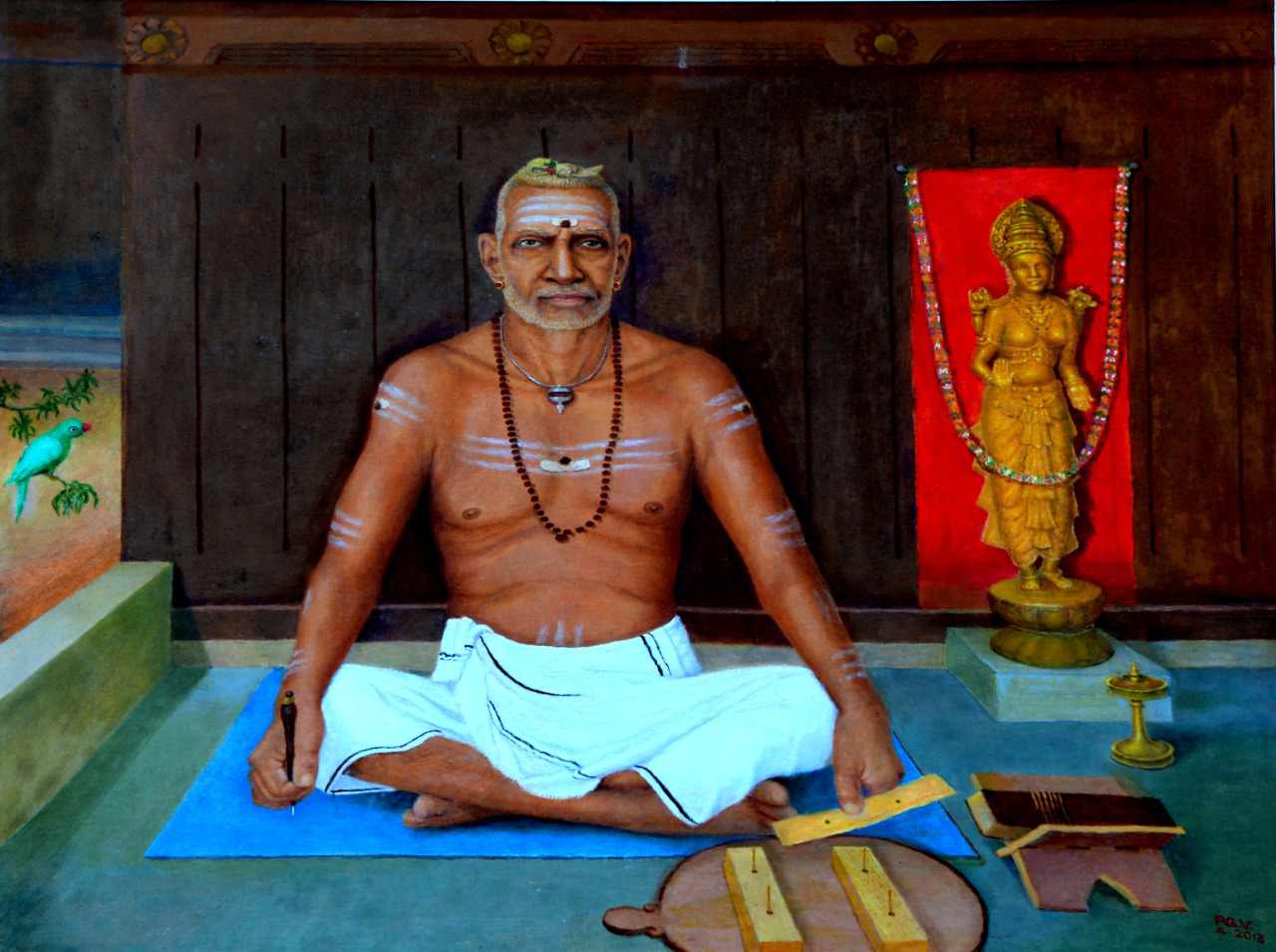
Thunchath Ezhuthachan
Father of modern Malayalam, the Advaita schoolmaster
traditionally 1495 to 1575; some place him in the 17th c.
The schoolmaster who taught Kerala its alphabet and its Advaita in a single sixty-six-verse chant.
“The Reality which is Oṁ split itself at once into three. You yourself are the sole witness of all three.”
He came not as a temple insider but as a village reformer of the alphabet. The kṣetra holds him as the sixth voice in the Guruvāyur circle, the one in whom the Advaita that flows underneath the kṣetra became a chant the village could carry away.
The Need
Born around 1495 in a Nambūdiri-adjacent low caste in central Kerala. He was an Ezhuthachan, a schoolmaster, the village's keeper of the writing slate. He was not a Brahmin. He could not enter the inner Sanskrit śāstra. But he had been initiated into the Adhyātma-Rāmāyaṇa tradition and had an unmistakable command of the highest non-dual realisation. He decided that the alphabet of the people was the only ladder they would ever have to it.
The Response
He composed the Adhyātma-Rāmāyaṇam Kiḷippāṭṭu, the Mahābhāratam Kiḷippāṭṭu, and a small handful of shorter works, in the parrot-song genre where the poet sets his text in the mouth of a parrot. The Harināma Kīrtanam, the smallest of these, is his most concentrated. Sixty-six verses, each beginning with the next letter of the reformed Malayalam alphabet, each ending in the same closing salutation to Hari Nārāyaṇa. He used the work to demonstrate that the new fifty-one-letter alphabet was sufficient to carry the highest theology, and that the highest theology was sufficient to carry the new alphabet.
The Teaching
He did not pilgrim to Guruvāyur in the way the Five Beloveds did. He worked in his own village, at Tirur. But the kṣetra-tradition has long held that the Advaita that flows underneath Guruvāyur, the same insight Mēlpattūr places in the first verse of the Nārāyaṇīyam and the same insight Pūntānam closes the Jñānappāna with, finds its plainest voice in his work. He taught the village to write by teaching the village to chant the Name. The alphabet-reform and the bhakti-reform were a single project.
He composed in plain Malayalam the great epics of the Sanskrit canon, in a parrot-song form designed for village reading. He proved that the language of the schoolmaster could hold the language of Vyāsa and Vālmīki without strain, and made the proof permanent.
Adhyātma-Rāmāyaṇam Kiḷippāṭṭu
Malayalam, parrot-songHis principal work, set to song. Not a translation of the Vālmīki Rāmāyaṇa but of the Sanskrit Adhyātma-Rāmāyaṇa, the Vedānta-saturated reading of the Rāma story. The book that brought non-dual Vaiṣṇavism into the Malayali household.
Mahābhāratam Kiḷippāṭṭu
MalayalamHis abridged Mahābhārata in Malayalam parrot-song verse. Long.
Harināma Kīrtanam
Malayalam, alphabet-ordered66 verses. The Advaita-bhakti hymn of Kerala. Each verse begins with one letter of the reformed alphabet, each closes with Hari Nārāyaṇāya Nama. The hallmark text.
Cintāratnam (attributed)
MalayalamA short Vedānta-poem, the attribution contested but the bhāva consistent with his other Advaita writing.
ഹരിനാമകീർത്തനം
Harināma Kīrtanam
Structure
- ·66 verses, each beginning with the next letter of the reformed Malayalam alphabet, in the order hari śrī gaṇapataye namaḥ + 51 letters.
- ·Each verse closes with the same constant line: Hari Nārāyaṇāya Nama.
- ·The first verse names the Lord as the Oṁkāra-Reality that became three. The whole of Advaita Vedānta in four lines.
- ·The final verse asks for the Name to remain on the tongue at the moment of death, the same closing as the Jñānappāna.
Themes
- ·The shapeless one has accepted shape because someone needed something to hold; behind every shape, the Name.
- ·The Advaita Vedānta of Śaṅkara, and the bhakti of the Bhāgavata, are the same realisation chanted from two ends.
- ·The dark age has simplified the practice to the Name alone. The simplification is severe and consoling at once.
- ·The alphabet is itself a rosary. To learn to read is already to begin chanting.
A Verse
The Reality which is Oṁ split itself at once into three.
Of the form that thus arose, you yourself are the sole witness.
To the one who stood forth as the supreme teacher,
in order to bring this knowledge to awakening,
salutation to Hari Nārāyaṇa.
The opening verse, the entire compression of the work. The closing line Hari Nārāyaṇāya Nama is the constant refrain that closes every one of the sixty-six verses.
By Ezhuthachan
The Advaita and the bhakti are not two paths. The Vedānta the Upaniṣads point to and the Name the village chants in the field are the same realisation, approached from two ends. Ezhuthachan, who built the alphabet of his language and the bhakti of his region in one work, shows that the highest non-dualism does not need to be defended in argument. It can be sung. The seeker today does not need to choose between studying the Brahma-Sūtras and chanting the Name. Both are the same body's labour.
Ezhuthachan saw the Lord as the one who has become the three.