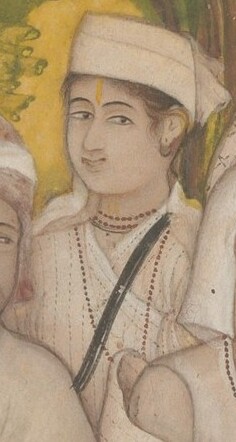
Shyamasundara, just as described in the chhappay, went and served the king, pleasing him. After serving the saints, Sen Bhakta proceeded toward the king. On the way, he asked people coming from the king's presence, 'Has the king finished his bath? Who applied the oil?' The people replied, 'You yourself applied it.' Hearing this, great astonishment arose in the bhakta's heart, and he understood that this was some wondrous play of Prabhu's grace. From this, an overwhelming surge of prema-rasa flooded his heart. When Sen Bhakta reached the king, the king began to ask him questions.
श्याममुन्दर ने, जसा छप्पय में कहि आये वसा ही जाके राजा कौ सेवा कर प्रसन्न किया। सन््तों की सेवो करने के पीछे सेन भक्क राजा के समीप चले, मार्ग में राजा के समीप॑ से आनेवाले लोगों से आपने पूछा कि ' राजा महाराज स्नान कर चुके तो तेल किसने लगाया था ?'
On an ordinary morning in Bandhavgarh, a barber named Sen was walking back toward the raja's palace, his heart still full of the guests he had just finished feeding, when he began passing people coming the other way, down from the direction of the king's own chambers. He stopped one after another and asked the same question, the way a man asks after something he fears he has left undone: has the maharaj finished his bath yet? Has anyone seen to the oil? And each person gave him the same answer, spoken as though it were the most obvious thing in the world: why, you have already done it yourself. Sen had done no such thing. He had not yet set foot near the palace that day. He stood in the road turning the words over, and astonishment broke over him in a wave, followed by something larger, a flood of prema-rasa he had no name for, filling his chest until his eyes stung. Someone else had worn his hands that morning. He walked the rest of the way to the palace not knowing whether to run or to weep.
Sen belonged to the guild of barbers who served the courts of medieval India, men entrusted with the most intimate kind of daily labor: shaving, oiling, dressing the hair and limbs of a king who let almost no one else come that close to his body. In Bandhavgarh, an old fortress town cut into the Vindhya hills of what is now Madhya Pradesh, Sen held exactly that post in the household of a raja the Bhaktamal remembers as Vir Singh. Tradition does not agree on where Sen was born; one thread of memory places his birth in the Punjab, another in the Vindhya country itself, and a separate memory, current for centuries in Maharashtra, tells of a barber named Sena in almost identical terms, devoted not to Sita-Ram but to Vitthal of Pandharpur, singing among Namdev's circle of poet-saints. Whether these are one soul remembered twice along two different rivers of bhakti, or two barbers who each lived out the same surrender on their own, nobody can say for certain, and the Bhaktamal does not try to settle it. What the text does say plainly is that Sen lived in the Vikrami fifteenth century, a span that lines up with the very years in which later tradition counts him among the disciples gathered by the great teacher Ramananda, a fellowship that, startlingly for its time, held together a weaver, a tanner, a farmer, a prince, a butcher, and a barber, as though Ramananda had gone looking for devotion precisely in the hands the world was in the habit of overlooking.
Two loves ran through Sen's days, and he never let one starve the other, not from duty but because for him they had quietly become the same love. Before the sun was properly up he would sit before his household shrine and turn the names of Sita and Ram over on his tongue like a man handling something too precious to set down carelessly. Then he walked to the palace and gave the king the same unhurried, whole-hearted attention: the blade drawn clean, the oil worked in with real tenderness, the small mirror lifted at exactly the moment a king wants to see his own reflection. And whenever a sadhu appeared at his door, ash on the skin, dust on the feet, hungry from the road, that other love in him simply rose up and took over. He would stop wherever he was standing.
That is what happened on the morning that undid him. He had set out for the palace at his usual hour, Ram's name still moving on his lips, when he came upon a small company of wandering sants walking the same road. He did not merely greet them and pass on. He fell full length in the dust before them, folded his hands, and begged them not to pass a devotee's threshold without eating something first. When they agreed, he led them back to his own house, laughing with relief, and forgot the palace entirely. He forgot, more remarkably, to be afraid of forgetting it. He built up the cooking fire with his own hands rather than hand the work to a servant, and would not let a single guest's plate sit empty while he thought of his own hunger. Only after they had eaten, blessed his house, and gone on their way did the hour come back to him with a jolt: the king's bath. The king's oil. Long, long overdue.
Fear caught up with him on the road, the plain fear of a servant who knows he has failed a powerful master, and it was that fear that produced the strange exchange with which this story opened, the passersby who insisted, again and again, that the king's attendant had already come and gone and done everything exactly as always. Sen reached the palace in a daze somewhere between terror and wonder, and found the king waiting for him in evident confusion.
"Sen," the raja said, "why have you come back? Did you not already see to me this morning?" Sen could only sink to his knees, hands joined, and tell the truth as he understood it. "Sants came to my door, Maharaj. I stayed to serve them. I have not been near you today, and I do not know what you are describing." As he spoke, the memory rearranged itself behind the king's eyes. That morning's bath had felt different from every other bath of his reign, not in any detail he could point to, but in the quality of the touch itself, a tenderness so complete and so without hurry or self-interest that it had left him strangely at peace for hours afterward, the way real grace does, without ever explaining itself. He had assumed, because why would he not, that it was only Sen being Sen. Hearing now that Sen had never come, he understood that no ordinary hand had touched him that day.
The chhappay that carries this story compares what happened to a cow that never takes her eyes off her calf: just so, it says, does Shyamasundar stand ever facing the one who loves him, ready before the need is even spoken aloud. On this telling, the Lord himself had gone to Sen's own house that morning, taken up the leather satchel with its razor exactly as Sen wore it, slung the small mirror the same way over the shoulder, and worn Sen's own shape and unhurried gait down the palace corridors, so that a blade, a jar of oil, and a stranger's borrowed hands became, for one morning, instruments in the hand of God.
What happened next reversed the order of the room completely. It was the raja, not the barber, who ran. Vir Singh crossed the floor and fell at the feet of his own servant, the man who trimmed his beard and oiled his limbs every morning of his reign, because he now understood whose hands had actually done the work, and whom that servant's love had been strong enough to summon. Something in him gave way. The commentary says his heart dissolved entirely in the rasa of Ram-prema, that from that hour he stopped believing in the importance of his own throne, and that he took up dasya-bhava, the disposition of a servant, toward Sita-Ram and toward Sen both, becoming in every way that mattered his own barber's disciple. He had tasted, the text says, the real saar, the essence, and beside it his kingdom looked for the first time like what it was, asar, without essence, a thing made only of appearances.
The Bhaktamal's commentator, writing generations later, adds a detail almost more startling than the miracle itself. He says this was not a private conversion that faded with one king's lifetime, but the beginning of an actual custom: it became the settled practice of the ruling house at Bandhavgarh, and later at Rewa when the Baghela kings moved their capital there, that the raja himself would remain a disciple of Sen's own descendants, generation answering generation, the throne permanently in debt to the barber's line. Rupkala's Hindi tilak, printed in its now-standard 1951 edition, notes that even by his own day Sen's sons and grandsons were still walking the same road of seva and bhakti their ancestor had walked centuries before. One morning's overflow of love had quietly rearranged, for hundreds of years, who bowed to whom inside that palace.
Sen's memory travelled well beyond Bandhavgarh. A single hymn attributed to a Sain or Sen found its way into the Sikh Guru Granth Sahib, set to Raag Dhanasari, the only composition under that name to survive there, and it turns the temple's own arati inside out: it sings of an inner lamp, an arati kindled in the body and the mind for the sake of the One, and warns that a tray of camphor flame waved without that inner fire is only smoke. Whether or not it was written by the very Sen who fed sadhus in Bandhavgarh, whoever composed it belonged to the same current, someone who had learned, in the middle of the most ordinary work, that the outward show of religion and its inward truth are not the same thing, and that the truth can visit a person on any road, at any hour, with the oil still wet on his hands.
The tika that closes this chapter draws only one conclusion from the whole story, and states it less as a moral than as something close to a law: whoever carries true priti, true love, and true pratiti, true trust, in the heart, will certainly meet the Lord. Not eventually, not in some other life, but will meet him the way Sen met him that morning, without even realizing at first that it was happening, in the unremarkable act of feeding hungry strangers and forgetting to be afraid of the consequences. Sen never intended a miracle. He only chose, when the moment came, to let a sadhu's hunger matter more than a king's oil, and left the rest, without knowing it, to be finished by hands greater than his own. That is the whole of what Bandhavgarh's palace barber still has to teach anyone standing at their own version of that fork in the road, unsure whether love or duty should win: give the love first, and see who quietly shows up to finish what you left undone.
Service Is Not Interrupted by Service
One morning, Sen Bhakta set out to attend the king at Bandhavgarh. On the way, he encountered a gathering of wandering sadhus and could not leave them without hospitality. He brought them home, cooked for them, served them with full heart, and lost track of time entirely. What he did not know was that Prabhu had taken his form and gone ahead to serve the king in his place. The teaching here is quiet and piercing: when you are absorbed in genuine seva, the Lord Himself steps in to keep your other obligations. You do not have to choose between devotion and duty. The one who is fully surrendered is never truly absent from where they are needed.
Bhaktamal, Tika of Priyadas and Vattik Tilak; story of Sen Bhakta at Bandhavgarh
The Lord Finds Ways to Reveal Himself
When Sen Bhakta finally arrived at court and asked the people he met on the road whether the king had been attended to, they told him he had done it himself. He had not. Yet the king had received a service of such extraordinary beauty that he felt the touch of divine hands. Sen's reaction to this news was not pride or confusion. It was wonder, and then an overwhelming flood of prema. The event did not puff him up; it dissolved something in him. This is how grace works in a prepared heart: not through argument or doctrine, but through a moment of undeniable wonder that opens into love.
Bhaktamal, Mool verse and Tika on Sen Bhakta
What Happens When a King Meets Real Devotion
Raja Virasingha of Bandhavgarh had tasted something inexplicable. He had felt a presence in what he assumed was Sen's touch, a quality that was beyond any skill. When Sen arrived and the full story came to light, the king did not feel deceived or dishonored. He fell at Sen Bhakta's feet. In an instant, his worldly authority became irrelevant to him. He became a disciple. This reversal is a constant teaching in the bhakti tradition: the king bows to the devotee, not because the devotee sought power, but because genuine love for God is its own radiant authority. Rank cannot compete with it.
Bhaktamal, Vattik Tilak on Sen Bhakta
Naam Is the Highest Worship
In the hymn of Sain preserved in the Guru Granth Sahib, he says that the name of God is the finest lamp, and meditation on it the purest wick. He is not describing an elaborate ritual or a complicated path. He is describing something anyone can do, in any condition, at any moment. Singing the praises of the Lord and turning the mind toward His name: this, Sain says, is what carries a person across the fearful ocean of samsara. Not status, not scholarship, not ceremony alone. The simple, sustained act of remembrance is the whole practice.
Sain, Raag Dhanasari, Guru Granth Sahib, p. 695
The Craft Is Never Separate from the Calling
Sen Bhakta performed the work of a barber at the royal court with the same inner attention he brought to his japa and his seva of sadhus. He did not divide his life into the sacred and the mundane. The oil applied carefully to the king's head, the mirror held without a trembling hand, the blade drawn with precision: all of it was an extension of the same offering. This is the quiet instruction his life holds for anyone who does daily, unglamorous work. The work itself is not the obstacle to devotion. The quality of attention you bring to it is everything.
Bhaktamal tradition; lineage of Ramananda
Lineages Are Kept Alive by Living the Riti
The commentators of the Bhaktamal note that even in their own time, the descendants of Sen Bhakta continued in the same spirit of sant-seva that he had established. The tradition did not harden into mere ritual repetition. It remained a living practice of hospitality toward wandering saints, of keeping the door open and the kitchen fire ready. What passes from generation to generation in a true bhakti lineage is not just a name or a ceremony. It is a riti, a way of living, rooted in the certainty that whatever comes to the door in the form of a sadhu is Prabhu Himself arriving.
Bhaktamal, Vattik Tilak on Sen Bhakta
Hindi text from OCR scan (Khemraj Shrikrishnadas Prakashan, CC0). May contain errors.