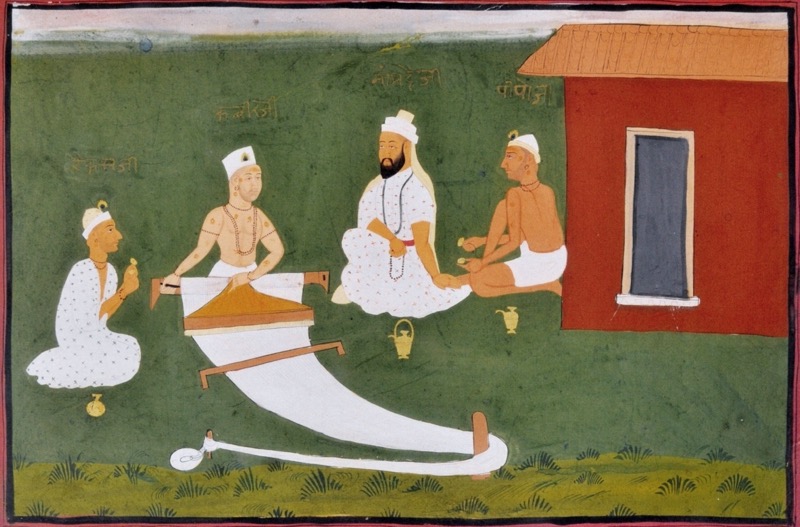
Doha: Between a paras (philosopher's stone) and a saint, know there is a great difference. The paras turns iron into gold, but the saint makes others equal to himself.
In their padas, they used the stamp 'Sukhsagar.' Just as Shri Mirabai used 'Giridhar Nagar,' so too did they compose many padas in Raag Gauri. In those compositions, one finds a unique and extraordinary aesthetic sensibility quite apart from the worldly.
They composed such powerful, disciplined padas that they seem to be guru-mantras or divine shastra-tantras. Day and night, the flow of Shri Rama prema-ashru poured from their eyes, as though the springs of Chitrakuta Parvata were overflowing. The singing of Shri Sita-Rama's guna-gana was abundant.
दो० पारस में अरु संत में, बड़ो अंतरों जान । वह लोहा सोना कर ये करें आपु समान ॥ . शाप अपने पदों की पति में सुखसागर की छाप दिया करते थे. जेसे श्रीमीरावाई गिरिधर नागर की, और आपने गौरी रागे
Picture an old man seated very still at the edge of a river in the hour when night is thinning into dawn, his eyes swollen and red as though he had wept the whole night through. Look closer and you will find that he had. This was Sukhanand, and the tears were not grief. They were the only response his body seemed to know whenever it came near the name Ram. Those who kept his company said that day and night a stream of prema-ashru, tears born of love rather than sorrow, ran from his eyes the way the mountain springs of Chitrakuta Parvat never stop running, summer or monsoon. He had probably never set foot on that mountain, where Ram, Sita, and Lakshman lived out their years of exile, and yet the devotees who remembered him reached for exactly that image: a man whose inner life had become a perennial spring, overflowing on its own schedule, indifferent to whether anyone was there to see it.
His name itself carried a blessing folded into two words. Sukh is ease, the plain untroubled contentment a person feels when a burden lifts; anand is the deeper bliss beneath all happiness, the ground note of being itself. Sukhanand names a man who had stopped distinguishing between the two, for whom ordinary contentment and ultimate bliss had become a single taste. When he composed his padas, songs meant to be sung rather than merely read, he did not sign them with this name. He folded a different word into the last line of each one instead: Sukhsagar, the ocean of happiness. This was the custom of the age. Mirabai, singing of her Giridhar Nagar, hid her signature the same way, tucking it into her final line like a private word slipped into a public song, and the memory of Sukhanand's padas was kept alive partly through this very comparison to her. He composed most of his in Raag Gauri, a melody long tied to the turning of the day toward dawn, so that to hear his songs at all was to hear them near the hour they were written for.
Tradition remembers a boy before it remembers the saint. Some threads of memory give him the childhood name Chandrahari and place his birth in a Brahmin household in Ujjain, naming his father as Tripurari Bhatt and his mother as Jambuvati. These particulars come down through later retellings rather than through any contemporary record, and no exact year attaches to them with confidence, so they are best held the way a family holds an old photograph without a date on the back: certainly someone, almost certainly this one, but not a fact to build an argument on. What every strand of the tradition agrees on, without exception, is that this Brahmin-born boy grew into a man who gave his whole life to Swami Ramananda, and that the giving was total.
Ramananda's circle was famous, even in his own lifetime, for having no fences in it. He drew his closest disciples from every corner of society and refused to let any ladder of birth or status stand between them once they arrived. Among the dozen or so he kept nearest, later devotion remembers a fellowship it calls the twelve Mahabhagavatas, the great blessed ones: Anantanand, Kabir, Raidas, Pipa, Dhanna, Sena, Bhavanand, Naraharyanand, Surasuranand, the women saints Padmavati and Surasuri, and, among them, this quiet Brahmin who had left behind whatever name his mother gave him and answered now only to Sukhanand. He did not stand above the weaver's son or the tanner's son in that company, nor beneath them. He stood beside them, which was the entire point of Ramananda's teaching before it was ever put into a doctrine: in the presence of Ram-nam, the old distinctions simply stop mattering.
The single teaching that later memory ties most tightly to Sukhanand is a doha, a couplet, that Nabhadas places just before his name in the Bhaktamal: between the paras, the alchemist's touchstone, and the sant, know that there is a vast difference. The stone turns iron into gold. The saint turns you into himself. It is worth sitting with that line rather than skimming past it, because it says something almost nobody says about spiritual company. A touchstone is astonishing, but limited: it changes what a thing is made of without changing what a thing is. Gold-plated iron is still iron underneath, however brilliant the surface. A true sant does something stranger and more total. His company does not gild you. It remakes you into another version of himself, someone who can now do for others what he once did for you. The verse that follows this doha calls Sukhanand directly by this name, paras parasa, the touch of the touchstone, because those who sat with him did not come away merely impressed or improved. They came away changed at the root, carrying something of him forward into their own lives the way a lit wick carries fire into an unlit one without diminishing the flame it came from.
His chosen method for this was not lecture but katha, the telling of Bhagavat stories and the praises, the guna-gana, of Sita and Ram. Witnesses who sat through these tellings said something happened to his face while he spoke: his forehead grew luminous, they said, radiant as the wide sky, as though the telling itself were lighting a lamp behind his skin. And they reached for water imagery to describe what he was to the people who kept coming back to hear him: a clear, immaculate pond, brimming with nectar, whose very presence was enough to open the lotus faces of the gathered community of devotees the way sunlight opens a lotus pool at dawn. A pond does not chase anyone. It simply stays full and clean, and whoever wants to drink or bloom near it may come as they please. This, more than any doctrine he might have argued, was how Sukhanand taught: by staying so consistently, so unshowily full of Ram that people wanted to sit near the fullness.
The padas themselves were remembered as having a flavor unlike anything else being sung in that age, a ruchi lok se nyari, a taste set apart from the world's usual register. They were composed with such discipline, such exactness of form and feeling together, that hearing them felt less like listening to poetry and more like receiving a guru-mantra, an initiation delivered through melody rather than whispered formula. This is a serious claim to make about anyone's verse, and it says something about how completely Sukhanand's public voice and his private practice of weeping over Ram's name had fused into a single instrument. He was not performing devotion for an audience. The songs were simply what devotion sounded like when it passed through him and came out the other side as Raag Gauri.
Later commentary on his life reaches, tellingly, for a line out of Tulsidas's Ramcharitmanas to explain what Sukhanand actually did for the people around him: jin sudharahin satsangati paai, paras parasi kudhaatu suhai, souls are set right by finding the company of the good, just as base metal, touched by the paras, becomes beautiful. That the commentator instinctively returns to the very touchstone image from Sukhanand's own opening doha, borrowing Tulsidas's words to describe Sukhanand's effect on others, shows how thoroughly this one metaphor had become inseparable from his memory within the Ram-bhakti tradition. He was not merely a man who loved the touchstone teaching. He had become, in the memory of those who followed him, a living demonstration of it.
The tilak commentary on him also calls him, in bestowing the gift of bhakti and in lifting the world's fear from those who came to him, something like the very arm, the bhuja, of Shri Ram Raghuvir. It is a striking phrase, an arm being the instrument through which a person actually reaches out and acts, and some later devotional memory folded this image into an even larger claim: that Sukhanand carried within him a portion of Bharata, Ram's brother, who spent his own life as exactly this kind of instrument, ruling in Ram's name and for Ram's sake without ever once claiming the throne for himself. Other strands of memory, just as sincerely held, name him instead as a portion of Shankar. Both identifications should be received as devotional memory rather than settled fact, two different communities each reaching for the highest comparison they knew to explain a man whose ordinary human biography had otherwise mostly dissolved into legend. What is not in dispute in any version is the function itself: he was remembered as an arm that reached out, not as a throne that sat still.
Of his final hours almost nothing can be said with real confidence. One thread of oral memory holds that Hanuman himself appeared to him at the very end and that Sukhanand's passing was less a death than a dissolving into that presence, fear-remover meeting fear-remover. It is impossible to verify this the way one verifies a date or a place, and it should be told, if it is told at all, as exactly what it is: a devotee's story about a devotee, offered by people who loved him enough to want his ending to match his life. What can be said with more confidence is simpler and in some ways more moving: a man remembered chiefly for weeping at the name of Ram, for a forehead that seemed to catch fire when he spoke of Hari's goodness, and for a single sharp teaching about the difference between being polished and being transformed, needed no invented death scene to complete his portrait. The portrait was already complete in the living.
What is left of Sukhanand, eight or nine hundred years on, is not a dated biography and not even a securely located grave, but something arguably more durable: one precise, unforgettable distinction, offered to anyone willing to sit with it. A touchstone can make you shine. Only a saint's company can make you a saint. It is worth asking, quietly, which kind of company keeps your own life, whether the people and places you return to most often are gilding you or actually remaking you, and whether you have ever sat near anyone, even once, the way those weeping crowds sat near Sukhanand at dawn: not to be improved, but to catch fire from a flame that had stopped needing to be told to burn.
The Saint Goes Further Than Gold
The philosopher's stone of legend turns iron into gold. That is remarkable. But the Bhaktamal opens Sukhanand Ji's entry with a deeper wonder: the saint does not merely elevate you to something better. The saint makes you equal to himself. Gold remains gold, not a philosopher's stone. But the one touched by a true saint becomes, in time, capable of touching others the same way. This is how the lineage lives. Ramananda touched Sukhanand Ji. Sukhanand Ji touched those who came to him. Each soul transformed became a source of transformation for others. If you have ever been near a person whose very presence quieted your mind and opened something in you, you have touched this teaching. The question it leaves with us: what are we becoming? Are we gold, or are we becoming something that can transform others?
Bhaktamal of Nabhadas, entry on Shri Sukhanand Ji
Satsang as Living Water
The Bhaktamal describes Sukhanand Ji as a sarasa tarang, an abundantly nourishing body of water, sustaining the lotus-hearts of those who came to drink. This image is precise. A pond of sweet water does not argue with those who are thirsty. It does not demand credentials. It simply is what it is, and whoever comes with genuine thirst is welcome to drink. Sukhanand Ji's satsang worked this way. People came to him not to receive a lecture but to enter a field. Something in the atmosphere around him nourished what was already alive in the seeker. This is the deepest meaning of satsang: the company of truth. Not a transmission of information but a proximity to being. Whoever has attended satsang with a genuine saint knows this quality. You walk in carrying the weight of the world and something in you, unbidden, lets it down.
Bhaktamal of Nabhadas, entry on Shri Sukhanand Ji
The Seal of Sukhsagar
Sukhanand Ji signed his devotional padas with the stamp Sukhsagar, the ocean of bliss. Mirabai signed hers with Giridhar Nagar, the clever lord who lifts mountains. These are not mere pen names. They are declarations of the inner state from which the poetry poured. To call oneself Sukhsagar is to say: I have found a joy that is not contingent on circumstance. Not a happiness that depends on things going well, but a bliss that underlies all conditions. The name Sukhanand itself carries this: sukha is ease and joy, ananda is the formless delight at the ground of existence. His very name was a teaching. The invitation in his poetry was not to admire his realization but to come and taste what he was pointing at. Ram-prema, the love of Ram, as an inexhaustible ocean. Its shores cannot be seen from the middle. Its depths cannot be sounded from the shore.
Bhaktamal of Nabhadas, entry on Shri Sukhanand Ji
When Katha Becomes Light
Those who sat before Sukhanand Ji during Bhagavat katha reported something visible: his forehead would become radiant. Prakashamana. Blazing with an inner light. This was not metaphor for those present. They saw it. The face of a person absorbed in Ram-katha becomes a kind of mirror of what they are speaking about. The light of the story passes through the face of the one who truly knows it and loves it. This is why hearing katha from one who is living in Ram is a different experience than hearing the same words from one who is only reciting them. The words are the same. The raga may be the same. But something passes through the voice and face of the surrendered one that cannot be manufactured by learning alone. If you have ever felt a scripture come alive in the presence of a particular teacher, you have seen this. The teaching is real. The radiance is real.
Bhaktamal of Nabhadas, entry on Shri Sukhanand Ji
Tears as the River of Chitrakuta
Day and night, prema-ashru, tears of love, flowed from Sukhanand Ji's eyes without ceasing. The Bhaktamal says it was as if the streams of Chitrakuta Parvata were overflowing. Chitrakuta is the forest hill where Ram, Sita, and Lakshmana spent their early seasons of exile. It is where Bharata came with all of Ayodhya behind him, weeping, begging Ram to return. Sukhanand Ji was understood by those who loved him to carry the quality of Bharata: utterly selfless love, the inability to separate one's own wellbeing from the wellbeing of the beloved. His tears were not sorrow. They were fullness that cannot be contained within composed expression. There is a kind of love so complete that it overflows through the eyes. The tradition calls this rasa, the essential juice of devotion. In the presence of such love, the observer often finds something loosening in themselves too. The rivers of Chitrakuta still flow.
Bhaktamal of Nabhadas, entry on Shri Sukhanand Ji
Hindi text from OCR scan (Khemraj Shrikrishnadas Prakashan, CC0). May contain errors.