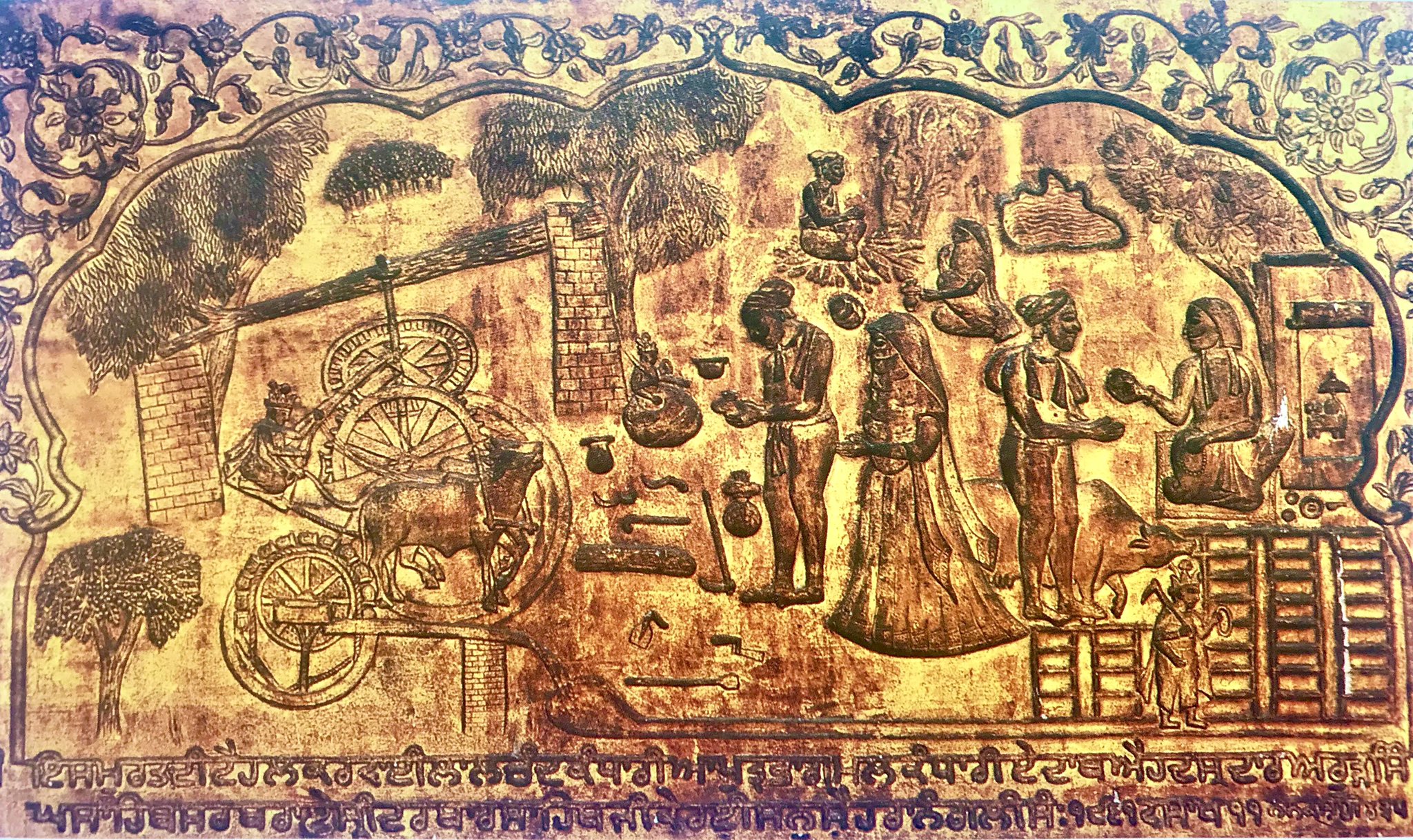
Swamiji himself has told the tale in his own kavitt (chhappay). Now hear one more account: how bhakti first arose in Shri Dhana Bhaktaji. One time, a brahmana who was a bhakta of Bhagavan came to Dhanaji's home and began worshipping Shri Shaligram with great care. Watching this, Dhana Bhaktaji went near and said: 'Swamiji! Please give me a Thakurji too. I have great priti; I will perform puja.' Hearing this, the brahmana bhakta gave him a smooth, round stone and said: 'Here, take this. Worship it attentively and with prema.' Dhana Bhaktaji took the Thakur, pressed it to his hridaya, and as if...
स्वामीजी ही ने अपने कवित्त (छप्पय) में कह दिया, अब और एक बात मुनिये, कि जिस रीति से श्रीपना भक्कजी को प्रथम भक्कि उत्पन्न हुई। एक समय आपके ग्रह में एक श्रीभगवद्भक्त बाह्मण आये सो श्रीशालग्रामजी को भली प्रकार पूजा करने लगे; देखके धना भक्नकजी समीप में जाके
The boy could not stop watching. Every morning the visiting brahmin unrolled a small cloth in the corner of the cattle-yard, drew out a smooth dark stone no bigger than a fist, bathed it, dressed it in a scrap of new cloth, set a marigold or two against it, and fed it before he would touch his own food. Dhanna had seen his elders feed guests, feed cows, feed the fire at a wedding, but he had never seen anyone feed a stone as though it could taste, and want, and be pleased. He edged closer each day until one morning he could not hold the question in any longer. Swamiji, he said, give me a Thakurji too. I have great love. I will do puja just the same as you. In most of the old tellings the priest is remembered by the name Trilochan, a wandering brahmin who kept a Shaligram of his own and had stopped for some days at the farmer's house on his way through the country. He tried to put the child off. He was too young, he said, it was not a game. But Dhanna would not be put off, and the neighbors who had gathered to watch the exchange took the boy's side, laughing, urging the brahmin to give him something, anything, just to quiet him. So the priest went down to the water, picked up an ordinary round black stone, the kind a hundred children might skip across a pond, pressed it into Dhanna's hands, and told him, only half seriously: here, take this, be careful, worship it with attention and with prema. He meant nothing more by it than a kind man's way of ending an argument with a child.
Dhanna did not hear the joke in it. He carried the stone home against his chest as though he had been handed his own heartbeat, and from that hour he copied, gesture for gesture, everything he had watched the brahmin do. He bathed the stone. He found it a seat. He begged flowers from the hedges to lay before it. When his mother's roti came hot off the griddle for the day's first meal, he carried it out to his little Thakurji exactly as he had seen it done: bread set before the deity, an arm raised to screen the offering from prying eyes, his own eyes shut tight in reverence while the god, unseen and unwatched, was supposed to eat. He waited the way he imagined a god eating would take, then opened his eyes to look. The roti sat exactly as he had placed it. Not one bite gone. A cold fright went through the boy, not the fright of doubt but the fright of a child who is certain he has done something wrong and cannot see what it is. Why will my Lord not eat, he must have asked himself. What have I failed to give him.
What followed is the part of the story that every version keeps, because it is the part that matters. Dhanna did not walk away from the stone and decide it was only a stone. He fell at its feet, got up, fell again, and kept falling, begging the food to be taken, refusing now to eat or drink anything himself until his Thakurji had eaten first. The old commentary calls what took hold of him hath, a word that means something like willful, unreasonable, immovable insistence, the kind that has stopped listening to sense and will not be talked down. Hours went by. By most accounts it stretched across days, the boy fasting alongside his silent god, weeping, pleading, refusing to be comforted by anyone who told him a stone could not eat. He had seen love shown to a Shaligram and had simply assumed, in the complete and terrible logic of a child, that the same love shown to any stone would work the same way. He was not prepared to discover he might be wrong, and so he made it impossible for himself to be wrong.
And on the day his own hunger and grief had worn him down to nothing left to bargain with, the stone ate. Not symbolically, not in some dream Dhanna half remembered afterward: the bread was gone, and it had not gone into any human mouth. This is the hinge the whole story turns on, and it is worth sitting with rather than rushing past. Learned men spend lifetimes in study, in mantra, in the correct performance of every rite, trying to make themselves fit to receive God's attention. Dhanna did not know a single verse. He did not know that the stone in his hands had never been consecrated as anything at all. He only knew that he loved it the way he had seen love shown, with his whole undivided attention, and he would not be moved from that love by any evidence against it. It was this, the tradition insists, and nothing else, that God could not refuse. Whatever great sages spend years failing to compel through austerity, an unlettered farmer's son summoned in an afternoon with stubborn tears and a hot roti.
After that the arrangement between them settled into something almost domestic. Each day Dhanna brought his offering, and each day it was eaten, and whatever remained he took as his own meal, understanding without being told that this was now prasad, the leavings of the Lord's own plate, sweeter to him than anything cooked fresh. Then one day, so the story goes, the god who lived in the stone spoke to him plainly: since you feed me so faithfully, let me earn what I eat rather than simply take it. I will graze your cows. And from that day the herd went out into the fields under a divine cowherd's care, and came home each evening fat, unlost, untroubled by wolf or thief, while Dhanna went about his other work as though this were the most ordinary thing in the world, a boy and his God dividing up the farm chores between them.
When Trilochan finally came back through that country and stopped again at the house, he asked, half in passing, whether the boy still kept up his little worship. And Dhanna, who did not have it in him to make a story more interesting than the truth, told him everything without embellishment: that his Thakurji would not eat for two days, so neither had he; that after that the Lord had begun eating daily; that now his God even took the cows to pasture for him. The brahmin was astonished nearly past speech, and begged to be shown. Dhanna led him out to the grazing ground, but the priest, straining his eyes across the field, saw nothing but cattle and grass and a boy's ordinary shadow. So Dhanna prayed, urgently now, on the brahmin's behalf as fiercely as he had once prayed on his own, and Shyamsunder relented and let himself be seen. The tika describes the brahmin's reaction the way you would describe a man being called back from death: joy too large for his chest, tears breaking before he could stop them, the sudden wound of prema opening in a heart that had spent years performing devotion correctly without ever once being struck by it like this. He resolved on the spot to go home and do his own bhajan with the same helpless abandon he had just witnessed, so that he too might one day please Sri Sitaram as this unlettered farmer's son so plainly had. What the brahmin had spent a lifetime approaching through discipline, he had just watched a child arrive at directly, by refusing to let go.
The fields carry their own version of the same lesson. Wandering sadhus once came through at sowing time, hungry, and Dhanna, without weighing the cost, gave them the grain his family had set aside as seed for that year's planting. Then, dreading what his parents would say when they found the seed gone and the field bare, he did the only thing he could think to do: he ran the plough across the empty ground anyway, turning up bare earth over no seed at all, so that at a glance it would look as if planting had happened as planned. The neighboring farmers, who had heard what he'd done with the grain, made a running joke of Dhanna's field all that season, certain nothing would come of it. And yet, the tellings agree, though they differ on exactly what grew there, whether it was grain thick enough to feed the family through the year or gourds that split open to reveal something richer still, something did grow, out of ground that by every rule of farming should have stayed bare. Nabhadas himself marvels at it in his verse: sown in one field, and the harvest came up in another; no seed went into the ground at all, and still the ground bore fruit. The point was never agriculture. The point was that what Dhanna had actually planted, that morning at the threshing floor, was the readiness to go hungry so that wandering strangers would not, and that particular seed, it turns out, cannot fail to yield.
The old chronicles agree that Dhanna was a farmer, born somewhere in the country that is now Rajasthan, in a household that had never sent a son to learn letters or scripture, though they do not agree on which village first knew him, some naming a place called Dhuan Kalan, others a village called Chauru, and they place his life loosely in the early fifteenth century without much more precision than that. What every strand of the tradition does agree on is that he became, in time, one of the circle of disciples gathered around the great teacher Ramananda, a fellowship that also held Kabir, Raidas, Pipa, Sena, and Sadhna within it, men whom the ordinary rules of the world would have kept apart from one another and from any guru at all, all of them accepted by the same teacher on no evidence but the seriousness of their love. It is not hard to see why a guru who had already decided that devotion outranks pedigree would want this particular farmer among his own.
Dhanna's own voice survives still, a handful of hymns preserved in the Guru Granth Sahib, carried there by a later generation that found something in his plainness worth keeping beside far more polished verse. In one of them, known by its opening line as Gopal Tera Aarta, he stands before God not as a philosopher but as a beggar, and asks, without a trace of shame at wanting ordinary things, for lentils and flour and ghee, for shoes and good cloth and grain of seven kinds, for a milk cow and a water buffalo and a fine mare, and for a good wife to keep his house. It would be easy to hear this as a lesser kind of prayer, a man haggling with heaven over groceries. It is truer to hear it as the same voice that once fed roti to a river stone: a man who simply does not know how to address God through anything but exactly what is in front of him, without translating his hunger into something more dignified first. He brought God his actual life, unedited, the same way he had once brought him an actual roti, and trusted that the asking itself, addressed to the right one, was already a kind of love.
This, finally, is why the story of Dhanna has been told for six centuries to children who cannot yet read and to skeptics who think they have outgrown belief altogether. It makes no argument about the correct form of worship, the right words, the proper vessel. It says only that a stubborn, uninstructed love, pressed to the chest and refused to be reasoned out of itself, was enough to make the unmovable move. Whatever stone is in your own hands today, however plain, however wrongly come by, however certain you are that nothing could possibly answer it: hold it the way Dhanna held his. Fall at its feet if you have to. Refuse to eat until it eats. The tradition that carries his name insists this is not naivety. It is the whole of the path, arrived at early by a boy who had never been taught there was supposed to be anything more difficult to it than that.
Priti Is Its Own Preparation
Dhanna had no puja thali, no flowers, no scripture memorized. What he had was a round stone from a riverbank and a love so total it could not imagine Thakurji going hungry. He placed the roti before the stone, closed his eyes, and prayed with his whole body. The tradition holds this up not as the story of an uneducated man getting lucky, but as the story of what happens when priti is utterly uncontaminated by doubt or self-regard. You do not need to be prepared for Bhagavan. You need only to want Him completely. The preparation that matters is not ritual knowledge; it is the willingness to be entirely present to what you love.
Bhaktamal, chhappay 307; Nabhadas with Priyadas tika
Do Not Eat Alone
When the stone did not eat, Dhanna stopped eating. This was not a spiritual strategy; it was simply what made sense to him. A host does not feast while his guest goes hungry. He sat beside the murti and spoke to it plainly: you have not eaten, so I will not eat either. This stubbornness born of love, this refusal to separate his own life from the life of Bhagavan, is what the Bhaktamal calls the riti of bhakti: its way is unlike the way of the world. In ordinary life, you eat when you are hungry. In bhakti, your hunger and Prabhu's hunger are the same hunger. When that boundary dissolves, so does the distance between the devotee and the Lord.
Bhaktamal tika; Priyadas commentary
Give the Seed-Grain Away
Wandering sadhus came to Dhanna's home hungry. He had grain set aside for the next season's sowing. He gave it all away and ploughed the field empty. His neighbors watched and waited, ready to point at the foolishness of it. Then the field came up green without a single seed in the ground. The Bhaktamal offers this as direct evidence: when you pour yourself out for those who come hungry to your door, something else plants the field. Something else tends it. The crop that comes is not the one you would have grown by ordinary means. Generosity toward the saints is not a sacrifice of the harvest; it is a different kind of sowing, one whose laws belong to bhakti rather than to agriculture.
Bhaktamal, tilak of Dhanna; chhappay 62
Householder Life Is Not an Obstacle
After his darshan, after his initiation at the feet of Shri Ramanandji in Kashi, Dhanna did not become a renunciant. He came home. He returned to his fields, his family, his cows, the morning work and evening work of a Rajasthani farming life. And Prabhu came with him. The tradition records this without apology: Dhanna "lived his remaining years in the householder's way, working his fields, caring for his family." The sabdas he left behind, which the Sikh Gurus later gathered into the Guru Granth Sahib, speak directly of the householder's needs: home, family, the simple provisions of daily life. Bhakti does not require you to leave. It requires only that you bring the same love you carry for Prabhu into everything you do.
Bhaktamal; Guru Granth Sahib, Ang 487-488, 695
The Murti Responds to Sincerity, Not Scholarship
The brahmana who gave Dhanna the stone was learned in the ways of puja. He knew the proper rites. He could distinguish a true shaligram from a river pebble. And he handed the pebble to Dhanna with something between kindness and condescension, not quite believing it would work. Dhanna, who knew none of the correct procedures, simply loved the stone as though Thakurji were fully present within it. And Thakurji was. When the brahmana returned and asked to see what Dhanna had seen, his own learning did not help him: Prabhu was not visible to him in the grazing field until Dhanna prayed on his behalf. The teaching here is not that learning is wrong. It is that sincerity is prior. The sacred responds to the genuine heart before it responds to the trained one.
Bhaktamal tika; Priyadas; SikhiWiki sakhi of Bhagat Dhanna
Prabhu Repays Love with Service
After Dhanna had been feeding Thakurji the morning roti and eating only what remained as prasad, Prabhu one day made an announcement: whoever eats at another's expense ought to serve that person properly. And so from that day, Shri Hari grazed the cows. This detail from the Bhaktamal is quietly extraordinary. It says that the relationship between a bhakta and Bhagavan is not one-directional. When you love without reservation, when you make Prabhu the first guest at every meal and yourself the last, Prabhu takes on your burdens as His own. The labor does not disappear. The cows still need grazing. But you are no longer carrying it alone. The One who accepted your roti has accepted everything that comes with your life.
Bhaktamal, Priyadas tika; moolEn narrative
Your Priti Has Captured My Heart
When Prabhu finally sent Dhanna to Kashi to receive the Rama-taraka-mantra from Shri Ramanandji, He gave a reason that the tradition has held on to ever since: "Your priti and your bhakti have captured My heart." Not your ritual correctness. Not your lineage or your learning or your caste. Your love. This is the core of what Dhanna's life demonstrates, and it is the core of what his sabdas in the Guru Granth Sahib continue to say across centuries. The path to Bhagavan is not closed to anyone who has not yet acquired the proper credentials. It is open to anyone whose love is genuine enough that Bhagavan cannot stay hidden.
Bhaktamal tilakHi; Guru Granth Sahib bani of Bhagat Dhanna
Hindi text from OCR scan (Khemraj Shrikrishnadas Prakashan, CC0). May contain errors.