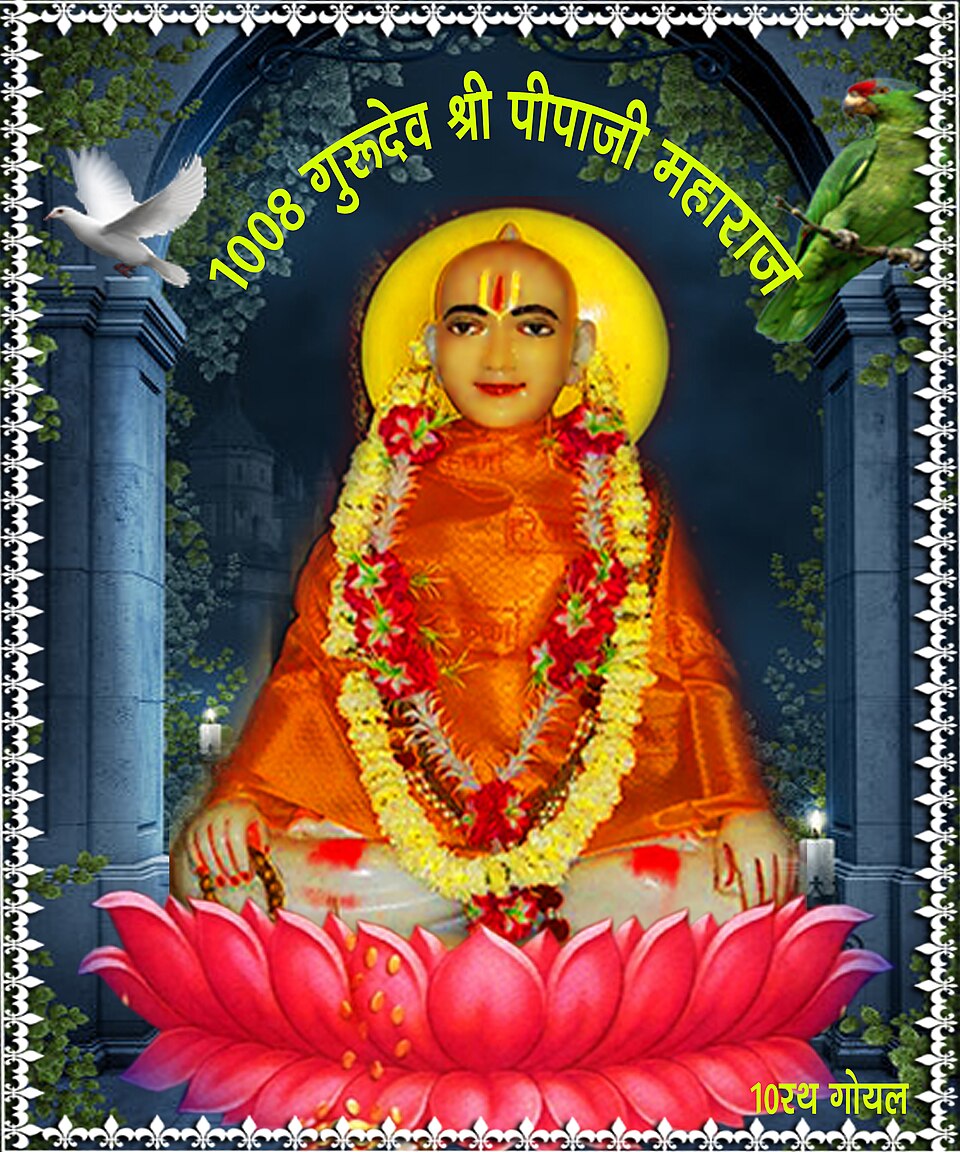
(2) One day, two beautiful young women from families the world overlooked were gathering cow-dung near the spot where Shri Pipaji and Shri Rangji were seated.
Chaupai: 'Shri Pipa spoke with a smile: Apart from Rama, I see no one else.'
'Having received such a beautiful and charming body, they gather dung. It is a matter of great compassion. See, I shall give both of them upadesha and, by Rama-kripa, lead them to kalyan.' Saying this, he called both of them near. They came forward, utterly innocent and simple, with folded hands. Shri Pipaji said to them: 'The true benefit of receiving such a beautiful body is to worship Shri Janaki-jivan, the abode of all beauty, the eternal, ever-youthful Lord...'
( २ ) एक दिन दो सुन्दरी अति नीच जाति की युवतियाँ उस जगह के समीप गोबर चुन रही थीं कि जहाँ श्रीपीपाजी अरे श्री रंगजी विराज रहे थे ॥ चौपाई ।
By the time these stories open, Pipa was no longer a king. He had already walked away from the fort of Gagaraungarh, the hill stronghold in what is now the Jhalawar country of Rajasthan, where tradition remembers him ruling under the name Pratap Singh before he ever heard the word guru. Of the many queens the sources give him, usually said to be twelve, only one had refused to let him go alone into his new life: a young woman the texts call Sita, whom devotional memory renamed Sita Sahachari, Sita the Companion, because from the day Pipa took initiation from Swami Ramananda she never again let the word wife describe her so much as the word co-pilgrim did. It is this pair, the dethroned king and the queen who chose the road, whom we find settled for a season in a small hut at a place called Todanagar, most likely the town of Toda Rai Singh in the Tonk region, living on nothing, owning nothing, and somehow becoming the address every wounded person in the district would eventually find their way to.
One day, near the very spot where Pipa sat in the shade with a fellow devotee named Rangji, two young women were gathering cow-dung for fuel, the kind of labor the world hands to people it has already decided not to look at twice. They were lovely, and they were poor, and no one had ever suggested to them that those two facts might matter to God. Pipa watched them for a moment and then, the old chronicler says, he spoke with a smile on his face: apart from Rama, I see no one else here. Then, turning to his companions, he said it plainly: what a pity, that bodies so fair and so full of promise should spend themselves on this. Come, he said, waving the two women closer, I will give you an upadesha, and by Rama's kripa I will see you through to kalyan. They came, he tells us, utterly unguarded and utterly simple, hands folded, and stood before him. Pipa told them that the true use of a beautiful human body is not vanity but remembrance: spend it in bhajan to Janakijivan, the beloved of Janaki, the eternally youthful Lord who is the home of all beauty. Something in the two women broke open on the spot. Before they had walked ten steps from him they had marked their foreheads with the tilak of the path and put on the tulsi bead necklace of a Vaishnava, and they went home not gathering dung anymore but singing Sita-Rama, Sita-Rama, in voices that would not stop.
Their households did not know what to do with them. A doha remembered from that hour has one of the women singing it to herself as she walked: I no longer know the cleanliness of my body or my house, I have left the world's ways behind, wandering, I sing of Narayana, songs brimful of love for Hari. Whatever this looked like from the outside, it did not look like a good match for domestic life, and their families made that clear enough that both women eventually turned around and walked straight back to Pipa. There is a second doha attached to this turning: you may have to leave behind your wealth, your home's comforts, your well-wishers, your mother, your father, your brothers, because when a soul turns to face Rama's feet, none of them will easily go on helping you. So the two women simply stayed. They took up residence near Pipa and Sita Sahachari and spent the rest of their days singing the glory of Bhagavat, no longer defined by the labor their birth had assigned them, but by the path a wandering ex-king had opened to them in a single afternoon. It is worth pausing on how unremarkable this radicalism seemed to Pipa himself: he never frames it as a scandal or a risk, only as an obvious mercy too long delayed. It is the same conviction, that the divine plays no favorites among the bodies it enters, that centuries later moved the compilers of the Guru Granth Sahib to set a single hymn of Pipa's own into their scripture, in Raag Dhanasari, alongside the words of Kabir and Ravidas and the other companions of his guru Ramananda.
Not long after, a Brahmin came to Pipa in real distress. His daughter was to be married, and kanyadan, the rite of giving her away, could not go forward without money he did not have. Pipa himself owned nothing to give him, not even the coin for a meal, so he did something else: he told the Brahmin to go to the region's king and say plainly that Pipa called this man his guru, and that if the king held any shraddha toward Pipa at all, he should see the wedding through. The Brahmin went, delivered the message exactly as told, and the king, hearing his renounced teacher's name invoked this way, handed over a generous sum on the spot. Pipa never touched the money. He had simply understood, the way only someone who has already given up an actual throne can understand, exactly how much unspent weight his own name still carried, and he spent that instead.
Some time later, having enjoyed satsang with Sri Rangdasji, Pipa and Sita Sahachari returned to their dwelling in Todanagar. On the night of an Ekadashi, a jagaran was under way, an all-night vigil of devotional singing, in the presence of King Suryasenmal. In the middle of the gathered assembly, Pipa suddenly stood and began rubbing his hands together, and everyone nearby saw soot, real lampblack, coming off his palms. The king asked what had happened. Pipa answered that a fire had broken out in the canopy shading the sacred image at Dwarka, and that he had just put it out. Suryasenmal, understandably startled, sent a rider out on a fast camel to find out whether any such thing was true. Word eventually came back that yes: on that very Ekadashi night, a fire had indeed broken out over the deity's canopy at Dwarka and had been extinguished by means no one there could explain. Pipa had never left the room. Whatever had gone to Dwarka that night to put out the flames, it had done so while his body sat visibly among his own people, singing.
Another day Pipa had gone down to bathe. Nearby, an oil presser's son had brought his family's bail, the draft ox that turned their press and drew their water, so that people could drink. At almost the same moment a Brahmin farmer arrived in tears, telling Pipa that without a bail his farming and his whole household were sinking, going under for want of exactly this kind of animal. Pipa simply took the rope of the very bail standing there, the oil presser's boy's own animal, and put it into the Brahmin's hands. The Brahmin, overjoyed, led it away. The boy, watching his family's only ox disappear down the road, began to cry and would not be consoled. Pipa told him gently not to worry, that his bail was tied at his own home waiting for him. The boy ran home not believing it, and found, tied at his own post, a bail exactly like the one he had just watched walk away with a stranger. He was so overcome that he became Pipa's disciple from that day forward. King Suryasenmal, hearing the story, was delighted, and in gratitude to the eternally youthful divine pair, Sita and Rama, he gave away grain and wealth without counting the cost.
A harder trial came later: a terrible famine settled over the region, bad enough that even Suryasenmal, with a king's resources, could not hold the suffering back. He turned to Pipa, and Pipa turned his own bare hut into the only granary that mattered. He gave out grain, water, and cloth to everyone who came, and when what he had ran out he had people dig into the earth itself for wealth that lay buried there, and gave that away too, without pause, for as long as the famine lasted. By the time it finally broke, the chronicler insists that the people of Todanagar and the whole of Suryasenmal's kingdom had come through that cruel season more comfortably than anyone had feared possible. A man who owned nothing had somehow made sure no one near him went without.
A smaller, sharper story from the same years concerns a moneylender who kept coming, again and again, to demand repayment of a debt from Pipa's household at a time when there was, quite simply, not a coin in the place to give him. Frustrated, he brought his ledger before the village panchayat and complained that the Maharaj owed him a great deal and would not pay. When the elders opened the book to check, they found the page blank, not one word entered against Pipa's name, and they were ready to punish the moneylender for what looked like an outright lie. Word reached Pipa, and he sent back a different account of it: the debt had been real enough, he said, but the man had pressed for it so harshly, so without mercy, that by Bhagavan's own will the ledger had gone empty before their eyes. The moneylender, hearing this, fell at Pipa's feet in genuine anguish. Soon after, a wealthy patron arrived and, by the grace of Sitarama, paid the man everything he was owed, so that his grief, too, was finally put to rest. Nobody in the story is left simply punished; even the man who had been graceless is made whole in the end.
For a while the hut at Todanagar grew almost too comfortable, filled with the riddhi and siddhi, the worldly and supernatural plenty, that seemed to gather wherever Pipa stayed. One day he and Sita Sahachari looked at what their dwelling had become, recognized the quiet danger sitting inside all that abundance, and simply walked away from it toward somewhere else, taking nothing with them. It is a small decision in the text, almost a throwaway line, but it says as much about Pipa's understanding of renunciation as any sermon could: the point was never poverty for its own sake, it was refusing to let comfort, once it arrives, be allowed to stay and calcify into attachment.
Around this time a Brahmin came to Pipa's shrine in tears, having been shut out by his own community after the accusation of killing a cow, a transgression his people considered unforgivable. Pipa taught him to chant Hari's name, in words the text preserves directly: Pipa said, repeat the name of Hari, and the sorrowful house of that sin will be erased; the Brahmin took up the japa of Rama's name, and at once every trace of the wrongdoing fled his body. Pipa gave him charanamrita and prasad and sent him on his way, but the stricter members of his own community still refused to take him back among them. So Pipa had that same man's own hands carry the naivedya, the offered food, into the shrine of Sri Hanumanji. When the plate was brought down afterward, it bore the unmistakable marks that the offering had actually been accepted and eaten. Faced with that, the Brahmin's people could no longer hold their judgment against him, and he was welcomed back among them. Nothing in Pipa's teaching here argues with the community or shames it; he simply lets grace show itself so plainly that exclusion has nowhere left to stand.
A long stretch of time passed, and King Suryasenmal was seized by an aching longing simply to see his guru's feet again. He sent horsemen out in every direction to find Pipa. One of them rode twenty days before he finally caught sight of him, and delivered the king's longing exactly as it had been given to him. Pipa's answer was startling in its calm: we already know of his longing, he said, we were just now on our way to give him darshan. He handed the rider a letter and sent him back the way he had come. In that same instant, Pipa and Sita Sahachari arrived in Todanagar and stood before Suryasenmal, granting him the sight he had ached for, long before the exhausted rider himself finally made it home, many days later, to tell everyone what had happened.
A renunciate once came asking Pipa for money to see through some undertaking of his own, and Pipa, again touching no coin himself, arranged for it through Suryasenmal and another king besides. And when a devotee named Sri Rangdas, a disciple of Swami Anantanand and, in the affectionate reckoning of guru-lineage, something like a nephew-disciple to Pipa himself, sent a respectful letter inviting him, Pipa and Sita Sahachari traveled to him and were welcomed with every honor his household could offer. It was there that one of the gentlest scenes in this whole cluster of stories takes place. Rangdas had been struggling for some time with his manasi puja, the practice of worshipping his beloved deity purely within the mind, because he could not work out, in his own visualization, how to lift a garland over the crown of the image without it catching. Pipa simply told him: lift the crown off first, then place the garland, then set the crown back down. Rangdas tried it exactly that way in his meditation, garlanded Sri Janakinath without difficulty, and was so filled with joy that he ended his contemplation, rose, and prostrated himself flat before Pipa in gratitude. The two of them stayed on together at Rangdas's home for some time after that, simply happy in each other's company.
The old compiler, having strung these fragments together, closes with a line that the page itself does not let us finish; the paper is worn away at exactly the point where he tells us what happens to anyone who once hears and sings Pipaji's shining fame, though what survives is enough to guess the shape of the blessing he meant to promise. Perhaps that unfinished sentence is its own kind of teaching. Pipa's whole life, after all, from the throne he walked away from to the two women gathering dung to the ledger that emptied itself to the crown lifted and set back down in a disciple's mind, keeps insisting on the same thing: that grace does not wait for the record to be complete, or the story to be tidy, or the person to be worthy by anyone else's accounting, before it reaches all the way in.
The Ledger That Was Wiped Clean
A moneylender pressed Pipaji with contempt, demanding payment with a sharp and unkind manner. When the case came before a village council, the page bearing Pipaji's name in the account-book was found spotless, as though no hand had ever written there. But Pipaji's response was not triumph. He sent word at once: the debt was real, the money was owed. He even arranged for a generous patron to settle the account in full, so the creditor left without loss or grief. This episode teaches that when grace moves on our behalf, the right response is not to collect the reward and walk away. It is to ensure that no person, not even the one who caused us harm, suffers because of our good fortune. Compassion flows in every direction, or it is not yet compassion.
Bhaktamal, tika on Shri Pipa Ji (continued)
Nama Japa as Purification, and the Miracle That Society Would Accept
A Brahman came to Pipaji carrying a terrible burden: accused of go-hatya, he had been cut off entirely from his community. Pipaji gave the simplest possible instruction: chant Hari-nama. The inner transformation happened at once. But the community needed evidence their eyes could receive. Pipaji understood this, and arranged for the Brahman to place an offering at the Hanuman temple with his own hands. The signs of acceptance were unmistakable, and the community received him back. Pipaji used his spiritual standing not for display, but for restoration. The teaching here is two-fold: nama japa truly purifies, but a genuine saint also sees the whole person, including their need to belong. Inner liberation and outward reintegration are both worthy of care.
Bhaktamal, tika on Shri Pipa Ji (continued)
Present in Two Places at Once
Raja Suryasenmal was seized by a desperate longing for Pipaji's darshan. He sent riders in all directions. One horseman rode twenty days before locating Pipaji at a great distance. Pipaji smiled and said: I already know his desire, I was about to go. He handed the horseman a letter, and in that same moment appeared before the raja in Tode-nagar, gave darshan, and departed. The horseman arrived many days later to find Pipaji had already come and gone. This is not presented as a curiosity. The Bhaktamal offers it as a portrait of what happens when the self no longer sets a boundary between here and there. For a consciousness entirely given to Rama, the world's distances are thin. The practical teaching is this: one who has truly surrendered is never far from those who need them.
Bhaktamal, tika on Shri Pipa Ji (continued)
Hands That Knew of a Distant Fire
During an ekadashi jagaran kirtana in the presence of Raja Suryasenmal, Pipaji suddenly stood and began rubbing his hands together urgently. Soot appeared on his palms. He explained quietly: at Dwarika, the canopy over Bhagavan's temple had caught fire. He had extinguished it from here. A messenger sent to Dwarika confirmed that on that very night, the canopy had caught fire and then, inexplicably, gone out. Pipaji's body was seated in Tode; his hands were busy at Dwarika. The Bhaktamal does not ask us to debate whether this is possible. It asks us to feel what kind of inner life would be required to live it. Decades of bhajan had worn thin the boundary between here and elsewhere. A life offered fully to Bhagavan becomes, in the end, available everywhere.
Bhaktamal, tika on Shri Pipa Ji (continued)
Seeing Rama in Every Face
Two young women of humble circumstances were gathering cow-dung near where Pipaji and Shri Rangji were seated, bent in ordinary labor. Pipaji smiled and said softly: apart from Rama, I see no one else. He called them near. They came with folded hands, unembarrassed and open. He told them simply: the true purpose of a beautiful human birth is to worship Shri Janaki-jivan with unbroken love. His words did not arrive as doctrine. They pierced. Both women took the tilaka and kanthi, went home singing Sita-Ram, and when their households grew cold toward them, they returned to Pipaji's shelter and never left. This is the pattern of Pipaji's darshan throughout this section of the Bhaktamal: he sees Rama everywhere, and those who come close begin to see it too. Vision is contagious.
Bhaktamal, tika on Shri Pipa Ji (continued)
Hindi text from OCR scan (Khemraj Shrikrishnadas Prakashan, CC0). May contain errors.