Chhappay: I seek the pada-raja (foot-dust) of the old and young, men and women, the gopas. Nanda Gopa, Upananda, Shiva (?), Dharananda, the great Yashoda. Kirti-da (giver of fame) Vrishabhanu-kumari (Radha), with her sakhis (companions) sporting, the mind filled with delight. Madhu, Mangala, Subala, Subahu, Bhoja, Ajana. The exemplar of prema is Shri Kirti-suta, Vrishabhanu-kumari Shri Radhika Ji ki jaya.
(१२४ ) छप्पय। (७१६ ) बाल दृद्ध नर नारि गोप, हों अर्थी उन पादरज ॥ ननन््द गोप, उपनंद्, शव धरानेद, महारे जसोदा। कौर- तिदा दृषभानु कुओरि सहचारे (विहरति) मन
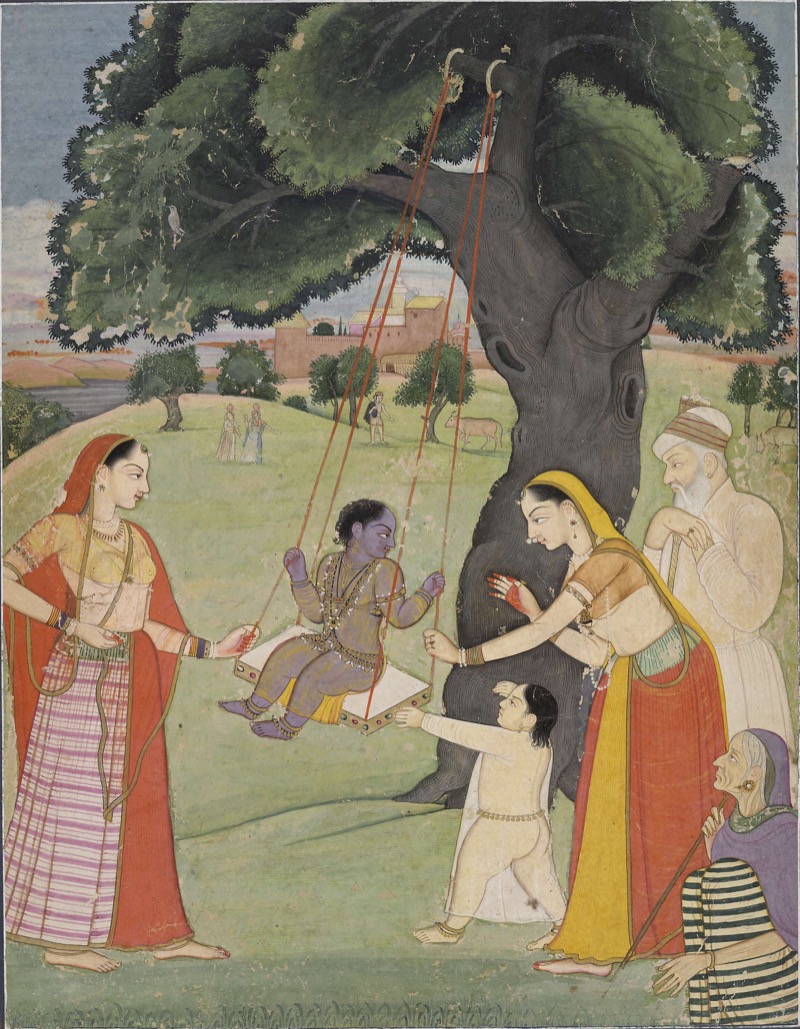
Somewhere in the middle of his great garland of saints, Nabhadas stops and does something startling. He has already bowed before renunciants who mastered their breath for decades, before kings who gave away kingdoms, before sages whose names alone could purify a river. Then, in a single chhappay, he kneels in the dust outside a cattle-yard and declares that this, and only this, is what he actually wants. "Bal vridh nar naari gop, hon arthi un paad raj," he writes: I am a beggar for the pada-raja, the dust of their feet, the feet of gopas young and old, men and women alike. He names them as though reading a village roll call: Nanda Gopa, Upananda, Dharananda, mother Yashoda, Kirtida, Vrishabhanu's own daughter lost in delight among her companions, and then a run of plainer names, Madhu, Mangala, Subala, Subahu, Bhoja, Ajana, Shridama, and many more, all called by Shyam's own name. He adds, almost as an aside, that Brahma and the immortals themselves crave the grace of these dwellers of the cowherd settlement. It is one of the boldest claims in the whole Bhaktamal: that the summit of bhakti is not found in a temple or a forest hermitage but among the graying, sunburned, turban-tying elders of Gokula, who happened to share a cattle-yard with God and never made much of it.
Nanda himself, the man Nabhadas names first, headed that cattle-yard, but he never ran it alone. Tradition remembers him as one of several sons born to Parjanya, a chieftain of the Yadava cowherds, and his wife Variyasi. His brothers are named with small variations from telling to telling: Upananda, the eldest, a man of such open-handed dignity that when their father passed him the headship of Gokula, he handed it straight to Nanda instead and stayed on as counselor rather than chief; Abhinanda, dark-bearded and steady; and Sanandan, also called Sunanda, fair of complexion and, the old poets insist, dearer to Krishna than almost anyone outside his own parents. The Bhaktamal's own commentary adds still more names to this circle, among them one it calls Parananda or Pravananda, along with Kamananda, Vallabhananda, and Dharmananda, though the commentators admit, in a small honest aside tucked into the manuscript itself, that there are "many variant readings" about how many brothers there actually were and what to call the last of them. What survives past all the disputed names is one clear picture: Gokula was governed not by a single patriarch in isolation but by a standing council of brothers and elders who ate together, argued together, and, without knowing it, spent their old age within arm's reach of the Supreme.
The Bhagavata Purana insists this arrangement was no accident. In an earlier existence, it says, Nanda had been Drona, one of the eight Vasu gods, and Yashoda had been his wife Dhara; the two of them performed such fierce austerity, begging Brahma for nothing less than the Lord himself as their child, that Brahma could only promise the boon and send them onward to be born again as ordinary cowherds in Vraja, waiting. That is the theology folded quietly into every scene of Nanda bouncing a butter-thief on his knee: an old debt of longing, carried across lifetimes, finally coming due in a cattle-shed in Gokula.
When it came due, Nanda was at home. The night Krishna was born in the prison at Mathura, Vasudeva carried the infant across a flooding Yamuna into Nanda's own house and, under the cover of Yogamaya's sleep spread over the whole settlement, exchanged him for the newborn girl at Yashoda's side, then vanished before dawn. Nanda woke to nothing but joy, with no notion that anything had been exchanged at all, and celebrated exactly as any cowherd father would: with a Nandotsav, a birth-feast so lavish that Vraja still keeps its name in the festival calendar. Weeks later, still glowing with new fatherhood, he made the ordinary, unglamorous trip every head of a cowherd settlement owed the crown: to Mathura, to pay Kamsa his annual tribute. It was there that Vasudeva sought him out. Nanda embraced his old friend as though he had recovered his very life, the Purana says, not yet knowing how literally that would one day prove true, and Vasudeva, for his part, asked after the safety of Nanda's children with a carefulness Nanda could not have understood. Vasudeva already knew what Nanda did not and could say none of it aloud. He only urged him to hurry home; trouble, he said, was coming to Gokula.
Trouble came fast. A beautiful stranger named Putana walked into the settlement offering her poisoned breast to the infant and was found dead and monstrous in a field; a whirlwind demon named Trinavarta snatched the baby into the sky and was dashed to pieces on a rock, the child laughing on the corpse's chest when the herdsmen found him. The elders did the two things such men know how to do with events like these: they thanked every god they could think of for the boy's survival, and they went back to worrying about the herd. In the middle of it all they arranged for Garga Muni, Vraja's own family priest, to name the child in secret, at night, hidden from Kamsa's spies, because even the naming of God's own incarnation had to be smuggled past a tyrant. Garga called the second son Rama, for the delight he gave everyone, and the dark one Krishna. Beyond that small circle of night lamps, no one else in Gokula yet knew what either name really meant.
It was fear, in the end, that moved the whole settlement to Vrindavan. After Trinavarta and the omens that followed, the family heads of Gokula gathered in Nanda's own courtyard to decide what to do, and it was Upananda, the elder brother who had once given away a headship rather than hold on to it, who stood and spoke. He had walked the length of Vraja himself, he told the assembly, and found a stretch of country called Vrindavan, thick with grass and shaded by tamala and kadamba trees, well off the roads Kamsa's men liked to travel. The council agreed within the hour. Carts were yoked, cows and calves roped into long lines, grandmothers and infants settled onto bedding among the pots, and Gokula uprooted itself in a single dust-choked day, arriving to raise new byres in the shadow of a hill called Govardhan.
Vrindavan settled into its own rhythm quickly, and that rhythm was set less by any single ruler than by the standing court of elders under whatever tree gave the best shade that season. Small disputes came to them: a gopi's complaint that Yashoda's boy had broken into her butter pots again, an argument over which pasture to open next, a decision about whose turn it was to keep watch against wolves and stray demons. Nanda presided; Upananda advised; Abhinanda weighed in; Sanandan and the rest sat listening with the patience of men who had already raised their own sons and now, without quite realizing it, were raising something else besides. It is this ordinary, undramatic government of uncles and grandfathers, more than any single miracle, that the Bhaktamal seems to be pointing toward when it begs for their footdust: vatsalya, a parent's love, asks nothing back, and here was an entire council of elders practicing it daily on a boy none of them yet understood to be God.
Their most consequential decision as a council grew directly out of that same boy's questions. Each year Gokula, and now Vrindavan, gathered offerings for a yajna to Indra, thanking the rain-god for the monsoon that kept the pastures green. One year the young Krishna watched his father and uncles assembling the ritual goods and asked, with a child's disarming bluntness, what it was all for and what they hoped to gain by it. Nanda answered plainly: Indra sends the rain that keeps the herds alive. Krishna pressed further, arguing that Indra was only doing the work appointed to him, the way rain simply does what rain does, and that what actually fed them day to day stood much closer at hand: the cows themselves, the brahmins who blessed them, and Govardhan hill, whose grass fattened every animal in the settlement and asked for nothing in return. It might have been dismissed as a boy's mischief. Instead Nanda, with the elders standing beside him, changed the yajna on the spot, carrying the mountain of food to Govardhan and circling the hill in worship instead of gazing skyward. Indra's fury at being passed over broke loose as a cloudburst that did not let up for seven days, and the entire settlement, cattle, children, and every elder among them, sheltered dry and disbelieving beneath a hill their small nephew had lifted on one raised finger, until Indra himself came down to apologize.
Nanda's closest brush with the truth of who he was raising, though, came to him alone, at the edge of the Yamuna. Keeping an Ekadashi fast, he rose before dawn for a purifying bath and, by ill chance, stepped into the river at the very hour sacred to Varuna's own servants, who mistook him for fair game and dragged him down into the water-god's court. When the herdsmen found Nanda gone, they ran for Krishna and Balarama, and the two brothers walked into the river after him as easily as into their own courtyard. Varuna, mortified, returned Nanda at once with a deep apology, explaining that his men had erred in ignorance. What Nanda carried back up out of that water was more than his own life. He had seen his son received as sovereign of an entire watery kingdom, and when Krishna afterward let the gathered herdsmen bathe once more in that same pool, he opened their eyes, if only for a moment, onto Brahmaloka itself, the plane sages reach only after lifetimes of mystic trance. It is a strange, almost throwaway detail in the middle of an otherwise domestic story: liberation, the very thing ascetics starve their whole lives for, handed to a circle of graying cowherds as something close to an afterthought, because their real wealth had never been that vision. It was a boy who still needed reminding to come home before dark.
That boy was taken from them soon enough. When Akrura arrived from Mathura with Kamsa's invitation to a wrestling festival that both Nanda and the tyrant understood was really a summons to execution, the elders of Gokula could do nothing but load the cart with the finest curds and grain they had, embrace their sons and grandsons, and watch the wheels vanish down the road in a haze of dust. Nanda and Yashoda lived through Kamsa's fall, through a coronation in Mathura they were never asked to attend, through years and then decades in which their son became a ruling king in a city called Dwaraka, a life they could not follow him into. The reunion tradition remembers most vividly came long afterward, at Kurukshetra, during a great solar eclipse pilgrimage, when kings and sages gathered from every corner of the land to bathe away the eclipse's ill fortune, and among the crowds a small caravan arrived from Vraja, led by a very old man and woman who had heard their boy would be there. When Krishna came to them, carrying all the years and majesty of a ruling king, the kshatriyas and philosophers gathered around fell to praising him as the Supreme Being beyond birth and death. Nanda and Yashoda, the story insists, heard every word of it and let none of it change what they saw. They saw only their child, grown taller than they remembered, and held him exactly as they always had.
That, finally, is why Nabhadas kneels for the dust of these particular feet rather than any philosopher's or ascetic's. Every other saint in the Bhaktamal fought for God, renounced for God, sang for God, suffered for God. The elders of Gokula did none of that. Upananda gave up a headship so his younger brother could raise a stranger's child in peace; Sanandan, Abhinanda, Parananda, and the rest sat on councils, herded cattle, worried about rain and wolves and stolen butter, and somewhere in the middle of all that ordinary worry, God grew up in their laps and none of them ever stopped treating him as anything but their own. That is vatsalya, love that asks for nothing back, not even the knowledge of who it is loving, and Nabhadas, singing centuries after the fact, still finds it the one thing worth begging for. A tired reader, closing the page at midnight, could do worse than ask the same thing of them: teach me to love with nothing held back and nothing understood, and let that be enough.
The Inversion of Worship: God as the Child
In most devotional modes, the devotee looks upward toward God as master, protector, or sovereign. Vatsalya rasa inverts this entirely. Nanda Maharaj did not worship Krishna as the Almighty. He worried whether Krishna had eaten enough. He lay awake when Krishna wandered too far from the village. He scolded him for stealing butter. The Supreme Lord of the universe, the source of all creation, was bounced on his knees and hushed to sleep with lullabies. This natural, unforced parental concern was precisely what made Nanda's devotion so pure. He did not know he was specially blessed. He simply loved his son. This is the teaching the Bhaktamala places before us: the highest relationship is not the grandest. It is the most ordinary, offered with the most open heart.
Bhaktamala, Chhappay 114; Srimad Bhagavatam, Canto 10
Drona's Prayer and the Asking of a Gift
The Bhagavata Purana tells us that in a previous birth, Nanda Maharaj was Drona, one of the eight Vasus, celestial attendants of Indra. Drona and his wife Dhara once approached Lord Brahma with a singular request: they did not wish for liberation, nor for any celestial reward. They wished to serve Lord Vishnu not from the comfort of heaven but by becoming His parents when He descended to earth. Brahma granted the wish. So Drona and Dhara were born as Nanda and Yashoda in the village of Gokula. Their entire existence was shaped by a single asking, a desire to hold the Divine as their own child. We are taught here that the quality of our inner asking matters. The direction in which the heart turns, and the depth of that turning, determines the nature of our encounter with the Lord.
Srimad Bhagavatam, Canto 10, Chapter 8
An Entire Village Moves for Love
After a series of attacks on Gokula by demons sent to harm the children, Upananda, the elder brother of Nanda, rose in council and addressed the gopa elders directly. He described a forest called Vrindavan on the banks of the Yamuna, rich with pastureland and close to the Govardhana hill, and he asked the community to move there for the safety of Balarama and Krishna. The entire settlement agreed. They packed their belongings, gathered their herds, loaded their carts, and left. This was not the decision of one patriarch. It was a collective act of love. An entire village uprooted itself so that two children might be safe. The Bhaktamala holds up this moment as a portrait of community in devotion: not a hierarchy of solitary seekers, but a living fabric in which every thread pulls together in service of the Lord's well-being.
Srimad Bhagavatam, Canto 10, Chapter 11; Bhaktamala tikaEn, entry 114
Brahma Seeks the Dust of Cowherds
The Bhaktamala verse declares that even Brahma, the creator of the universe, seeks the grace of the ghosha-nivasis, the simple residents of the cowherd settlement of Gokula. This is not poetic flattery. In the Bhagavata Purana, Brahma once stole the cowherd boys and calves in order to test Krishna's divinity. When Krishna simply expanded himself to replace every single one of them, Brahma was left stunned and humbled. He understood then that these gopas, these ordinary elders and children of Vraja, occupied a position of intimacy with the Lord that no cosmic attainment could reach. Their closeness with Krishna was not earned through tapasya or learning. It was given freely, because they had asked for nothing. They simply lived with him, loved him, and let him be their own.
Srimad Bhagavatam, Canto 10, Chapter 13-14; Bhaktamala, Chhappay 114
The True Parent: Love Given Without Calculation
Balarama himself declared to Nanda Maharaj: the one who merely gives birth is not the real parent. You are our true father, because you nourished us, protected us, and gave us a home. This statement from the Lord's own elder brother confirms what the Bhaktamala implies. Parenthood in the spiritual sense is not a matter of biology or circumstance. It is the willingness to give everything, to hold nothing back, to love without calculation or condition. Nanda gave Krishna a name, a childhood, and the experience of being a village boy who ran through fields and got caught with his hand in the butter pot. These are not small gifts. They are the very substance of the Lord's most cherished pastimes. The teaching is clear: the Lord does not come to the greatest. He comes to those who love the most simply.
Srimad Bhagavatam, Canto 10; Bhaktamala tikaEn, entry 114
Hindi text from OCR scan (Khemraj Shrikrishnadas Prakashan, CC0). May contain errors.