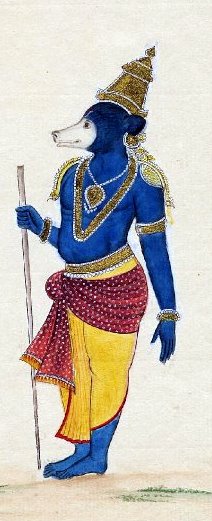
Doha: Knowing the right time, relishing seva, he acts with wise judgment. Among servants, who is like Jambavan? Jambavan, the wise counselor, supremely victorious, a treasury of strength and wisdom. Firmly established in equanimity, of unwavering faith, at the time of the setu (bridge) he spoke thus. Soratha: Listen, O banner of the Surya-vamsha, said Jambavan with folded hands. Lord, Your name is itself the setu; mortals who ascend it cross the ocean of worldly existence.
दो० जानि समय सेवा सरस, समुक करब अनुमान । पुरुखा ते सेवक ॥ ० किन जबवान ॥ “जाम्बवन्त मनन््त्री मतिमाना | अति विजयी बल बुद्धि निधाना॥ सामनिष्ठ अति हृढ़ विश्वासोी। सेतु समय अस बचन प्रकासी॥'
On the shore below Mount Mahendra, with the sea roaring in the dark and Lanka somewhere lost across a hundred yojanas of water, the finest army the forest kingdoms could gather sat in silence. One by one the vanara chieftains had named how far each could leap, and one by one the distances had fallen short. In the middle of that circle sat the one warrior who said nothing at all: Hanuman, son of the wind, folded in on himself as though his own childhood had never happened. It was an old bear who finally crossed the circle and sat down beside him, not to shame him into trying, but to give him back his own memory. Jambavan did not order Hanuman to leap. He told him a story instead: of a mother named Anjana whose long tapasya had won this son from Vayu, the wind; of an infant who once mistook the rising sun for a ripe fruit and sprang clean off the earth to seize it in his fist; of the boons that Indra and Surya and the wind god himself had poured onto that astonishing child. And he told him, gently, of the curse, how sages once disturbed by Hanuman's boyhood mischief had bound away his knowledge of his own strength, so that he could never summon it himself, only recover it when someone else spoke it back to him. That was the office Jambavan held that evening: not general, not king, but the one soul old enough and patient enough to remember what a hero had forgotten about himself. As the words went on, something in Hanuman's chest seemed to loosen and rise. His shoulders squared. By the time the old counselor fell silent, Hanuman had swollen to the size of a mountain, and with a roar that scattered birds from the far coast, he sprang across the ocean toward Lanka.
This was not a young voice doing the reminding. By the time of that council at Kishkindha, Jambavan was already reckoned ancient beyond ordinary telling, a minister so steeped in years that the vanara princes deferred to him the way children defer to a grandfather who has outlived every crisis they can imagine. Tradition holds that he was present at events far older than the war with Ravana, that he had watched the ocean churned in the age of the tortoise and stood by at the footsteps of Vamana the dwarf, making him, by some reckonings, the longest-lived of all the great immortals of the itihasa. He was known as Riksharaj, king of the rikshas, and old lore tells that he came into the world when Brahma, the creator, sat lost in thought over the shaping of the forest-folk and let out an enormous yawn, and Jambavan stepped out of that yawn fully formed, which is why some say his very name preserves the Sanskrit word for it. Whatever the truth folded inside that old etymology, what matters for his story is simpler: by the time Rama needed him, Jambavan was already the wisest head in the council chamber of Sugriva's court, a mantri whose counsel Sugriva himself would not overrule.
His greatest hour, though, was still ahead of him, on the beach where the vanara army stood staring at an ocean none of them could cross by leaping. Once Hanuman had returned from Lanka with news of Sita, and Rama had marched his army down to the coast, the question was no longer who could jump the sea but how an army could walk across it. It was Jambavan, elder statesman among a crowd of restless, powerful, and largely undisciplined forest-warriors, who kept the enormous labor of the setu from collapsing into chaos. He set gangs of monkeys and bears to tearing whole hillsides loose and rolling the stone down to the shore. He gave the two brothers Nala and Nila, who had carried since childhood a sage's blessing that let anything they touched float upon water, the central task of laying and binding the great causeway plank by plank and boulder by boulder. Day and night for five days the work went on, an old bear moving unhurried among the shouting, straining crowd, judging exactly when to push a gang harder and when to let them rest, until a road of stone stretched improbably across the sea toward Lanka.
When the bridge stood finished and the whole army gazed at it in wonder, it was Jambavan who stepped forward, folded his hands, and said the words for which the poet Nabhadas would remember him centuries later above every feat of strength: Listen, O banner of the solar line, he said to Rama, Your Name itself is the true setu. It is not the stone that carries a soul across the ocean of birth and death; it is Rama-nama, and whoever climbs onto that alone will cross the bhavsagar and never sink. It is a startling thing for a chief engineer to say about his own bridge, in the very hour of its triumph, that it is not the point. But that was Jambavan's particular genius: even standing in the middle of a stone miracle he had organized with his own hands, he understood exactly where the real crossing happened, and it was not underfoot. It happened in the syllables of the Name.
This is why the Bhaktamal remembers Jambavan not primarily as a warrior or an engineer but as the model of seva itself. Knowing the right time, relishing seva, he acts with wise judgment, the doha says of him, and asks, among all who serve, who compares to Jambavan. It is worth sitting with what that praise actually means. It is not obedience the text is praising, the kind of service that simply waits for an order and executes it. It is service exercised with taste, with rasa, with the discernment to know exactly when a word is needed and when silence is, when to push and when to hold back. He is called mantri, a wise counselor, supremely victorious, a treasury of strength and wisdom, firmly established in equanimity, of unwavering faith. Every one of those words describes a temperament rather than a feat: a mind so settled in devotion that it can be trusted with judgment, not just muscle.
After Ravana fell and the long war ended, tradition tells that Rama, moved to reward those who had served him, went among his allies offering boons. Jambavan alone asked for something strange. He did not ask for land or gold or a kingdom for his people. He confessed a private, almost childlike longing: he wanted, just once, to wrestle the Lord himself, hand to hand, the way children strain against a father they love without any fear of him, not as an enemy testing a rival but as a devotee wanting the sheer intimacy of contact with the divine strength he had spent his whole life serving. Rama, the story says, only smiled, and told him that this present form of his was not suited to grant that particular wish, but that in another age, wearing another shape, Jambavan would have his match. The old bear accepted this without complaint, the way he accepted everything, patiently, and the promise was tucked away to ripen across an age of the world.
It ripened in Dwaraka. A jewel called the Syamantaka, gifted by the sun-god Surya, had come into the keeping of a Yadava nobleman named Satrajit. His brother Prasena wore it once too often into the forest to hunt, and there a lion killed him for it, and the lion in turn was killed at its den by Jambavan, who carried the shining stone home and gave it to his household as a plaything, thinking little more of it than a piece of children's treasure. When Prasena failed to return, whispers began to circle Dwaraka that Krishna himself had killed him for the gem, and to clear his name Krishna went out and followed the trail himself: a slain man, a dead lion, and then paw-prints leading to a cave mouth in the hills.
What happened inside that cave has been told for a very long time with slightly different counts of days, twenty-one by one reckoning, twenty-seven or twenty-eight by another, but every version agrees on the shape of it: a battle unlike any fought before, two immense strengths grappling in near darkness without weapons, without food, without pause, day folding into night and night into day again. Outside, Krishna's companions waited twelve days and then, certain he must be dead, turned back for Dwaraka grieving, and the whole city took up mourning and prayer for his return even as the fight went on unseen underground. Inside the cave, Jambavan, who had not lost a contest of strength in longer than anyone could remember, began at last to weaken against this unfamiliar young cowherd, and in that exhaustion something in him cleared, the way memory had once cleared in Hanuman when Jambavan spoke to him on the shore. He recognized, finally, the one he was fighting. This was Rama, come back in a new form, keeping the old promise on the old beach.
Jambavan let go of the fight at once, bowed to the ground, and offered everything he had brought into that cave: the Syamantaka jewel, and his own daughter Jambavati in marriage, given not as ransom but as an act of joy, a devotee finally being allowed to bind his whole household to his Lord. Krishna, for his part, accepted her with tenderness, and later returned the jewel to Satrajit to clear his name once and for all, proof that he had wanted the fight, not the treasure. A soul who had waited an entire age of the world for that wrestling match had gotten his wish after all, and lost it gladly.
A cave still stands today near the town of Ranavav outside Porbandar in Gujarat, known simply as Jambavan's cave, where pilgrims come to see more than fifty naturally formed Shiva-lingas glistening under a constant trickle of water from the rock overhead, and where local memory insists this is the very ground where that long, dark battle was fought. A small shrine to Rama and a saint's samadhi sit just outside the entrance, and a fair still gathers there once a year, ordinary devotion attaching itself, as it always does, to the place where a very old story is said to have actually happened.
What carries through both of Jambavan's ages, the Treta of Rama and the Dwapara of Krishna, is not his strength, considerable as it was, but the singular shape of his devotion: patient enough to wait lifetimes for a promise, humble enough to point past his own greatest achievement to something greater still, and hungry, in the end, not for reward but simply for closeness to the one he served. Counted often among the chiranjivis, the immortals said to walk the earth even now, Jambavan is remembered less for any battle he won than for the one he was glad to lose, and for a single sentence spoken with folded hands on a beach: that the Name itself is the bridge, and needs no bridge of stone to prove it.
The Name Is the Bridge
At the moment the vanara army stood before the vast ocean, uncertain how to cross to Lanka, Jambavant spoke to Shri Rama with folded hands: "Lord, Your Name is itself the setu. Mortals who ascend it cross the ocean of worldly existence." Nal and Neel built a physical bridge of stones that floated by the grace of Rama. But Jambavant pointed beyond the physical to the eternal: the Name of the Lord is the bridge that carries souls across the ocean of samsara. The stones of any bridge may be swept away by time, but the Name endures through all ages. This is the central teaching of Nama-bhakti: what the world cannot cross by force or engineering, the sincere devotee crosses by simply repeating the Name with love and faith.
Ramcharitmanas, Sundar Kand; Bhaktamal verse 21 (Nabhadas)
The Art of Knowing the Right Moment
Nabhadas honors Jambavant with three qualities that together define perfect service: knowing the right time, relishing seva as inner sweetness, and acting with precise wisdom. Among all the vanaras present at the ocean shore, each one capable and devoted, Jambavant alone recognized the moment. He did not leap across himself, though he was one of the chiranjeevi, born of Brahma's breath at the dawn of creation. He understood that the leap belonged to Hanuman, and that the moment called for recognition rather than action. The greatest seva is sometimes not performing the deed but ensuring that the right soul performs it at the right time. This discernment, borne of deep stillness rather than ambition, is what the tradition calls mati-mana: the intelligence of devotion.
Bhaktamal verse 21 (Nabhadas)
Awakening the Strength That Sleeps Within
When Hanuman stood at the ocean's edge, paralyzed by the sight of the vast waters and unaware of his own capacity, Jambavant came to him as the elder who sees clearly what the younger cannot see in himself. He spoke of Hanuman's birth, his boons, and his nature: son of Vayu, born for this very mission. With a few words rooted in deep knowledge, Jambavant restored to Hanuman the memory of who he was. The entire course of the Ramayana turned on that single act of awakening. This is the role of the true guide in the spiritual life: not to carry the seeker across, but to remind the seeker that the capacity to cross was always present. The guru does not give what the disciple lacks. The guru removes what obscures what was never absent.
Valmiki Ramayana, Kishkindha Kanda; Srimad Bhagavatam 10.56
Recognition Across the Ages
In the Dvapara Yuga, Jambavant fought Krishna for twenty-seven days over the Syamantaka jewel, blow for blow, the ancient warrior giving all his strength against the Lord he did not yet recognize. As his body weakened and exhaustion opened a space in the mind, recognition dawned: the same eyes, the same presence he had known in Ayodhya. The same Rama who had wept for Sita, who had built the setu, who had embraced every devotee. Jambavant surrendered completely, offering both the jewel and his daughter Jambavati. His long chiranjeevi life was not a burden but a gift: the privilege of serving the same Lord in form after form, in Treta and Dvapara, in the age of Vamana and the age of Krishna. True bhakti does not belong to a single avatar. It belongs to the unchanging One who wears all forms.
Srimad Bhagavatam 10.56; Vishnu Purana
The Creator Who Becomes the Servant
The tilaka tradition records that Jambavant is an avatara of Brahma himself. The Creator of all worlds descends, takes the form of a bear, and places himself in devoted service to Shri Rama. This is not a diminishment. It is the highest expression of wisdom: that knowledge finds its complete fulfillment only in surrender. Brahma, who holds the Vedas and fashions the universe, discovers that no act of creation equals the act of folding the hands and saying, "Lord, Your Name is the bridge." In this voluntary descent, the entire hierarchy of creation bows before bhakti. Wisdom does not stand apart and instruct from above. It takes a body, enters the forest, serves the mission, and speaks when the moment calls for a single transforming word.
Bhaktamal tilaka commentary; Bhaktamal verse 21 (Nabhadas)
Hindi text from OCR scan (Khemraj Shrikrishnadas Prakashan, CC0). May contain errors.