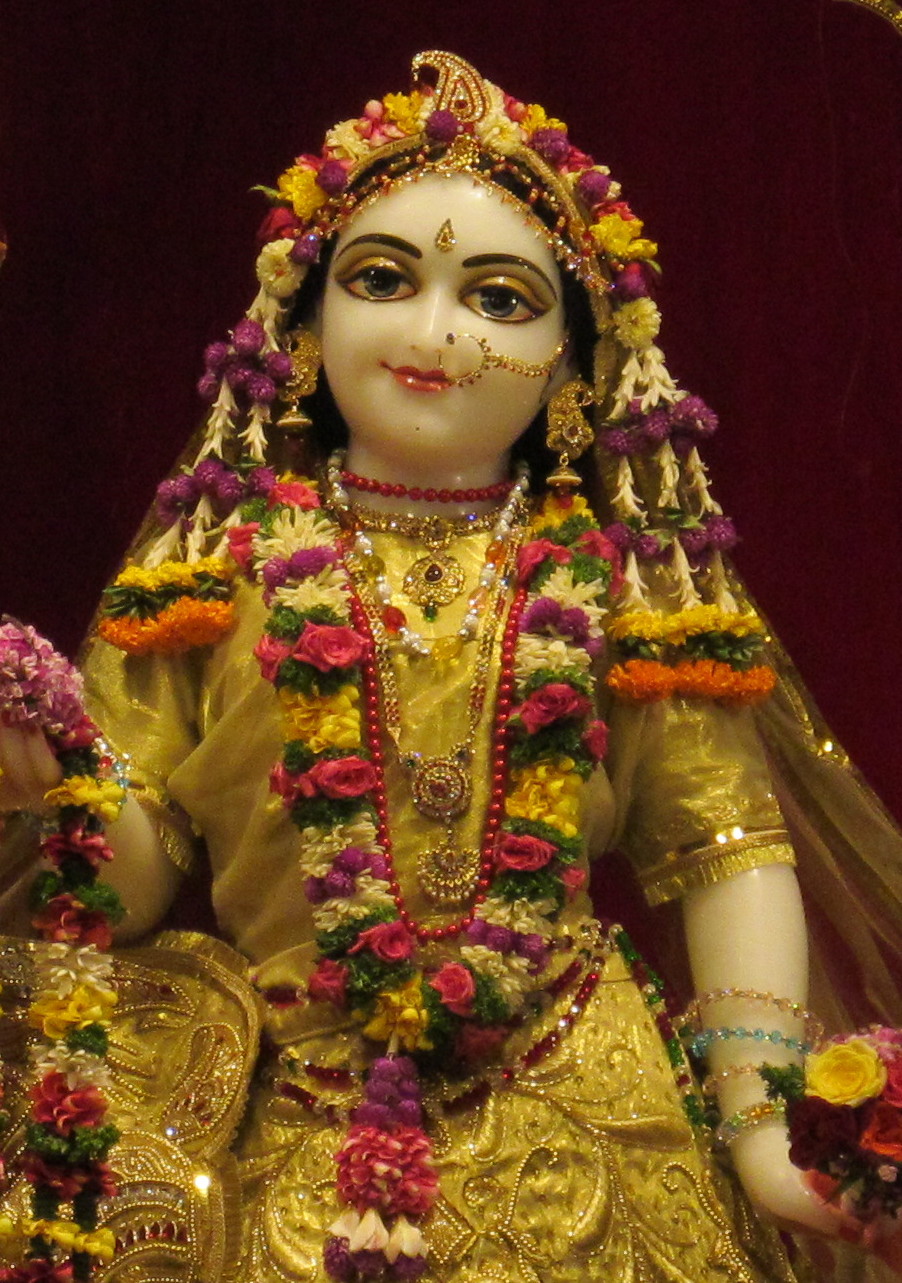
At midday, when the heat lay thick over the fields of Braj and even the herds had gone still beneath the trees, Vrishabhanu walked down to the Yamuna to bathe, as he did most days of his life as a chieftain among the cowherd clans. What waited for him in the river that particular noon, in the bright month of Bhadrapada, on the eighth day of its waxing fortnight, was not the water he expected. A lotus had opened on the surface, gold where the others around it were white, and cradled among its petals, as though the flower had grown up around her rather than she having fallen into it, lay an infant girl. He did not stand there weighing the strangeness of it for long. He lifted her out, held her against his chest, and carried her home to his wife, certain before either of them had spoken a word that the shape of their lives had just changed.
Kirti, his wife, took the child without a moment's hesitation. Word spread through Barsana quickly, the way it does in a village built around a handful of wells and a shared herd, and neighbors came to see the girl who had been found floating on a lotus rather than born in the usual way. But the joy in that house had one shadow in it. The child would not open her eyes. Days passed. Kirti held her at every hour, sang to her, pressed her lips to the small closed lids, and still the girl kept them sealed, as if she were waiting for a sight that had not yet arrived in the world. The older women of the village are remembered as having murmured among themselves, wondering whether something had gone wrong, whether the beautiful foundling might be blind. Kirti answered the whispers the only way a mother in her position could, by holding the child closer and refusing to despair.
The waiting ended, tradition says, on the day Nanda and Yashoda rode over from Gokula to see the newborn talk of the district, bringing their own dark limbed infant son with them. When the two babies were laid near each other, the girl's eyes opened for the first time in her life. She did not glance at the gathered crowd, at her mother, at the lamps or the flowers brought for the occasion. She looked only at the boy beside her, and having found him, she did not look away. The story that Braj has told ever since is that she had made a vow before ever taking this birth, that the first sight her eyes would rest upon in this world would be his face and nothing less. Whatever the room made of it that day, the households of Vrishabhanu and Nanda left that meeting joined in a way that would color everything that followed.
There is a whole theology folded into that single detail of the closed eyes, and it rewards sitting with. This is not the story of a soul who meets God partway through life and is transformed by the encounter, the way so many devotional biographies unfold. Her devotion did not begin at a shrine or in a moment of crisis. It was already complete before she drew a single breath in this body. The sealed eyes were not an illness to be worried over. They were closer to a vow being kept, a declaration that she belonged to Krishna before she belonged to anyone or anything else, including her own name. Later teachers of this path would say that in Radha, love does not develop; it simply becomes visible.
Behind that vow, the Puranas remember an older story still. In an age before this one, they say, Vrishabhanu had lived as a king named Suchandra, married to a woman named Kalavati, granddaughter of the great patriarch Daksha. Late in his life Suchandra left the throne and his wife to take up residence in the forest hermitage of the sage Agastya, and Kalavati, alone and heartbroken, wept until her grief reached the ears of Brahma himself. The creator granted her a boon: in a life to come she would be reunited with her husband, and this time a daughter would be born to them who was, in truth, the goddess Lakshmi herself, arriving to give and receive a love that circumstance had denied her before. When the Dvapara Yuga came, the boon is said to have ripened. Suchandra returned as Vrishabhanu. Kalavati returned as Kirti. And the daughter promised to them arrived, dressed in gold, on the face of a river in Braj.
Whatever cosmic accounting lay behind her arrival, the daily life of the household in Barsana was plain and full, in the way that any prosperous cowherd family's life was plain and full. Vrishabhanu was said to own herds numbering in the hundreds of thousands, wealth measured the way wealth was measured in Braj, in cattle rather than coin, and his standing among the gopas of the region was considerable. By every account that has come down through Braj memory, he was a close friend of Nanda's, the two men's households bound together long before their children ever were, visiting back and forth between Gokula, later Nandagram, and the rising hill town the family made its home. None of that friendship, none of the counting of cows or the management of a clan, asked Vrishabhanu to become someone other than himself. He fed his daughter, walked his fields, greeted his neighbors, and did all of this in the ordinary unremarkable rhythm of a father raising a child, even though the tradition insists that the child he raised was the very energy through which the divine tastes its own joy. He did not need to renounce anything to be near what saints elsewhere sought through decades in caves and forests. It was sitting in his own courtyard, learning to walk.
As she grew, the girl the villagers called Vrishabhanu-nandini, the daughter of Vrishabhanu, gathered around her a circle of friends who would remain with her through every later story Braj tells. Chief among them were Lalita and Vishakha, said to have been born within days of her. Lalita became the sharpest and boldest of the group, the one who managed the lovers' quarrels between Radha and Krishna, who could scold Krishna to his face when he had wounded her friend's feelings and then, minutes later, engineer the reunion that both of them were secretly longing for. Vishakha took on the gentler task of dressing and adorning Radha before she went to meet him, braiding flowers into her hair, choosing which anklets would sound best against the sound of a flute in the distance. Around these two gathered six more companions, each with her own particular way of loving, until the household in Barsana had become something more than a family. It had become the inner circle of an entire world of devotion, radiating outward into every lane and orchard of Braj.
Even the scriptures that never once say her name seem to be circling her. In the Bhagavata Purana's account of the rasa dance, Krishna multiplies himself to dance with every gopi at once, and then, in the middle of the night, vanishes from the circle with one gopi in particular, the one he seems to love best. She grows proud of her fortune, thinking herself raised above every other woman in Braj, and Krishna, sensing the pride, disappears from her too, leaving her alone and frantic in the dark forest. The other gopis go searching and find two sets of footprints together on the forest floor, and then only one, his growing deeper in the soil as though he had lifted his companion and carried her, hers vanishing altogether. The Bhagavata never speaks her name. It did not need to. Every generation of poets and devotees since, beginning with Jayadeva's Gita Govinda centuries later, has read that unnamed favorite as Radha, and has read her brief pride and her long night of separation as the pattern her whole love would follow: chosen above all others, and asked, over and over, to love without any guarantee of being able to hold on to what she loved.
This is where the Gaudiya Vaishnava teachers place the deepest claim of all. Krishna, they say, holds within himself three great powers, and the one called hladini shakti is the power by which he tastes his own bliss. Radha is not a separate being who happens to possess some of that power. She is that power, given a form, a name, a childhood in Barsana, a father who found her on a lotus. To say this plainly, joy in its most complete and self aware expression is not an abstraction in this telling. It is a person, and that person spent her mornings churning butter and calling out to her friends across a courtyard. Krishna, the tradition insists, cannot fully know his own sweetness without her, cannot experience the very bliss that is supposedly his own nature except through this one, singular relationship. The Lord who is said to need nothing is described, in text after text, as needing her.
That is also why the Gaudiya teachers describe Radha's love with the word mahabhava, the highest pitch of divine feeling said to exist, a state in which the one who loves and the one who is loved cease to be experienced as separate at all. There is a startling claim embedded in this, repeated across the devotional literature of Bengal and Braj: that Krishna himself has said he cannot fully repay what Radha gives him, that her love outstrips even his capacity to return it. If that is true, then love, at its furthest reach, has become greater than the god who receives it. This is part of why Chaitanya Mahaprabhu, who gave the worship of Krishna its most passionate form in the sixteenth century, is remembered by his own followers as Krishna who has taken on Radha's complexion and her longing, tasting from the inside what it feels like to be the one who loves rather than the one who is loved. And it is why, in the Gaudiya path, a devotee does not approach Krishna directly at all. One asks Radha first. Without her welcome, tradition says, the sweetness of Krishna stays a door that does not open.
The hill town of Barsana still keeps this whole story in its stones. The temple that crowns Bhanugarh hill today, raised in its present form during the sixteenth century under the patronage of the Orchha ruler Bir Singh Deo, is known simply as the Radha Rani temple, and local memory reaches back further still, holding that the site was first consecrated long before that by Vajranabha, said to be Krishna's own great grandson. At the base of the hill lies Vrishabhanu Kund, a bathing tank that still carries the chieftain's name, and every spring the town becomes the setting for Lathmar Holi, in which the women of Barsana take up long sticks and playfully drive back the men who come from Nandgaon, reenacting, with real laughter and real bruises, the day Krishna and his friends supposedly crossed over from Nanda's territory hoping to color Radha and her companions and were chased out for their trouble. Krishna, in that memory, comes to Barsana each year as a son in law visiting his wife's family, a small domestic joke wrapped around an infinite love.
Nabhadas, in the verse that gathers this household into the register of Braj's sacred names, does not set Vrishabhanu and his daughter apart in a separate class of their own. He lists them in a single breath alongside Kirti, alongside the sakhis, and alongside the gopa companions of Krishna, Madhu, Mangal, Subal, Subahu, Bhoj, Ajan-gopa, and Shridama, one household of love folded into another. That placement carries its own quiet teaching. Nowhere does the text ask Vrishabhanu to leave his cattle, to sit in silence on a riverbank, to renounce the ordinary shape of his days in order to be counted among the devoted. His devotion was simply to keep loving what had been placed, without explanation, into his arms one hot afternoon by the Yamuna, to raise her as his own even while sensing that she was infinitely more than his own, and to let his home in Barsana become the ground on which the whole story of divine love would stand. Anyone who has ever cared for someone they did not fully understand, and loved them anyway, keeps a small share of what Vrishabhanu practiced every day of his life.
The Grace of Being Chosen
Vrishabhanu did not seek Radha. He was bathing at the Yamuna on an auspicious morning in the month of Bhadrapada when he found her resting on the open face of a golden lotus. He lifted her from the water and carried her home. This is the nature of divine grace: it arrives uninvited, in the middle of an ordinary day, and asks only that you receive it. Vrishabhanu's qualification was not austerity or scholarship. It was a readiness of heart. He and Kirtida recognized at once that something vast had entered their household. To be chosen as the guardian of the sacred is itself a form of worship. The Bhaktamal names Vrishabhanu among the saints of Vraja because his love was pure enough to shelter what was beyond his full comprehension.
Padma Purana, Patala-khanda 71; Bhaktamal (tilak commentary)
Eyes Sealed for the Beloved
Radha was born with her eyes closed and did not open them for days. The villagers of Barsana whispered their concern. But the tradition understands her silence differently: before descending to this world, Radha had made a vow that the first sight her eyes would rest upon would be the face of Krishna. She would see nothing lesser first. When Nanda and Yashoda arrived from Gokula carrying their infant son, and Krishna was brought near her, Radha opened her eyes. She looked at nothing else. This is not a story about blindness. It is a teaching about the nature of pure prema. Her love did not begin when she saw Krishna. Her love preceded her birth, her body, her senses. The closed eyes were not a defect; they were a declaration.
Padma Purana; Radhashtami scriptural narratives
Hladini Shakti: The Energy That Gives God Joy
In Gaudiya Vaishnava theology, Krishna possesses three primary internal energies. The one called hladini is the energy through which he experiences bliss. Radha is not separate from this energy; she is its very form. To say that Radha is the hladini shakti of Krishna is to say that joy in its most complete expression is a person, and that person stands in Vrishabhanu's courtyard braiding flowers into her hair. This understanding transforms how one reads the entire landscape of Vraja. Every one of Radha's gestures, every moment of her separation from Krishna and every moment of reunion, is the activity of the Lord's own bliss-giving power playing out its nature in a human form. She is not a devotee who found God. She is the means by which God finds himself.
Brahma Samhita 5.37; Chaitanya Charitamrita, Adi-lila 4
Mahabhava: Love That Leaves No Remainder
The Gaudiya teachers describe Radha's love as mahabhava, the highest and most intense form of divine love that exists. It is not desire seeking fulfillment, nor devotion seeking reward. It is a state in which the lover becomes so absorbed in the beloved that no boundary remains between self and other. Krishna is the source of all that exists, and yet even he is said to stand in wonder before Radha's prema. The tradition records that he cannot fully repay what she gives, that the depth of her love exceeds even his capacity to receive it. This is an astonishing claim. It means that love, at its pinnacle, is more powerful than the one who is loved. The devotee, at the highest pitch of surrender, surpasses even God. This is why the Gaudiya path teaches: seek Radha's grace first. Without her mercy, the sweetness of Krishna remains a closed door.
Chaitanya Charitamrita, Madhya-lila 8; Ujjvala Nilamani of Rupa Gosvami
Barsana: The Geography of Love
Barsana was known in earlier times as Bhanupura or Bhanu Nagari, named after Vrishabhanu himself. Even today, pilgrims who climb its hills understand that they are entering Radha's territory. If Vrindavan belongs to Krishna, Barsana belongs to her. The festival of Lathmar Holi, in which the women of Barsana playfully chase the men of Nandgaon, reenacts in joyful form the exchanges between Radha's companions and Krishna's friends. The entire geography of Braj is a love letter written in villages, rivers, and hills, and Barsana is its center. Vrishabhanu Kund, one of the four main sacred tanks in Barsana, bears his name still. The Radha Rani Temple stands on the site where tradition says Radha lived in her father's home. The earthly father and the divine daughter have made this ground holy together.
Bhaktamal; Braj pilgrimage tradition; Padma Purana
The Ordinary as Worship
Vrishabhanu did not need to leave his household to practice devotion. The object of all devotion was sitting in his courtyard. His daily acts, feeding his daughter, watching over his cattle, greeting neighbors at the door, were all performed in the presence of the one whom sages sought through lifetimes of austerity. The Bhaktamal's inclusion of Vrishabhanu among the saints of Vraja carries a specific teaching: the path of prema does not require renunciation of ordinary life. It requires only that ordinary life be seen clearly. In Vraja, every relationship was a mode of love, and every act of care was an act of worship. To be a devoted parent to a beloved child, to shelter the sacred without fully grasping its depth, to serve with tenderness and ask nothing in return: this too is the path. Vrishabhanu walked it every day.
Bhaktamal, Priyadas tilak commentary
Hindi text from OCR scan (Khemraj Shrikrishnadas Prakashan, CC0). May contain errors.