Doha: Crushing the strength of the foe, the monkey rejoiced. Bali-tanaya (son of Bali), a mass of strength, his body thrilled with horripilation, eyes filled with tears, clasped the lotus feet of Shri Rama. When all were departing after the return to Shri Ayodhya and his turn came, his stubborn insistence, earnest entreaty, and humble request to remain there draw before one's eyes the true portrait of his deep and genuine love. Doha: Hearing the humble words of Angad, Raghupati, the ocean of compassion.
दो० 'रिपु बल धरषि हरषि कपि, बालितनय बलपंज। पुलक शरीर नयन जल गहे रामपद कंज॥ श्रीअवध में आने पर जब सब विदा होने लगे ओर आपका अवसर जाया तो यहाँ रहने के निमित्त आपका हटठ आग्रह एवं विनय करना
At the edge of Ayodhya, on the road that led south again toward Kishkindha, every farewell had already been said. The bears and vanaras who had crossed an ocean and set a kingdom of rakshasas ablaze for Rama's sake had bowed, received his blessing, and turned for home one by one. Only one had not moved. Angad lay across Rama's feet, arms locked around the ankles he had once carried an ultimatum on behalf of, and would not rise. This was the one the old doha calls Bali-tanaya, Bali's son, a mass of strength whose body had thrilled with joy at the crushing of the enemy only days before; now that same body shook with a grief no war had drawn from him. He had walked into the ten-headed Ravana's own hall without flinching and planted his foot before an assembly of rakshasas without fear, but the thought of simply walking away from Rama undid him completely. Tears filled his eyes and fell to the ground; his voice, when it finally came, was not the voice of an ambassador anymore but of someone begging to be allowed to stay a little longer.
To understand what brought a battle-hardened prince of Kishkindha to weep like this, it helps to go back to his birth. Angad was the son of Vali, the vanara king whose boon let him draw off half the strength of any rival who met him in a duel, and of Tara, a woman remembered in her own right as one of the panchakanya, the five whose names devotees still recite for their wisdom and constancy. His very name comes from an old Sanskrit word for a warrior's armlet, "the adorned one," as though his father's household had marked him for ornament and strength before he had done a single thing to earn either.
That inheritance turned to sorrow early. Vali and his younger brother Sugriva broke apart over a misunderstanding at the mouth of a mountain cave, and their quarrel became one of the tangles Rama's forest years happened to pass through and untie. Hidden among the trees at Sugriva's side, Rama loosed an arrow into Vali during a duel that no vanara custom had prepared him to expect it from behind. Even as he lay dying, Vali did not spend his last breath on anger. He called Tara and the boy standing over him close and asked them to hold no bitterness against Sugriva, and he asked Sugriva, in turn, to raise Angad as his own and let no harm come to Tara. It is one of the epic's harder scenes to sit with: a father instructing his son, with his final strength, to go on loving the very household his own death was about to break open.
Angad kept that instruction. When Sugriva was crowned and the debt of a promise made to Rama came due, the search for Sita was organized in every direction, and Angad was placed at the head of the party sent toward the southern ocean, walking beside Hanuman, the elder statesman-bear Jambavan, and a company of vanaras who scoured cave after cave and hill after hill of the peninsula without finding her. A month later, provisions gone and their king's deadline long past, the party gathered above the sea to end their lives there rather than return to Sugriva having failed. It was Angad, still the youngest of the group's leaders, who kept them from despair long enough for the aged vulture Sampati to appear, tell them Sita sat grieving under a shimshapa tree across the water in Lanka, and hand the mission the second wind that would carry Hanuman the rest of the way in a single leap.
When war finally came and one last chance at peace remained, it was Angad, not the mightier Hanuman, whom Rama sent as his own emissary into Ravana's hall. The choice was deliberate. Angad carried royal blood the court could not wave off as a servant's, and he carried something sharper still: tradition remembers that his own father had once caught Ravana by the arm during his evening prayers at the edge of the four oceans and dragged him along without breaking his own devotions, humiliating the demon king in front of no one and everyone at once. Even the memory of the name Vali arrived in that court wrapped in old defeat. Rama was gambling that Vali's son could walk in and say aloud what no one else there would dare.
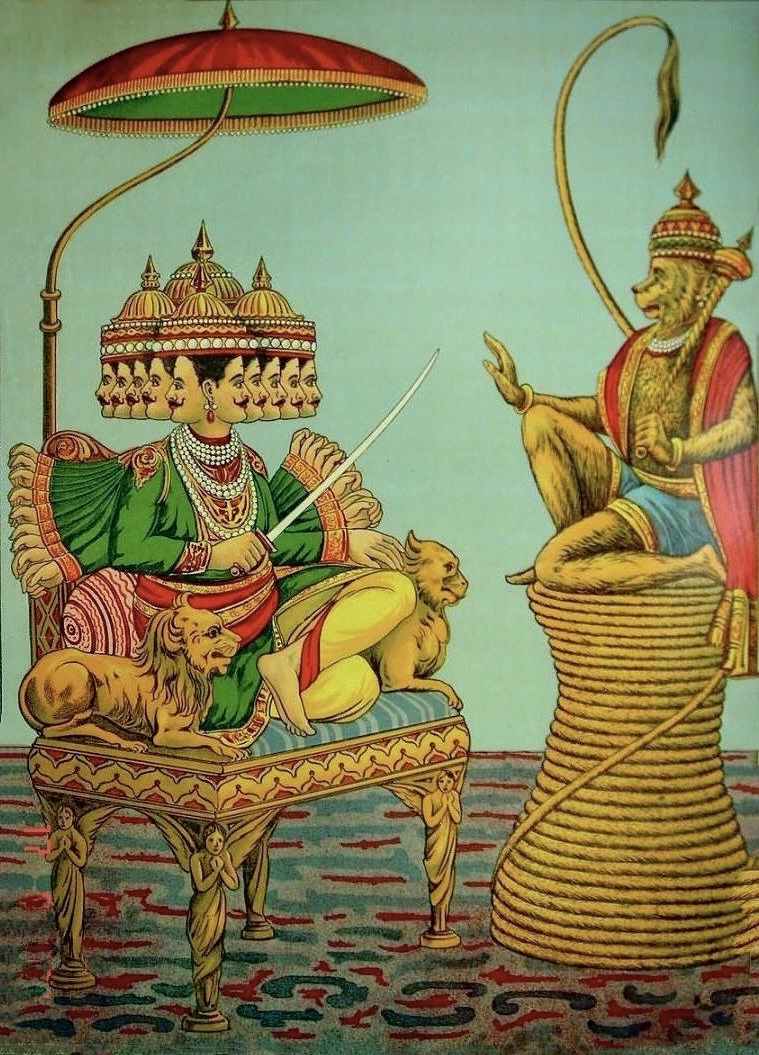
Angad did exactly that. Refused proper welcome, he is said in a much-loved strand of the storytelling to have coiled his own tail into a seat that rose higher than Ravana's throne and settled onto it before a word was exchanged, though this particular image appears in regional retellings more than in the oldest texts. What the earliest telling does preserve is blunter still: pressed to prove what he had come to say, Angad leapt onto the roof of Ravana's own palace and brought his foot down on it once, and the golden pinnacle came apart like a Himalayan peak struck by lightning, in plain view of the king who had built it. He reminded Ravana of every place his pride had already been dented, from the ocean Rama's army had bridged in days to the city Hanuman had burned with nothing but a lit tail, and he said plainly that no fortress and no boon could outlast what devotion to Rama could do. Give Sita back, he told him, and ask forgiveness, for the same Lord who could unmake Lanka in an afternoon was compassionate enough to pardon even this.
Ravana laughed him off the way pride always answers a truth it has no use for, so Angad staked the whole embassy on a single wager. He set his foot on the floor of the court and told the gathered rakshasas that if even one of them could lift it, he would call off the war and let Sita be. Warrior after warrior tried, down to the fearsome Indrajit himself, and none could so much as rock it loose. When Ravana at last stooped to try it himself, Angad drew the foot aside; Ravana pitched forward, and his crown rolled off across the floor of his own court in front of everyone he ruled. Angad picked it up, sent it in the direction of Rama's camp, and walked out unchallenged, leaving the ten-headed king to gather back whatever dignity he could find.
In the war that followed, Angad fought at the front rather than behind it. Long after, flying home over the very ground where it had happened, Rama pointed the battlefield out to Sita from the chariot carrying them back to Ayodhya: here, he told her, Lakshman brought down Indrajit, and there Hanuman and Angad felled the mightiest of the rakshasa captains. It is a small detail, easy to read past, but it matters that this account of Angad's courage survives in Rama's own voice rather than in any boast Angad made about himself.
Which brings the story back to the road out of Ayodhya, and to a prince who could stare down Ravana's entire court without blinking, undone by nothing more than the prospect of walking home. Rama did not simply order him to go. He lifted Angad by the hand and held him, his own eyes filling with tears at a devotion he had done nothing to demand and everything to deserve. Then, in a gesture the old commentators linger over more than almost any other in this parting, Rama took the necklace from his own neck and the fine cloth from his own shoulders and dressed Angad in them with his own hands, explaining gently, patiently, in as many ways as it took, why a king's son belonged first to the mother and the throne waiting for him in Kishkindha. He sent his own brothers, Lakshman, Bharat, and Shatrughna, to walk beside Angad as far as the border, so that a parting which had to happen would happen wrapped in as much love as Ayodhya could send along with him.
What became of Angad afterward is remembered less certainly than what he did during the war, and it is worth saying so plainly rather than filling the gap with invented detail. Later tradition holds that Sugriva, in time, crowned him king of Kishkindha in his own place, and that he married and had a son to carry the line forward; these are threads later texts add to the story rather than facts fixed beyond question, and in any case they matter less than what nobody disputes: this is a devotee who never had to choose between strength and surrender, because in him the two turned out to be the same offering, made to the same feet.
That is the deeper teaching this jewel of the Bhaktamal wants noticed. The commentary states it almost like a law: to a heart that has genuinely learned to love Sita-Ram's charan-kamal, no matter of this world or the next is left unmastered, because that love is itself the mastery. Angad needed no other weapon in Ravana's court and no other argument at Ayodhya's gate; the same prema that planted an unmovable foot in a demon's hall also could not let go of Rama's ankles when the moment came to leave. A reader too tired to expect scripture to move them tonight might sit with just that one contradiction: a warrior nobody could shift by force, undone completely by love, and let it become, quietly, a prayer of their own.
The Foot That Could Not Be Moved
In Ravana's court, Angad planted his foot on the floor and issued a challenge: let any warrior in this assembly move it. One by one, the mightiest rakshasas tried and failed. Even Indrajit, the conqueror of Indra, could not budge it by a hair. That foot was not held in place by muscle alone. It was anchored by devotion to Rama, and devotion to Rama is heavier than Mount Meru. Tulsidas sings of this moment: the foot became heavier than Meru, as though Brahma had fixed it to the earth at creation. When a bhakta is rooted in the Lord, no worldly force can dislodge him from dharma. The strength that comes from surrender to the divine is greater than anything the ego can muster.
Ramcharitmanas, Lanka Kanda; Bhaktamal of Nabhadas
Grace Can Redeem Even Adversity
Angad's father Vali was slain by Rama's own arrow. A lesser soul might have nursed resentment or fled. Instead, Angad heard his dying father's instruction: serve Rama, stand by dharma, devote yourself to the Lord's work. Bali's final act was to entrust his son to the one who ended his own life. He recognized in that last breath that Rama was no ordinary warrior but the Supreme Lord. Angad received this teaching through grief and held it as the compass of his entire life. When what we love is taken, it can become the very doorway through which the Lord enters. The loss does not diminish; it deepens into seva.
Valmiki Ramayana, Kishkindha Kanda
True Loyalty Is Directed Toward Truth, Not Rank
When Sugriva forgot his sacred pledge to Rama and sank into the comforts of kingship, it was Angad who stood firm. The young prince did not flatter his uncle and king. Together with Lakshmana, he challenged Sugriva directly and reminded him of the vow he had made. This was not rebellion. It was the highest form of loyalty: the kind that remains faithful not to a person's position, but to the promise they made before the Lord. A genuine devotee does not enable forgetfulness of God in those close to him, even when that requires courage. Real love does not allow the beloved to stray from dharma without a word.
Valmiki Ramayana, Kishkindha Kanda
The Crown Belongs at the Lotus Feet
When Ravana lunged at Angad's foot and stumbled, his crown tumbled to the ground. Angad seized it and hurled it with such force that it sailed across the ocean and landed at Rama's feet. In that single gesture, Angad made visible what all the diplomacy and argument could not: Ravana's sovereignty was already lost. The crown did not belong on the head of one who had stolen another's beloved and refused to bow before the Lord. Wherever Angad threw it, it fell exactly where it was destined to rest. Every title, every honor, every power we hold is only rightly worn when it is offered back to the one from whom all glory flows. The crown that reaches the Lord's feet is the only one that is not already fallen.
Ramcharitmanas, Lanka Kanda; Bhaktamal of Nabhadas
The Warrior Who Could Not Say Goodbye
After Rama's coronation in Ayodhya, the great vanara hosts took their leave one by one. When Angad's turn came, he could not do it. He could not say goodbye. He wept. He pleaded. He insisted with stubborn earnestness that he be allowed to stay. The Bhaktamal holds up this moment as the truest portrait of genuine love. The same Angad whose foot could not be moved from Ravana's court could not move his own heart from Rama's presence. Hearing his humble words, Rama rose from His seat, drew Angad into His arms, and held him close with eyes wet with tears. He placed His own garland on Angad's neck, dressed him in fine cloth, and with great tenderness consoled him. Strength and tenderness are not opposites in bhakti. They are two faces of prema, and both find their home at the Lord's feet.
Bhaktamal of Nabhadas, doha on Angad; Ramcharitmanas, Uttara Kanda
Hindi text from OCR scan (Khemraj Shrikrishnadas Prakashan, CC0). May contain errors.