Janaka Praises the Formless Brahman before His Eyes
Bala Kanda, Chaupai 338
Doha 341 · Movement 1 of 2
Keep this contemplation
Preserve, print, or share
Janaka bows before the sages and receives their blessings, then embraces his four sons in law. With lotus like hands joined, the king whose wisdom knows the formless Absolute turns toward Ram and lets love itself speak.
Ram is the royal swan dwelling in the Manas lake of Shiva and the sages. Yogis renounce anger, delusion, attachment, and pride to seek him. He is all pervading Brahman, unseen and imperishable, pure consciousness and bliss, beyond qualities yet the treasury of every virtue.
Mind, speech, and reasoning cannot grasp him. The Vedas approach through neti, neti, while he remains unchanged through all time. Yet that ungraspable Reality stands before Janaka in a human form he can embrace. Knowledge does not dissolve the scene. It makes the father's farewell an astonished worship of the Infinite made near.
The Brahman whom speech cannot reach stands close enough for Janaka to fold his hands before him.
Read the passage from the Manas
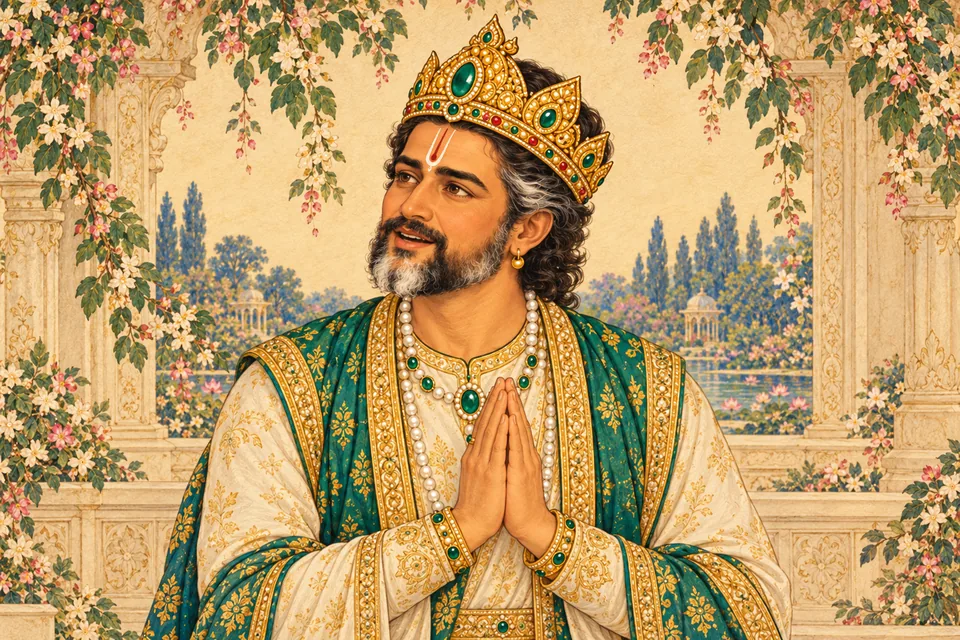
AI-created devotional illustration · Chaupai 338
All8couplets/HindiPDF326; selectedJanaka praisingRama ownjoinedhands, sages/Rama/ALLbrothers/Shiva fullmetadataoffcrop.
Source reference and artistic choices
Gita Press code81 undated · PDF pages 326 · printed pages 324. Reader passage: bala-kanda-chaupai-338. Printed numbering may differ.
Source facts
- JANAKA HEADBOWS SAGEASSEMBLY andreceivesBLESSINGS FROMALL thenrespectfullyMEETSALLSONSINLAW treasuryBEAUTY CHARACTER QUALITIES.
- OWNLOTUSLIKEJOINEDHANDS speaksASIFWORDSbornLOVE; praisesRAMA SWANofMINDLAKES SAGESANDSHIVA metaphor, Shiva notomitted no literalbirdbrain.
- YOGISpracticeforhim renouncing ANGER DELUSION POSSESSIVENESS and PRIDE allfour, notprideonly.
- ALLPERVADING UNMANIFEST IMPERISHABLE BRAHMAN CONSCIOUSNESSBLISS NIRGUNA andTREASURYQUALITIES semanticattributes notliteralbodymorph.
- SPEECHWITHMIND cannotKNOW HIM, allINFERENCEcannotreach; VEDAS gloryNETI, unchangedALLTHREETIMES notonlyendlessbliss.
Artistic choices
- PASS E02 ONEproperJanakahead TWOarms TWOOWNNAMASTE hands atownCHEST. ActualOPENeyesUPLEFT ratherthanUPRIGHTprompt, GENTLYPARTEDspeechmouth teethvisible headupright. Darkgreybeard blackwavysilvertemples Ured GREENEMERALDgoldCRESTEDcrown ivoryTEALgold pearlsgreenjewels hoops/cuffs. Antiquecreamgoldminiature floralpavilion. No literalmetaphysicaldiagrams/swanbody/text/otherfigures or wholeassembly/speechaudibilitycertificate.
- Exact poses/gazes/numericalages/clothes/ornamentcounts/geargeometryfastening/materials/spatialframing artistchoices not history or wholeparticipant/anatomy/motion/audible/emotionmotive census. Fullsourceoffcrop facts retained noabsenceinference/corpuscorrection/inventedHindi/publishing. Source comparisons/characterinsults/threats not physicaltransformations/violentevents.
An imaginative interpretation, not a historical portrait or documentary evidence.
मुनि मंडलिहि जनक सिरु नावा। आसिरबादु सबहि सन पावा।। सादर पुनि भेंटे जामाता। रूप सील गुन निधि सब भ्राता।। जोरि पंकरुह पानि सुहाए। बोले बचन प्रेम जनु जाए।। राम करौ केहि भाँति प्रसंसा। मुनि महेस मन मानस हंसा।। करहिं जोग जोगी जेहि लागी। कोहु मोहु ममता मदु त्यागी।। ब्यापकु ब्रह्मु अलखु अबिनासी। चिदानंदु निरगुन गुनरासी।। मन समेत जेहि जान न बानी। तरकि न सकहिं सकल अनुमानी।। महिमा निगमु नेति कहि कहई। जो तिहुँ काल एकरस रहई।।
Janaka bowed his head before the assembly of sages and received blessings from each one of them. Then he respectfully embraced his sons-in-law, all four brothers who were treasuries of beauty, grace and virtue. Joining his beautiful lotus-like hands, he spoke words as though love itself had taken voice. 'How can I praise Rama, who dwells like a royal swan in the Maanasa lake of the minds of sages and Lord Shiva? For whose sake yogis undertake their practice, renouncing anger, delusion, attachment and pride. He is the all-pervading Brahman, unseen and imperishable, pure consciousness and bliss, beyond all attributes yet the very storehouse of all qualities. Whom neither speech together with the mind can know, and whom all logicians cannot fathom through reasoning. Whose glory even the Vedas describe only by saying "neti, neti" (not this, not this), and who remains ever the same through all three periods of time.'