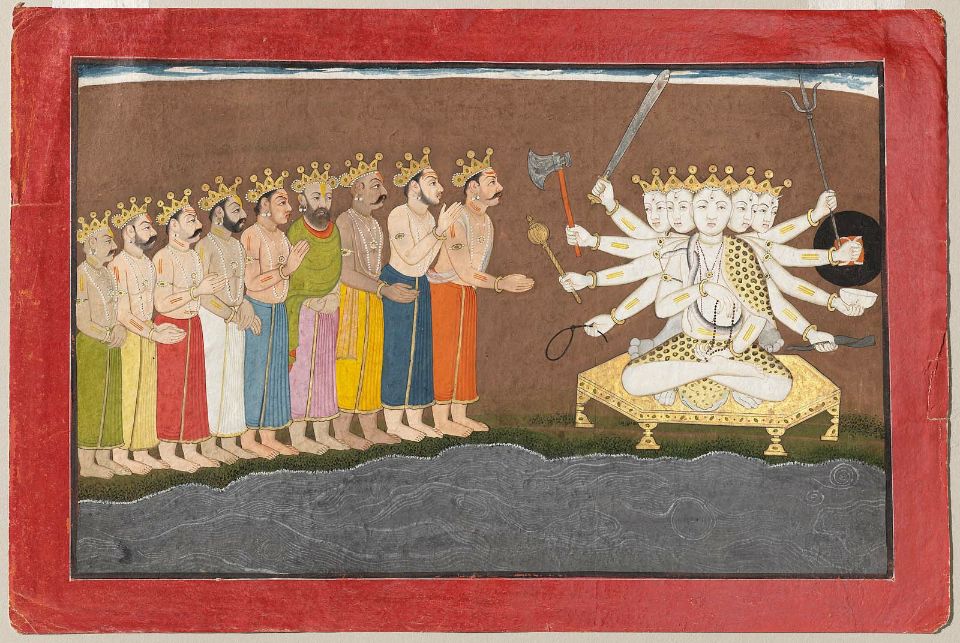
Ten young men walk out through their father's gate in a single file, so alike in bearing and face that the palace guards cannot tell where one brother ends and the next begins. They are the sons of King Prachinabarhi, and their father, a monarch so devoted to the fire altar that he has spent lifetimes offering yajnas until the smoke of his sacrifices is said to have darkened the directions, has given them a plain command: go, perform tapasya, make yourselves fit, and then return to marry and carry the royal line forward. Nabhadas gathers all ten into a single name in his roll of devotees, Shri Prachetaji, because what happened to them happened to all ten as if to one soul wearing ten bodies. Even their name carries the trace of this unity: Prachetas, the ones of keen and gathered awareness, souls already leaning toward remembrance before the story properly begins.
They have not gone far along the road, making for the shores of a sacred water that the old commentary calls Siddhisar, or by another name Narayansar, when a barefoot figure crosses their path carrying a vina and humming the name of Hari under his breath. It is Devarshi Narada, the wandering sage who seems to appear wherever a soul stands at a fork between duty and love and needs someone to show that the two roads are not actually different. Out of sheer compassion, with no one having asked him, he stops the ten brothers and gives them upadesha: your father has told you to do tapasya so that you may found a household, he says, and that is good and no fault of his, but let me show you what tapasya is actually for. Austerity that does not end in loving Hari is a well dug in sand, filling only to drain away. Let your penance be aimed not merely at strength or progeny but at seeing him. The brothers, still boys in devotion though grown men in body, take this teaching the way dry ground takes rain, and they walk on toward the water changed.
What follows is ten thousand years, by the reckoning the tilak of Rupkalaji gives, of standing in the sea. Picture it slowly rather than as a mere number: ten brothers waist deep and then shoulder deep in salt water, the tide working over them season after season, their bodies gone still as pillars, their lips still moving in japa long after they have stopped noticing hunger or cold or the passing of kings in the world above. They do not perform this penance for its own harsh glory. They perform it as Narada taught them, as an act of remembering, each repetition of the sacred syllables a small act of turning the face toward the unseen Lord.
Somewhere in the middle of that long vigil, the water in front of them stirs and a figure rises from the depths of a lake, blue throated, three eyed, garlanded with serpents rather than flowers. It is Bhagavan Shiva himself, come not to test them but to bless them, moved to unexpected tenderness by the sight of ten princes drowning themselves in devotion. The brothers, astonished, bow before him, and Shiva, who is himself the greatest of Vishnu's devotees, does something that later generations would treasure as one of the most beautiful hymns of the whole Bhagavata: he teaches them a hymn of his own composing in praise of Narayana, verse after verse describing the Lord's form, his weapons, his mercy, urging the brothers to sing it daily with faith. There is a quiet lesson folded into this meeting that outlasts the episode itself: that the great god of renunciation and the great god of preservation are not rivals to be chosen between, and that Shiva's own bhakti flows toward the same Vishnu the brothers are seeking. Having given them the hymn, Shiva returns to his own tapas, and the ten return to theirs, now singing his gift into the years that remain.
When the ten thousand years finally close, the ocean itself seems to grow quiet, and out of the sky comes a sight no penance can fully prepare a soul for: the Lord himself, riding on the shoulders of Garuda, gleaming like a raincloud crowned in lightning, eight arms bearing conch and discus and mace, his face so radiant that the brothers, after ten millennia without so much as opening their eyes to the world, find that a single glimpse of it dissolves every trace of the fatigue they have carried. He speaks to them not with anger at their audacity in doing such long austerity, but gently, as an elder to children who have already earned what he came to give. He tells them, in effect, that the vision they have just received is itself the first and greatest of his gifts, and that whatever else they ask will only ever be the smaller boon riding behind it. When they ask, as their father had once asked them to, for the means to found a household and continue their line, Hari grants it, and adds an instruction that must have startled them: all ten of you, he says, will marry the same woman.
The woman he means has a strange and lovely history behind her, one worth pausing over, because it is itself a story of grace working through years no one was watching. Long before, a sage named Kandu had gone into the forest above the river Gomati to do his own tapas, only to be sent a great temptation by a worried Indra: the apsara Pramlocha, whose beauty undid a hundred years of the sage's discipline in what felt to him like a single afternoon. When Kandu at last woke to how much of his life he had spent in that valley, he sent Pramlocha away in grief and self reproach, and as she fled toward the heavens, sweating from the shame and haste of her departure, the child she carried slipped from her body onto the leaves of the forest trees. The trees, and Chandra who rules over all green and growing things, raised the abandoned infant as their own, nursing her on moonlight until she grew into a young woman of unearthly grace named Marisha. What the world did not know was that in an earlier life Marisha had been a widowed queen who prayed so purely to Vishnu that he promised her, for a future birth, many husbands who would each be worthy and a son who would be great. The promise had waited across two lifetimes for its hour, and its hour was now.
But before that marriage could happen, the newly liberated brothers nearly undid the very purpose of their boon. Rising from the sea after ten thousand years with the fierce, single minded energy of men suddenly free, they found the earth so thickly overgrown with trees that there seemed no room left to raise the human families they had been promised, and in their zeal they summoned wind and fire and began to burn and uproot the forests wholesale. It took the intervention of Chandra, guardian of all that grows, to make them stop, pleading the trees' cause and revealing that a bride he had raised, meant for exactly this moment, was waiting to be given to them so that creation could continue without destroying the world in order to fill it. Only then did anger give way to wonder, and the ten brothers accepted Marisha together as their shared wife, a union the tradition treats not as scandal but as the working of a divine promise across lifetimes.
From that one marriage was born Daksha, and the old tilak calls this his second birth, a phrase that means more than it first appears. An earlier Daksha, sprung directly from Brahma's own being, had once fathered thousands of sons who, on hearing Narada's teaching about how brief and unsatisfying the ordinary business of the world is, walked away one after another into renunciation rather than continue his line, until the grieving father cursed Narada to wander forever without home or fixed abode. It is one of the story's quiet ironies that it should be the teaching of this same wandering sage, given now to the Pracheta brothers rather than taken away by them, that eventually returns Daksha to the world through Marisha's womb. This second Daksha grew to become the great Prajapati of later legend, the father whose daughter Sati would one day light her own fire in defense of Shiva's honor, though that grief belonged to a chapter still far ahead of the ten brothers' own story.
Having placed the crown and the whole burden of kingship on Daksha's young shoulders, the ten brothers did not linger to enjoy what they had built. They returned, as the tilak simply and beautifully puts it, to the forest to do bhajan again, choosing worship over throne a second time in one lifetime. Years later, by some accounts after ages spent enjoying and then growing weary of both earthly and heavenly pleasure, Narada found them once more, and this time his teaching was not preparation but consummation: he told them plainly that no birth, no ritual, no span of years counts for anything if it is not spent in the service of Hari, and that a life given to him, however short, outweighs an age given to anything else. The brothers, who had already given the sage's first teaching ten thousand years of their youth, gave his second teaching what remained of their hearts.
What came after cannot really be narrated as event, because it belongs to the register of mystery rather than incident. By that same compassionate ocean of instruction from Devarshi Narada, the tilak says, they cultivated such bhakti that they set down their bodies and, taking on forms not of flesh but of light, departed for the dwelling place of the Lord himself. Ten separate lives that had shared one wife, one crown, one forest, and one teacher ended by sharing one destination, dissolving the very distinction between the many and the one that had shaped their whole journey. It is fitting that Nabhadas remembers them under a single name, for by the end there was truly nothing left to count.
What lingers from the story of Shri Prachetaji is not a miracle to marvel at from a safe distance but an invitation. Here were ten men handed the most ordinary of instructions, go and continue the family, and they let a chance meeting on a forest road turn that duty inside out until it became worship. They did not have to choose between the throne and the divine; they walked the strange, sea soaked, tree burning, forest returning path between the two and found that Hari was waiting at both ends of it, first as an unearned vision on Garuda's back and last as a doorway of light. For anyone reading this late at night, weighed down by their own list of duties waiting to be discharged before life can properly begin, the ten brothers offer a quiet, stubborn suggestion: that the discharging and the loving need not be two different errands, and that even ten thousand years is not too long to wait for the face of the one you love.
One Meeting Can Change Everything
The Prachetas were raised in a palace devoted to ritual correctness. Their father Prachinabarhis performed yajna after yajna throughout his life, yet something essential was missing: the living fire of love for God. When the ten brothers set out on their father's errand, they walked as dutiful sons toward a worldly assignment. Then Narada appeared on the road. A single conversation with that compassionate sage ignited in them a longing that no amount of ritual could have kindled. They had not sought him out; they had not traveled to a great ashram; they simply met him on a path between palace and ocean. The Prachetas teach us that satsang does not require special conditions. Grace arrives in ordinary moments. One genuine encounter with a person who carries God's light can redirect the trajectory of a whole life, just as a single meeting on a dusty road changed the direction of ten.
Bhagavata Purana, Canto 4; Bhaktamal tika on Prachetas
The Gift of a Hymn: Carrying God Through the Dark
When Lord Shiva appeared before the ten Prachetas, he did not hand them a map of the spiritual world or a list of rules to follow. He gave them a prayer. The Rudra Gita, sixty-four verses of luminous devotion, became the thread they carried beneath the ocean for ten thousand years. They stood submerged in water, enduring the pressure of the deep, and again and again at dawn and dusk they recited that hymn. The prayer was not a technique to accumulate merit. It was a relationship, a cord of remembrance that held them to Bhagavan through every moment of their extraordinary penance. The Prachetas show us that a sacred prayer given by a true teacher becomes more than words. Repeated with love over a long time, it becomes a living presence, the face of God held steady in the mind even when the outer world presses in from every side.
Bhagavata Purana 4.24, Rudra Gita; Bhaktamal tika on Prachetas
Asking for Nothing Except God
After ten thousand years of penance beneath the ocean, the Supreme Lord appeared before the ten Prachetas seated upon Garuda, radiant beyond all description. He offered them his blessing. At that extraordinary moment, the brothers did not ask for power over kingdoms. They did not ask for immortality. They did not bargain for dominion over the three worlds, which their long tapas could have earned. They asked only for pure bhakti, for unbroken love at the Lord's lotus feet. This restraint is itself a form of wisdom. Many seek God in order to obtain something from God: health, wealth, success, liberation understood as escape from difficulty. The Prachetas had reduced their desire to its most essential point. The only boon worth having, their ten thousand years of underwater penance had taught them, is the boon of wanting nothing except the One who gives all boons.
Bhagavata Purana 4.30; Bhaktamal tika on Prachetas
Ritual Without Love and Love Without Ritual
The contrast between Prachinabarhis and his ten sons is one of the most instructive in the entire Bhagavata Purana. The father performed yajnas with impeccable correctness for a lifetime. The sons performed bhakti with wholehearted longing for ten thousand years. The father arrived eventually at disillusionment, needing Narada to shake him awake with the parable of Puranjana. The sons arrived at God. The Bhaktamal is not saying that ritual is worthless. It is saying that ritual without the animating spark of devotion is a husk that cannot nourish. The same forms, the same scriptures, the same discipline can produce either outer performance or inner transformation depending on what lives at the center of the practice. The Prachetas received Narada's teaching before they even began their tapas. That sequence matters: love first, then austerity. When love is the root, every form of practice becomes fruitful.
Bhagavata Purana 4.24-4.31; Bhaktamal tika on Prachetas
Duty Fulfilled and Then Released
The Lord appeared before the Prachetas and blessed them, but He did not immediately take them to His eternal abode. He asked them to return to the world, marry, and father a son who would continue the work of creation. The ten brothers obeyed. They came out of the ocean, married the maiden Marisha, fathered the great Prajapati Daksha, gave him the kingdom, and only then withdrew into the forest for the final stage of their journey. This sequence of events reveals something important: devotion does not demand the abandonment of worldly duty at the wrong time. The Prachetas had not come into the world merely for their own liberation. Their tapas was embedded in a larger story of creation, and they were willing to serve that story even after Bhagavan had personally appeared to them. They fulfilled their duty completely and then released it completely. That combination of full engagement and full release is the signature of the mature devotee.
Bhagavata Purana 4.30-4.31; Bhaktamal tika on Prachetas
Hindi text from OCR scan (Khemraj Shrikrishnadas Prakashan, CC0). May contain errors.