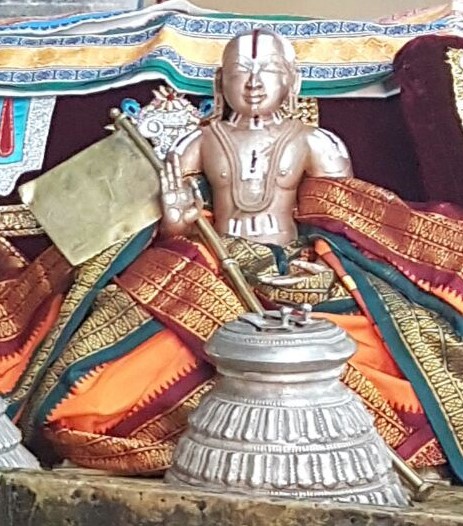
A boy of twelve stood before the assembled court of the Pandya king, and the man he had come to challenge looked him up and down with open contempt. This was Akkiyalvan, sometimes remembered by the epithet Kolahala, "the tumult," a royal debater so feared that scholars across the land had learned to pay him tribute rather than risk facing him in argument. When he heard why the child had come, he did not bother to hide his scorn. "Azhavandhaan?" he asked, a word that meant, more or less, "has this one come to rule over me?" The hall laughed. The boy did not.
He had earned the right to be standing there. His name was Yamunacharya, and tradition places his birth around the turn of the tenth century in Madurai, the old Pandya capital, into a family already marked by extraordinary devotion. His grandfather was Nathamuni, the yogi and scholar who had gone into the Tamil countryside to recover the nearly forgotten hymns of the poet-saint Nammalvar and had given the Vaishnava community, for the first time, a compiled and singable canon of that poetry. But Nathamuni had long since renounced the world, and Yamunacharya's own father died while the boy was still an infant, leaving him to be raised by his mother and his aged grandmother in genuine poverty. What wealth he had was of the mind: at five he was sent to study under a modest but gifted teacher named Bhashyacharya, and by twelve he was already that small school's finest pupil. In one telling of the story it was his teacher's unpaid debt to the arrogant court scholar that forced the crisis. Someone had to answer for it, and the boy, still a child by any measure, put himself forward.
What followed is remembered as one of the great set-pieces of Sri Vaishnava memory. Rather than wait to be examined, Yamunacharya turned the contest around and offered three propositions that he dared Akkiyalvan to refute: that the scholar's own mother was not, despite appearances, a barren woman; that the Pandya king was a paragon of righteousness; and that the queen was as chaste as the legendary Savitri. Akkiyalvan understood at once that he had been trapped. To deny any of the three was to insult either his own mother or the royal family in open court, an unthinkable risk. He fell silent, and in that silence Yamunacharya delivered the resolution himself, reaching into the fine print of dharmashastra: a woman who has borne only one child, the texts say, is technically counted among the barren, since she has not fulfilled the fuller measure of motherhood; a king carries a portion of his subjects' accumulated wrongs, so that none can be called wholly righteous while he reigns; and a married woman is, in the traditional reckoning, wedded not only to her husband but to eight guardian powers besides, which is a strange kind of company to call untouched. It was riddling logic, half play and half real argument, but it left the great debater with nothing to say. The court that had laughed at a child now watched him win.
The queen, who had wagered everything on the boy, was overjoyed, and the king rose and embraced him. In gratitude they gave him the very title that had been flung at him as an insult: Alavandar, "the one who came to conquer," or, in some renderings, "the one who came to save." With it came half the kingdom to govern. So the grandson of a renunciate ascetic became, while still barely into his teens, a ruling prince, and for something like two decades he stayed one, expanding his territory, enjoying the pleasures that power affords, and, by every account, letting the memory of his grandfather's hard-won devotion sink quietly out of view. Nathamuni had died believing his grandson would one day carry that inheritance forward. Watching Yamunacharya's court from a distance, it must have seemed a promise going unpaid.
But Nathamuni, before his death, had entrusted the matter to a disciple named Rama Misra, also remembered as Manakkal Nambi, who had himself studied under Nathamuni's foremost pupil Pundarikaksha. Rama Misra was patient in a way that suited the task. Rather than march into the palace demanding an audience, he became, quietly and for a long stretch of time, the supplier of a particular leafy dish, a wild spinach called tuduvalai, that had become a favorite on the king's table. Then, one day, the delivery simply stopped. Yamunacharya, missing it, asked after the mysterious old man who had been sending it, and so at last the door opened that Rama Misra had been waiting years to walk through. He did not lecture the king on his neglected duties. Instead he told him that his grandfather had left him a treasure: hidden, he said, within seven walls, between two rivers, guarded by a great serpent, secured by a mantra that only the rightful heir could use to claim it.
Curiosity, or perhaps something deeper stirring under all those years of comfort, made Yamunacharya follow him. As they traveled toward Srirangam, Rama Misra recited verses along the way, from the Bhagavad Gita and from the very hymns of Nammalvar that Nathamuni had spent his life preserving. When he came to the verse urging the listener to fix the mind on the Lord alone and let the intellect rest there, something in the king gave way. He is said to have realized, all at once, how many years he had spent chasing power and pleasure while the truer inheritance waited untouched. By the time they reached the seven-walled temple on its island between the branches of the Kaveri, he already half knew what the treasure would turn out to be.
It was Ranganatha himself, reclining on the coils of Adishesha within the innermost sanctum, and when Yamunacharya saw the deity his defenses left him entirely. He is remembered to have fallen at the feet of the image, undone, and to have spoken words very close to those that open his own later composition the Stotra Ratna: that he was no established knower of dharma, no realized knower of the self, without love and without the strength to control his own mind, that he came seeking only refuge, because there was nowhere else left to seek it. He renounced the kingdom then, formally and completely, taking the ascetic's path and the eight-syllabled mantra of surrender to Narayana. Alavandar the conqueror of debaters and captor of half a kingdom became, from that day, Yamuna Muni.
The rest of his long life he gave to Srirangam and to the community gathered there. He took up his grandfather's unfinished work of teaching and transmitting Nammalvar's Tiruvaymozhi, trained a circle of disciples that would go on to shape Sri Vaishnavism for generations, among them Periya Nambi, also called Mahapurna, and Tirukkottiyur Nambi, and set down in writing the philosophical foundations on which Vishishtadvaita, the teaching of a qualified non-duality between the soul, God, and the world, would later be built into its fuller architecture. His Siddhitraya laid out that relationship in three connected treatises. His Agama Pramanya defended the Pancharatra scriptures against rival schools that dismissed them, insisting they carried an authority equal to the Veda. His Gitartha Sangraha distilled the entire Bhagavad Gita into thirty-two verses built around the single claim that bhakti alone, love tempered by jnana and steadied by vairagya, carries the soul to the Lord's presence. And in the sixty-two verses of the Stotra Ratna, still recited by Sri Vaishnavas today, he sang of sharanagati, of surrender as both the beginning and the end of the path, and of Sri and Narayana together as the fullness he had finally come home to.
In his old age, word reached him of a young scholar in Kanchipuram whose brilliance and whose devotion to Narayana were already drawing notice: Ramanuja. Yamuna Muni wanted, before he died, to see this man in person and, some accounts suggest, to make him his successor with his own hands. He sent word inviting him to Srirangam. But time ran out first. When Ramanuja finally set out and arrived, he found that Yamunacharya had already passed from the world. The two men who would be remembered together as grandfather and grandson in spirit, the acharya who prepared the ground and the acharya who built the house upon it, never spoke a single word to each other in this life.
What Ramanuja found instead, standing over the body, was strange: three of Yamunacharya's fingers were curled inward, though the disciples gathered there said this had not been true of him in life. Ramanuja understood it as three wishes left unspoken and unfulfilled, and standing there he made three vows aloud. He would write a full commentary on the Brahma Sutras to establish Vishishtadvaita beyond dispute. He would see that the names of the sages Parashara and Vyasa, who had given the world the Vishnu Purana and the Mahabharata, were honored by being given to someone worthy of carrying them. And he would ensure that Nammalvar's Tiruvaymozhi, the hymns Nathamuni had rescued and Yamunacharya had taught, would be carried forward and expounded for as long as the tradition lived. As he spoke each vow, the story goes, one finger after another slowly straightened, until the hand lay open and at rest.
Ramanuja kept every one of those promises across a life that tradition, in its own generous way, also stretches to something like a hundred and twenty years, the same span given to Nathamuni and to Yamunacharya himself, less an exact accounting than the tradition's way of saying that some lives are too large for ordinary arithmetic. His Sri Bhashya became the great standing commentary on the Brahma Sutras that Yamunacharya had wished for. He took the son of his own beloved disciple Kurathalvan and named him Parashara Bhattar, so that the two ancient names would live again in a worthy bearer. And through his own teaching and through the disciples who followed him, Nammalvar's verses kept being sung, kept being explained, kept drawing new hearts toward the same surrender that had once undone a young king at the feet of Ranganatha. A boy who won half a kingdom by out-arguing the most feared debater in the land, a man who then spent that kingdom on pleasure until an old man's patient trick brought him back to himself: this is not, in the end, a story about conquest at all, whatever the title Alavandar might suggest. It is a story about the particular grace of being called home twice, once by a grandfather's promise kept beyond his own death, and once by a successor's vow kept at the very moment that ought to have been too late for any promise to matter.
The Kingdom You Must Leave Behind
Yamunacharya won a kingdom at the age of twelve by the sheer force of his intellect. He governed it well. Then, through the patient devotion of a single teacher and the sight of the Lord reclining at Srirangam, he gave it all away. The king who entered the temple did not rise from that prostration. Something collapsed in him, and what collapsed was exactly what he had been most proud of: his status, his authority, his independence. The teaching is not that worldly life is evil. Yamunacharya governed justly. But there comes a moment, for some seekers, when the Lord shows himself so clearly that everything else loses its weight. What Yamunacharya abandoned was not wicked. It was simply no longer enough. The seeker should ask: what do I hold onto most tightly? That is usually the thing the Lord is waiting for.
The Slow Path Through the Kitchen
Manakkal Nambi could not simply walk into the palace and announce himself as a teacher. So he befriended the cook, supplied a plant that sharpened the king's mind, waited until its absence was noticed, and used that moment to secure an audience. Months of patience for a single meeting. This story is about how grace actually works. The teacher who is meant to reach you does not always arrive through the front door. He arrives through the side entrance, through an apparently ordinary circumstance, through something as humble as a kitchen herb. The Lord arranges approach. The student's part is only to remain open enough to be reached. Yamunacharya's own brilliance had built walls around him. Grace did not break those walls. It found the door that was already there.
Sharanagati: The Path Open to Everyone
Yamunacharya taught that there are several paths back to God: karma yoga, the path of right action; jnana yoga, the path of knowledge; bhakti yoga, the path of loving devotion. These require considerable capacity, sustained discipline, and in some traditions, specific circumstances of birth or learning. But Yamunacharya also taught sharanagati, complete self-surrender to the Lord, as the path available to one who finds the others beyond reach. To surrender is not to give up. It is to place yourself entirely in the Lord's hands and trust that his grace will do what your own effort cannot. This was the philosophy he expressed in the Stotra Ratna: sixty-two verses of one soul saying to God, I have nothing to offer but this. Myself. The teaching travels across the centuries because the situation it addresses has not changed.
The Dead Hand That Opened
Yamunacharya died before he could meet Ramanuja, the successor he had identified from afar. When Ramanuja arrived at Srirangam, the master's hand was curled tight, three fingers drawn closed. Each finger held an unfulfilled wish: a commentary on the Brahma Sutras, honor for the sages Vyasa and Parashara, and the spreading of Vishnu's worship across the land. Ramanuja made three vows aloud. As each vow left his lips, one finger opened. A dead hand responded to a living promise. Whatever one thinks of the miraculous, the teaching is clear: unfinished devotional work does not simply end at death. It calls forth the one who is ready to carry it forward. Yamunacharya had done his part so completely that even his body communicated. The work he began became Ramanuja's life. This is how a lineage actually moves.
Receiving and Transmitting
Nabhadas places Yamunacharya within a chain of transmission that stretches from the Puranas to the present: from Suta to Shaunaka, from Nathamuni to Yamuna to Ramanuja and beyond. Yamunacharya received what his grandfather Nathamuni had gathered, added to it through his own philosophical writings and devotional hymns, and passed it forward through disciples who would shape the next generation. He integrated the Tamil hymns of the Alvars with Sanskrit Vedanta, creating what he called Ubhaya Vedanta, a twofold scripture that refused to separate the vernacular devotion of the heart from the formal philosophy of the mind. A seeker who only receives and never transmits has completed only half the work. A teacher who only transmits without continuing to receive becomes dry. Yamunacharya was both: a receiver of ancient grace and a giver of living teaching, which is why the lineage flowed through him rather than stopping at him.
Hindi text from OCR scan (Khemraj Shrikrishnadas Prakashan, CC0). May contain errors.