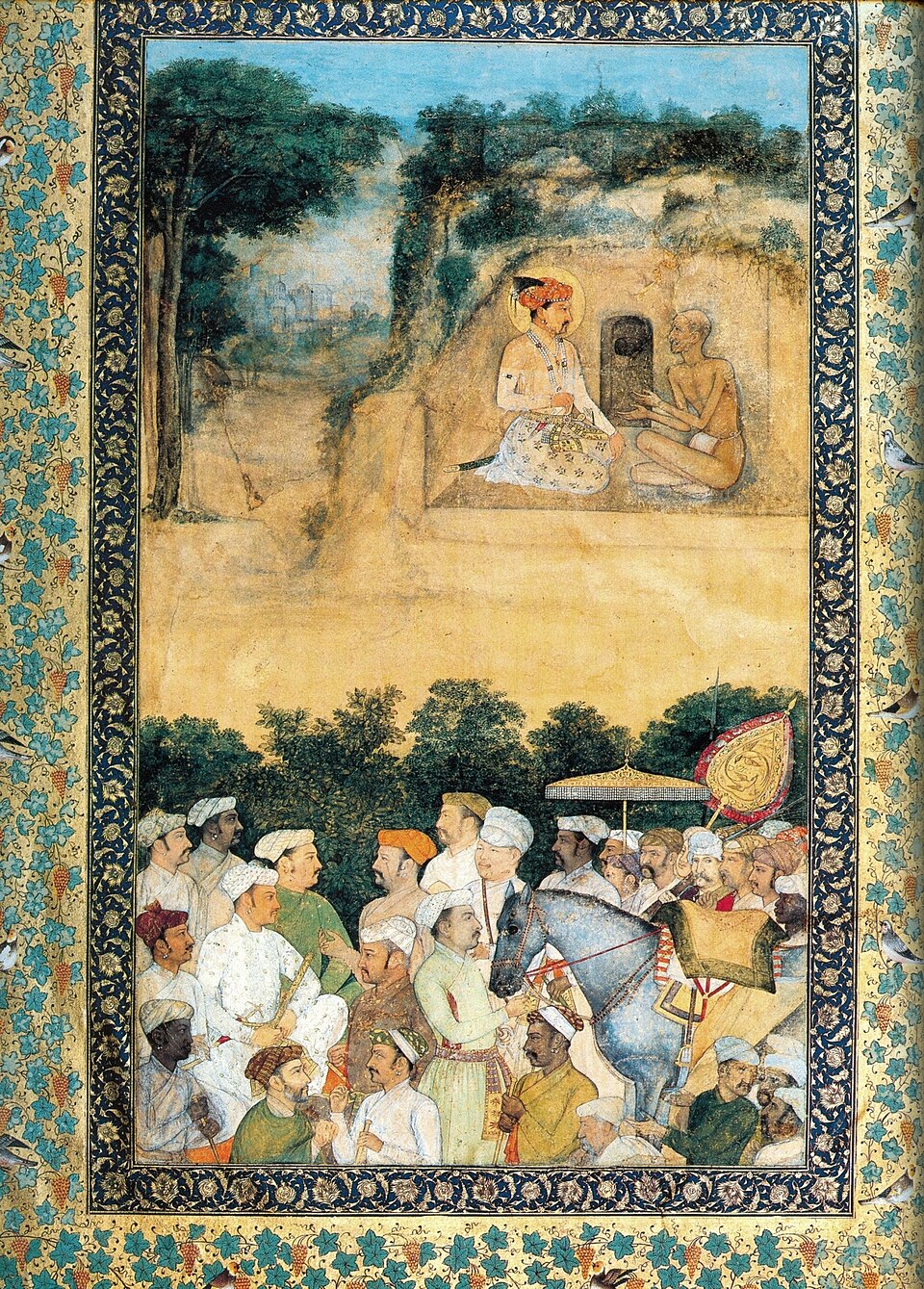
Picture a bard standing in the dust of Braj, his voice pitched to carry across a gathering of sadhus who own nothing but a loincloth and a name for God. His name is Deendas, and by caste and calling he is a Charan, one of those hereditary poet-genealogists whose whole livelihood was built on praising kings. A Charan's art was to stand before a Rajput chieftain and sing his lineage back to him in thundering chappay verses, and in return he would be given land, cattle, silver, sometimes a village. That was the trade. But here is Deendas doing something almost unthinkable within his own guild: he lifts his voice not for a prince but for a company of barefoot renunciates who have walked out of their households and their names and their money, and he calls them, astonishingly, his yajaman, his patrons, the ones for whom he sings and to whom he belongs. Among the two dozen or so names he calls out that day, weaving them into a single rolling chappay so that none of them would be lost to time, is one that has come down to us as Shri Krishnadasji.
That single verse is nearly all that survives of Deendas's testimony, and within it Krishnadas appears not as the subject of his own story but as one voice in a chorus. The roster around him reads like a muster of a lost regiment of bhakti: Uddhav, Ramrele, the elder Parshuram, Ganga, a Brahmdas of Krishna's own spiritual lineage, Vishram, Kinkar, Khema, Sotha, Gopanand, Jeev, Radha, Vihari, Dayal, Damodar, Mohan, Paramanand, a second Uddhav so that the bard has to specify which one he means, Raghunathi, Chaturbhuj, Nagan, and Kunj. Rupkala's own gloss on the verse, softened into modern Hindi some three and a half centuries after Nabhadas first set it down, explains Deendas's intention plainly: those who had become nirvritta, turned away and freed from samsara, from the household and the marketplace and the endless architecture of worldly wanting, were, in the bard's eyes, his true wealth. He calls himself their yashgayak, their singer of glory, and their yachak, their beggar. A man whose profession was to be fed by the rich chose instead to be fed by men who had nothing, because what they possessed instead of nothing was Krishna, and that, to a poet who understood bhakti, was the only currency that never depreciated.
To understand why so many men were walking out of ordinary life into that particular patch of dust in the sixteenth century, it helps to remember what Braj was becoming in those decades. For centuries the twelve forests of Krishna's childhood had been half forgotten, grazing land and scrub jungle along the Yamuna, their sacred groves remembered mostly in scripture rather than in stone. Then, within the span of two or three generations, they were reborn. Chaitanya Mahaprabhu's followers, the six Goswamis of Vrindavan, arrived from Bengal and began excavating lost tirthas and writing the theology that would define Gaudiya Vaishnavism for the rest of its history. Vallabhacharya and his son Vitthalnathji were building the seva of Shrinathji and drawing poet-musicians like Surdas and Krishnadas of the ashtachhap into the daily worship of the Pushti Marg. Swami Haridas was teaching a devotion built on music and inwardness. And in 1535 Hit Harivansh installed the first deities of what would become the Radhavallabh Sampradaya, a lineage that placed Radha herself, not Krishna, at the summit of divinity. Renunciates poured into this reawakening holy land from every direction, from Bengal, from Rajasthan, from the Gangetic plains, shedding their given names for names that spoke only of service and surrender. It is into this current, somewhere in the overlapping decades when all these streams ran together, that Krishnadas seems to have stepped.
What kind of life did that stepping away actually look like for men in his position? The record of the age, thin as it is for any single obscure figure, is consistent about the shape of it: begging alms door to door in Vrindavan's lanes, singing kirtan through the heat of the day and often through the night, walking the parikrama of the forests barefoot, sitting for hours in the shade of a tree turning a single name over on the tongue until the tongue and the name seemed to become the same thing. Deendas's chappay tells us that these companions had left samsara behind them entirely, which in that world meant more than leaving a house. It meant leaving the caste occupation a man was born to, the family that depended on him, the debts and honors that had defined him, and accepting in exchange only the company of others who had done the same. A community built this way does not produce many biographies, because biography depends on the very things its members were trying to shed: property, lineage, incident, reputation. It produces instead exactly what Deendas gives us, a list of names held together by nothing but the fact that each one belonged to someone who had made the same crossing.
Honesty requires saying plainly what the text does and does not preserve about Krishnadas as an individual. For some of his companions in that same verse, the commentary tradition kept at least a splinter of identification. Vishram is remembered as a dweller in the company of Seshasayi, the epithet for Vishnu resting on the serpent Shesha. Brahmdas is remembered as belonging to Achyut's own spiritual family. These are thin threads, but they are threads. For Krishnadas, even that thread seems to have frayed away somewhere between Nabhadas's original verse in the late sixteenth century, Priyadas's expanded commentary written more than a century later in 1712, and Rupkala's Hindi tilak compiled for the Tejkumar Press edition in the twentieth century. Whatever line once told a reader where Krishnadas lived, whom he served, or what small miracle or utterance made Deendas remember him by name, has not survived in any form available to us now. What remains is the bare fact of the name itself, sitting in the company of the blessed, and nothing more can honestly be claimed beyond that.
It would be tempting to reach for one of the far more famous men who carried this same name in that same century and simply borrow their story, because Krishnadas was among the most beloved names a Vaishnava mother could give her son in that generation. There was Krishnadas of the ashtachhap, the eight sealed poets of the Pushti Marg, a temple musician who served alongside Surdas and Paramanand Das in the daily seva of Shrinathji at Govardhan. There was Krishnadas Kaviraj Goswami, who arrived in Vrindavan from Bengal in his old age and, at the urging of devotees who had never met Chaitanya Mahaprabhu in the flesh, composed the Chaitanya Charitamrita, the text that would become the defining scripture of Gaudiya Vaishnavism, before being laid to rest at the Radha Damodar temple. And there was Krishnadas Payahari, the milk-drinking Ramanandi ascetic of Galta near Jaipur, guru to kings, whose own disciple's disciple was Nabhadas, the very poet who compiled this Bhaktamal. Scholars who have traced the legends of that last Krishnadas have noted how thoroughly his name gathered stories to itself across regions and generations, becoming almost a vessel that different communities filled with their own memories. That fact alone should caution against doing the same thing here. Nothing in Deendas's verse, nothing in Priyadas's commentary, nothing in Rupkala's gloss ties this particular Krishnadas to any of those three men. They belong to different sampradayas, different regions, different documented lives, and to borrow one of their stories for this bare name would be to trade honesty for the comfort of a fuller tale. He must be allowed to remain exactly what the text shows him to be: a fourth Krishnadas, unconnected to the famous three, known only by his place in a bard's roll call.
And yet it is worth asking whether that bareness is itself a kind of teaching, because nirvritti, the very state Deendas praises in this verse, is precisely the emptying out of everything that makes a biography interesting. A renunciate does not attempt to be remembered. He attempts, if he is doing the work honestly, to disappear into his bhajan so completely that there is nothing left of him to remember except the plain fact that he once turned his whole life toward Krishna and did not turn back. Measured against that goal, a story with no embellishment, no invented miracle, no borrowed incident, is not a failure of the record but perhaps the record working exactly as such a life would have wanted it to work. Sadhus like Krishnadas were not trying to become characters. They were trying to stop being characters, to stop accumulating the kind of story that a worldly biography needs, and to become instead simply a location where devotion happened. If four hundred years later all that is left of him is a single name inside a longer chorus, that thinness may be less a loss to mourn than a mirror held up to what he was actually attempting.
There is also something to sit with in Deendas's choice of the word yajaman itself. A Charan's yajaman was supposed to be his source of security, the wealthy hand that fed him and made his art possible. By that reckoning Krishnadas, who had nothing to give, should have been the last man Deendas would call by that name. But bhakti has its own economics, in which a beggar who has surrendered everything can still be called a patron, because what he offers a poet is not silver but the privilege of standing near a life that has actually done what most people only compose verses about. Deendas gained something real by naming Krishnadas: he gained the right to say that his own art had, at least once, come close enough to true renunciation to touch it and sing about it honestly. In that sense Krishnadas paid him after all, not in coin but in nearness.
So when his name is spoken now, after centuries of near silence, it is worth remembering what it is actually asking of a reader. It is not asking to be marveled at for some deed too spectacular to forget. It is asking only to be included, the way Deendas included him, in the company of those who managed to walk away from everything that usually convinces a person he is somebody, and who found, on the far side of that walking away, that being nobody in particular was no loss at all. Vrindavan's dust still receives the footsteps of pilgrims who go there for exactly the reason Krishnadas once went, to lay down whatever they have been carrying and pick up instead a single name worth repeating until it becomes the breath itself. If a tired reader closing this page tonight takes nothing else from a man about whom almost nothing can honestly be said, let it be this: a life does not have to be documented to have counted. It only has to have been turned, without looking back, toward the one it loved.
Hindi text from OCR scan (Khemraj Shrikrishnadas Prakashan, CC0). May contain errors.