English rendering in progress
( ४४३ ) छप्पय | ( ३६० ) (श्री ) हरिवंश गुसाई भजन की, रीति सकृत कीउठ जानिहे॥९ श्री ) राधाचरण प्रधान हदें आंत सुदुृदृ उपासी | कंज कोल दंपति, तहां की करत खवासी #॥
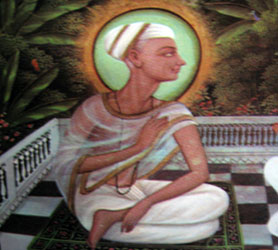
On a still night in the village of Deoban, in the country north of Delhi where the plains run up toward the Himalayan foothills, a young man kept vigil beneath a peepal tree outside his family's house. He was already restless with something the household could not name, an ache that had nothing to do with the stars his father read for the emperor's court or the Sanskrit grammar he had been drilled in since boyhood. That night, the story is told, Radha herself came to him in a dream and pointed to the topmost branch of the tree, where a single red leaf trembled though there was no wind. On it, she said, was written the Yugal Mantra, the sacred formula of the Divine Pair, and he was to take it and carry it to whatever rasik souls, whatever lovers of sweetness, he could find. He woke with the leaf's message burned into him as surely as if his hand had closed around it. No human guru had touched his forehead with ash or whispered a lineage into his ear. Radha had initiated him herself, and from that night the household's clever son became something the family had no word for: a man who now belonged, first and completely, to her.
He had been born, by the Bhaktamal's own reckoning, in Vikram Samvat 1556, which the calendars of the wider world place near the turn of the sixteenth century, in the small settlement of Baad not far from Mathura, where his father Vyas happened to be camped while accompanying the imperial court on the march. The family's true home was Deoban, in the Saharanpur country, and it was there the boy grew up under his mother Tara's watch, learning the astrology his father practiced for a living, the grammar and music and prosody that would later surface, transfigured, in his own verses. Nothing about his upbringing marked him out as unusual to the people around him. It was only the dream under the peepal tree that told a different story, one that would take years to fully declare itself.
He married, as was expected of him, a woman named Rukmini, and in time two sons and a daughter filled the house with the ordinary noise of family life. He kept every duty a householder owes: he did not abandon his wife's hearth or neglect his children's upbringing, and by all accounts he discharged the whole weight of domestic life without complaint. But something in him was already promised elsewhere. When, in the course of time, his parents died and his children came of age and were married into households of their own, he felt the last cord of ordinary obligation go slack. At thirty-two, owing no one anything, he set his face toward Vrindavan, the forest on the Yamuna where the old stories said Krishna had played as a boy, and began to walk.
He had not gone far when the second dream came, this one in a village called Charthaval near Muzaffarnagar. Radha told him that ahead he would meet a man named Atmadev, desperate to see his two daughters married, and that he was to accept them, and to accept, too, whatever else this stranger pressed into his hands. He woke not entirely understanding what he had been told, and understood only when he arrived and found Atmadev waiting, pleading with a wandering ascetic to take his daughters Krishnadasi and Manoharidasi as wives so that they would not go unsettled. Harivansh married them both. And with the marriage came something else: a small dark image of the flute player, an idol that Atmadev's family had kept for generations and that no one among them claimed credit for carving, said instead to have come down to them as an unearned gift. This was the image the world would come to know as Radha Vallabh, the Beloved of Radha, and it traveled the rest of the way to Vrindavan bound to a man who by then had three wives, no household of his own, and nothing left to protect except his devotion.
The Vrindavan he walked into was not yet a place of temples and pilgrims singing in the lanes. It was real forest, thorn and scrub along a wild stretch of the Yamuna, and by the account still told among his spiritual family, that stretch of ground answered in practice to a bandit chief remembered as Narvahan, a man travelers feared more than they feared the forest itself. One story that has stayed alive in the tradition tells of a merchant seized by Narvahan's men and held for ransom, until a servant girl who pitied him whispered that he should simply cry out the name Radhavallabh Shri Harivansh as loudly as he could. He did, more in desperation than faith, and when the cry reached the bandit's ears, Narvahan ordered the merchant released and his goods returned on the spot, so far had the fame of this penniless wanderer already traveled even among men who answered to no law but their own. In time, so the story continues, Narvahan came himself, laid down whatever violence had made him feared, and became a devotee, and it was his own wealth that raised the first stone walls of a temple to Radha Vallabh at the bend of the river known as Unchi Thaur, where Harivansh had first set the little image down inside a bower of woven creepers.
Other stories from that same settling-in have the flavor of a man mapping sacred ground with his own body. When the people of Braj pressed land on him, he is remembered to have refused to simply take it as property; instead he shot a single arrow and let it mark, by its own flight, the boundary of what would become his. It is said to have landed far off at what is still called Cheer Ghat, and the arc it traced is remembered as the outline of the five-kos circuit that pilgrims walk around Vrindavan to this day. Wherever he walked, forgotten corners of the old Krishna-lila are said to have resurfaced under his feet: Seva Kunj, Vamshivat, Dhira Samir, the still waters of Mansarovar. Whatever is legend and whatever is plain fact in these accounts, the effect attributed to him is the same: a wilderness turned, within his own lifetime, into a living map of the pastimes it had once only remembered in silence.
What he actually taught is harder to summarize than the stories about him, because it ran against the grain of much that passed, in his own century, for serious religion. He is remembered as unbound by the whole apparatus of do and do not, vidhi and nishedh, that governed most Vaishnava practice around him. He is said to have prized the grace of mahaprasad, food already touched and returned by the divine hand, more highly than the merit earned by a hundred kept fasts, valuing what love had already given a thousand times over what discipline still hoped to earn. This was not laxity so much as a different arithmetic of devotion: he seems to have measured a soul's nearness to God not by what it renounced but by what it had already, helplessly, been given. Underneath this was a theology as bold as anything in the devotional literature of his age. Where most of his contemporaries approached Krishna as the object of love and Radha as the path toward him, Harivansh reversed the current entirely. In his understanding, Radha herself was the one to be worshipped, the aradhya, and Krishna her most fortunate servant, drawn into her orbit rather than the other way around. It is why the very name of the deity he carried to Vrindavan announces whose side its founder is on: not Radha's Krishna, but Krishna as Radha Vallabh, the one beloved of Radha. His followers came in time to believe he must himself be the flute reborn as a man, because there is an old whispered understanding among rasik listeners that if you strip away everything else from the sound of Krishna's murali, what remains underneath is a single word repeated without end: Radha, Radha, Radha. A man whose every composition, whether it began with cows or clouds or the coming of spring, always somehow arrived back at her name alone, could hardly be anything else.
He left behind a small body of writing that his tradition still keeps close. The Hita Chaurasi gathers eighty-four verses in Braj Bhasha, sung rather than merely read, tracing the moods of the divine pair through the turning seasons. The Radha Sudha Nidhi, some two hundred and seventy Sanskrit couplets voicing the ache of a sakhi's devotion to Radha alone, is treasured by generations of rasik poets as a map of madhurya bhava, the sweetness-mood, regardless of exactly when in his life its verses first took shape. Alongside these stand the shorter Sphut Vani, a hymn to the Yamuna called Yamunashtak, and, more quietly moving than any of these, two ordinary letters that survive in his own hand, written to a disciple far off in Junagadh, a rare glimpse of a teacher's plain voice reassuring someone he could not see. He never took the ochre cloth of formal renunciation, and his household, three wives and the memory of children raised and settled, was not hidden or apologized for; it stood instead as his own argument that a life lived fully as a householder was no lesser path to the court of the divine pair, so long as the heart's real marriage had already been made elsewhere. Disciples such as Hariram Vyas carried his singing tradition forward, a distinctive style called Samaj Gayan that wove old Samavedic melodic threads into new devotional verse, still heard inside the Radha Vallabh temple. Under the eight-fold daily service he established, turning through the watches of day and night, no hour in that temple was ever left with the divine pair unattended, undressed, unfed, or unsung to.
Tradition holds that he did not die in any way his own community would call death. On the full moon night of the month of Ashwin, in a year the old reckoning places near the middle of the sixteenth century, he is said to have caught the scent of Radha's presence drifting from a grove near Mansarovar on the Yamuna's bank, and to have simply walked toward it and not come back, absorbed, as the story is told, into the very limbs of the Priya whose sweetness he had spent a lifetime trying to put into words. A disciple's lament from that time asks, in effect, who now will speak for Vrindavan's tenderness, now that the one voice that never tired of it has gone quiet. It is a fair question to sit with even now: a flute makes its music by being hollow, by having nothing of its own left to say, and the tradition that grew up around this particular flute insists that its single, endlessly repeated note is still there to be heard by anyone willing to listen closely enough, and to whisper the same name back.
Radha Is the Supreme: The Inversion That Changes Everything
In most of the Vaishnava world, Shri Krishna stands at the summit and Radha is understood as his beloved devotee. Shri Hit Harivansh Ji perceived it differently, and this difference was not a theological opinion but a direct seeing. He taught that Shri Radha is the param-tattva, the supreme reality, and that Krishna's own sweetness flows from her grace. The tilak commentary states it plainly: radhahi pradhan mane, pachhe krishna dhyaiye, hold Radha foremost and then contemplate Krishna. This is not a hierarchy of cold doctrine. It is the testimony of someone who had come close enough to the divine couple's eternal lila to see how presence and love are actually arranged. For the seeker who enters this tradition, the starting point is not a belief to be accepted but a fragrance to be recognized when one has been still enough to catch it.
Bhaktamal Tika (tilak commentary), verse 165; Radha Vallabh Sampradaya teaching tradition
Selfless Love: The Practice of Tat-Sukha Bhava
Shri Harivansh Ji's entire inner life was organized around a single orientation: not seeking one's own delight in the divine, but seeking the delight of the beloved. This is what the tradition calls tat-sukha bhava, the disposition of finding one's joy entirely in the joy of the other. He was described as supremely firm and tender in his devotion, ati sudriha, and the tilak says his heart held an unshakeable ananya bhakti, exclusive devotion, as its governing vow. Where some seekers approach the divine hoping to receive something, he approached as an attendant of the kunja, the sacred grove, whose quiet satisfaction was in witnessing the happiness of the divine couple. This orientation transforms every act of worship from a transaction into a gift. The seeker stops asking what they will receive and begins asking only how they can serve the joy that is already present.
Bhaktamal tikaEn commentary; Radhavallabh Sampradaya principle of tat-sukha bhava
The Path of the Sakhi: Entering the Lila as Companion
Shri Harivansh Ji's mode of inner worship was that of a sakhi, a confidential companion of Shri Radha. He did not come to the divine couple as a petitioner or a philosopher. He came as a trusted witness and servant of their intimate pastimes, their keli in the kunja. This sahchari-bhava, the companion mood, shaped every aspect of his practice. The Bhaktamal commentary says he gave special devotional attention to the kunja-keli, the delightful play of the divine couple in the forest bower, always approaching through the consciousness of a sakhi. In this tradition, the highest liberation is not dissolution into an absolute, nor residence in a remote heaven. It is simply this: to be present, always, as a companion in the bower where Radha and Krishna move through their endless, luminous, private play. The seeker's aspiration is not to escape the world but to enter the eternal one.
Bhaktamal tikaEn commentary; Bhaktamal tilak verse 165 (265)
Beyond Rules: The Inner Vow That Supersedes All Prescriptions
Shri Harivansh Ji was described as free from the fence of vidhi and nishedha, the ordinary framework of prescribed actions and prohibitions. The commentary says he did not give his attention to samanya dharma, common religious duty, because he lived entirely within bhagavata dharma, the law of pure devotion. This was not negligence or arrogance. It was the natural condition of someone in whom the inner flame of ananya bhakti was burning steadily enough to illuminate every path without the need for outer maps. The Bhaktamal notes that he considered bira prasada, the betel-leaf offering from the deity, a lakh times more nourishing than the Ekadashi fast. For one who has come into direct contact with the grace of the beloved, the outer structures of austerity become like scaffolding after the building stands. The seeker learns that rules exist to build the inner life, not to replace it.
Bhaktamal tikaEn commentary; tilak commentary on verse 165
Rasa as Direct Knowing: What the Hit Chaurasi Opens
Shri Harivansh Ji composed the Hit Chaurasi, eighty-four padas in Braj Bhasha that remain among the most intimate devotional poetry in the language. Each verse opens a small door into the kunja. The imagery is precise: a particular quality of light in the grove, the sound of anklets on stone, the scent of a garland moving from one hand to another. These are not poetic metaphors. In his perception, they are faithful descriptions of what became visible when meditation had given way to something more direct: the eternal lila perceived as present. The tradition he established understood rasa, divine flavor or aesthetic bliss, as a genuine mode of knowing, not ornamentation but the very medium through which the deepest truths are transmitted. To read the Hit Chaurasi with a prepared heart is not to read about devotion. It is to taste a small portion of what he tasted continuously.
Hit Chaurasi (84 padas); Bhaktamal tikaEn commentary on Hita Harivansh
Hindi text from OCR scan (Khemraj Shrikrishnadas Prakashan, CC0). May contain errors.