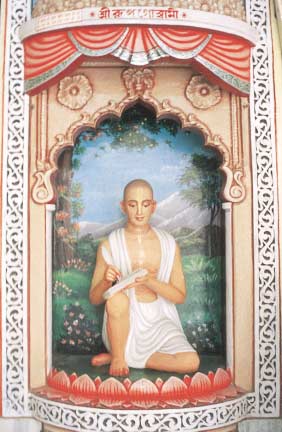
English rendering in progress
( ४४५ ) छप्पय | ( ३६८ ) संसारस्वादसुख बांत ज्यों, हुहूँ रूप,, सनातन, त्यागि दियों॥ गोंडदेश बंगाल हते सबही अधिकारी । हय गय भवन भंडार बिभों भ्रूघ्गनज उनहारी ॥ यह
The lamps in the treasury hall at Gauda had been refilled twice, and still the coins would not stop coming. Sanatana sat over the great ledger with his clerks nodding at his elbow, running silver and gold through his fingers by candlelight, weighing out what belonged to the Sultan against what had arrived that season from a hundred estates. Somewhere past midnight he lost his place in the column and had to start again. By the time the call to dawn prayer drifted up from the city and grey light came over the river, an entire night had gone by in nothing but counting. He would say afterward that this was the night something in him finally gave way, not from tiredness but from a disgust that had been building for years: all that wealth passing through his hands, none of it his, none of it meaning anything beyond the next tally. He was, at that time, one of the two or three most powerful officials in Bengal. It had done him no good at all.
He and his younger brother Rupa had risen about as high as two brothers of a Vaishnava Brahmin family could rise. Their father, Kumaradeva, had brought the household down from Karnataka a generation earlier and settled in Bengal, and by the reign of Nawab Hussain Shah at Gauda, Sanatana held the office of Sakar Mallik, the minister who kept the treasury, while Rupa served as Dabir Khas, the Sultan's private secretary and closest confidant. A third brother, Anupama, moved in the same circles. Between them they commanded elephants, horses, granaries, walled houses, more storerooms than any family could use in a lifetime. Two generations later, Nabhadas would sum up that entire glittering existence in one line of Hindi: they let it go the way a man spits out a mouthful whose taste has turned on him.
What finally moved them was not argument but a dream, the same dream, arriving in both their sleeping minds on the same night. A wandering renunciate stood before each of them and said, in words neither brother could afterward repeat exactly the same way, that all this opulence was a distraction, that their real work was to give their lives to the glory of Krishna. They woke separately, found each other before sunrise, and discovered with a kind of vertigo that they had dreamed the identical dream. Not long after, word reached them that a sannyasi from Nabadwip named Krishna Chaitanya, already spoken of as an incarnation of divine love itself, was passing through Ramakeli on his way toward Vrindavan. The brothers went out to find him under a stand of kadamba and tamal trees by a small tank of water. When Chaitanya looked at them he did not use their court titles. My dear Dabir Khas, he said to Rupa, and My dear Sakar Mallik to Sanatana, you two are My own old servants, returned to Me by a strange road. From this day your names are Rupa and Sanatana. Whatever they had been called at court fell away in that moment like a garment.
Rupa moved first, and fast. He divided his considerable fortune three ways, one portion for his family's needs, one for brahmanas and Vaishnavas and the poor, one set aside against emergency, and set out to catch up with Chaitanya again. He found Him at Prayag, at the Dashashvamedh Ghat, and for ten days the Lord kept him close and spoke to him privately about the deepest matter in Gaudiya theology: the nature of Krishna, the nature of bhakti, and finally the nature of rasa itself, the many flavors of devotional relationship culminating in the madhurya rasa, the conjugal sweetness between Radha and Krishna. Tradition remembers that at some point in that meeting Rupa composed two verses on the spot, verses so exact in their understanding of divine love that Chaitanya, hearing them, could not stop Himself: He clapped a hand over Rupa's mouth in astonishment, then embraced him and wept. Go to Vrindavan, He told him. Recover what has been lost there.
Sanatana's road out was not so clean. Hussain Shah refused to accept his resignation and ordered him back into service, insisting he accompany an army being readied against Orissa. Sanatana stopped appearing at court and claimed illness. The Sultan sent his own physicians, who examined him and reported that there was nothing wrong with him at all. Then the Sultan came himself, sat with his old minister, and pressed him plainly: continue your service, come with me on this campaign. Sanatana refused. For that refusal he was thrown into prison and held there while the machinery of the state waited for him to change his mind.
He did not change his mind. Word reached him in his cell that Chaitanya had already left Puri for Vrindavan and that Rupa and Anupama meant to meet Him there, and with that news something in Sanatana became immovable. Using money his brothers had smuggled to him for exactly this purpose, he bribed his jailer, who cut his chains in the dark and let him slip down to the riverbank. His brother-in-law Srikanta was waiting there with a boat and a warm woolen blanket against the night cold, and helped him across the Ganges before the household could raise an alarm. Behind him lay a ministry, a fortune, a name known across the province. Ahead of him lay an overland route through wild country that most travelers of the time went out of their way to avoid.
That route led through the Jharikhand forest, a stretch of jungle and back trails across Bihar with a poor reputation among ordinary pilgrims, and it cost him. Bad water and irregular food brought on a painful skin ailment that left him covered in weeping sores by the time he reached the outskirts of Varanasi, filthy, his hair and beard long uncut, carrying nothing but a beggar's pot. He learned there that Chaitanya, too, had come to Kashi. When the two finally met again, the Lord's eyes kept drifting, again and again, to the one fine thing Sanatana still owned: Srikanta's blanket. Sanatana understood the look without being told anything. He went down to the Ganges the next morning, found a wandering mendicant from Bengal drying a threadbare, patched quilt in the sun, and talked the bewildered man into trading it for the good woolen blanket. When Chaitanya heard what he had done, He said that Krishna is like a skilled physician who, having decided to cure a disease, does not permit even the faintest trace of it to remain in the body.
For the better part of two months after that, at the same Dashashvamedh Ghat, Chaitanya sat with Sanatana each day and answered the one question Sanatana had carried out of that prison cell and through that jungle: who am I? Out of that long conversation came the entire architecture later known in Gaudiya thought as sambandha, abhidheya, and prayojana, the soul's true relationship to Krishna as His eternal servant, the practice that restores that relationship, and the love that is its final fruit. Sanatana absorbed it the way a dying man drinks water. It was during this same period, by most tellings, that his skin disease grew worse rather than better, weeping and raw, so that he began refusing Chaitanya's embrace out of shame at what his own body might leave on the Lord's skin. Chaitanya would not be refused. He held Sanatana close by force, more than once, and after one such embrace the disease simply did not return. Later, at Puri, when despair over his own ruined-looking body and a lifetime spent amid worldly power pressed in on him hard enough that he considered ending it beneath the wheels of Jagannath's chariot, Chaitanya stopped him with a single reproach: this body is no longer yours to destroy, He said, you gave it to My service the day you crossed that river; there is too much work left in it. Go to Vrindavan and dig up what has been buried.
Vrindavan, when the two brothers finally reached it, was not a holy city. It was a scattering of huts and cow pasture, a handful of families, forest closing in on every side, and almost nobody living there had any idea that this ordinary-looking ground had once held the entire childhood of Krishna. Rupa and Sanatana set about proving otherwise. They walked the region on foot, asking, listening, cross-checking against the Bhagavata Purana verse by verse the way Shukadeva had once described it, and slowly the lost tirthas of Vraja began to surface: the groves, the ghats, the sites of half-remembered episodes that local memory alone had kept faintly alive. In their own daily lives they kept nothing beyond a kaupin and a single wrap of cloth. They ate by madhukari, the bee's method, taking a small unasked portion from many households rather than a full meal from one, slept most nights wherever a kunja offered shelter rather than under any fixed roof, and are remembered to have been content with whatever came and untroubled by whatever did not. Their old titles, their old wealth, their old names, none of it followed them into the forest.
Even inside that austerity, Krishna kept finding them. Sanatana one day received a Deity called Madana-mohana from a Mathura brahmana who could no longer look after Him properly; overjoyed but painfully poor, Sanatana could offer the Deity nothing grander than a dry chapati begged that morning, without so much as a pinch of salt to season it. When the Deity, in the intimate way Gaudiya tradition allows its Lord to complain, asked why He was never given even salt with His bread, Sanatana answered without apology that if he gave salt today, ghee would be wanted tomorrow, and rich food the day after, and he was a beggar with scripture still to write, not a cook. Krishna, by every account, ate the dry chapati anyway and did not ask again; a wealthy trader whose boat later stuck on a sandbar near Vrindavan prayed to that same Deity out of desperation, was freed, and built Him in gratitude the stone temple that still stands on the hill above the Yamuna. Rupa, searching for the original worship-seat of another form of Krishna known as Govindaji, walked the same ground for months without success until, worn down and in tears by the riverbank, he was approached by a Vrajavasi boy who told him a certain cow came each day to a mound nearby and emptied her milk into a hollow in the earth. Rupa dug where the boy pointed and found the Deity. Decades afterward, Raja Man Singh, a general under Akbar and himself devoted to Govindaji, built the great red sandstone temple that would house that same discovery.
Between begging rounds and pilgrimage-mapping, the two brothers wrote. Rupa produced Bhakti-rasamrita-sindhu, the systematic map of devotion from its first stirring of faith to its highest ecstatic love, along with Ujjvala-nilamani on the conjugal rasa specifically, and two Sanskrit dramas, Vidagdha-madhava and Lalita-madhava, staging Krishna's play in Vrindavan and Dwaraka. Sanatana, working alongside his godbrother Gopala Bhatta, compiled the Hari-bhakti-vilasa, the manual that still governs how Gaudiya Vaishnavas conduct daily worship, and wrote the Brihad-bhagavatamrita along with a commentary on the tenth canto of the Bhagavata Purana. Their youngest brother Anupama did not live to see Vrindavan himself, but his son Jiva made his way there as a young man to study under his uncles, and in time Rupa handed over his own unfinished manuscripts to that nephew with instructions to complete them, a trust Jiva more than repaid, becoming after his uncles' deaths the acknowledged head of the whole community that had grown up around them.
Of the depth of Rupa's absorption in that inner world of prema, one story kept alive in the tradition itself is worth telling exactly as it has come down. One night, during a kirtan so intense that the whole assembly around him had lost ordinary awareness of their bodies, Rupa stood frozen upright in trance, breathing but otherwise as still as wood. A visiting devotee, curious to see him up close, came near enough that Rupa's breath touched his skin, and it left him blistered, as though he had leaned too close to a fire. Nobody present could fully account for it. It was, they agreed, simply what love at that pitch does to the air around it.
Sanatana is remembered to have left his body in 1558; Rupa followed him some six years later, in 1564, said to have been about seventy-three. Both are still honored today with samadhi shrines in the courtyard of the Radha-Damodar temple in Vrindavan, the very ground they once walked as strangers asking local cowherds where things used to stand. Nabhadas, closing his own six lines on them, called them simply the acharyas of Radha-Krishna rasa, the ones who opened the gate to that sweetness for everyone who came after. It is not a small claim, and the two men who earned it began as a treasurer who could not stop counting coins and a secretary who could not stop drafting orders for a throne that meant nothing to him. What they found on the far side of that emptiness was not less than what they had given up. Anyone who has ever sat late at a desk doing work that adds up to nothing, and felt that same disgust rise in the chest that Sanatana felt over his ledger, has already met the beginning of their story.
The Night of the Coins
Rupa and Sanatana Goswami were ministers of great power in the court of Nawab Hussain Shah, holding titles, armies, treasuries, and estates. One night, counting rupees by lamplight, the two brothers watched an entire night slip away in the service of numbers. When dawn crept under the door, they looked at each other in silence. What passed between them needed no words: this anitya-sukha, this perishable happiness, was not happiness at all. It was a beautiful cage. That recognition broke something in them that could not be repaired. The world, with all its weight and splendor, had grown thin. They were ready to leave it. Sometimes what liberates us is not a great vision but simply seeing, with clear eyes, what we have been trading our nights for.
Bhaktamal, Tilak commentary (tikaEn)
Yatha-Labha-Santosh: Contentment with Whatever Comes
When Rupa and Sanatana arrived in Vrindavan, they brought nothing but a water-pot and a kaupina each. They had managed the resources of a kingdom; now they managed nothing. They slept under trees. They ate when food came and continued their work when it did not. This practice is called yatha-labha-santosh: deep contentment with whatever Providence brings, neither seeking nor refusing. It is not poverty as punishment. It is poverty as freedom. The two brothers had proven, by living it, that the greatest spiritual work in the history of Gaudiya Vaishnavism could be done by those who own nothing at all. The inner richness they carried was not diminished by the absence of outer resources. It was, in fact, made possible by it.
Bhaktamal, Tilak and Tika commentaries
Uttama Bhakti: Pure Devotion Without Motive
Rupa Goswami's most foundational teaching, set out in the opening verses of the Bhakti-rasamrita-sindhu, is the definition of uttama-bhakti: pure devotion. He writes that the highest devotional service is offered to Sri Krishna favorably, with no desire for the fruits of karma, and without being colored by the pursuit of knowledge alone. Most of what passes for devotion in the world carries a thread of want inside it. We want protection, comfort, merit, liberation, or at least the feeling of being good. Rupa Goswami asks: what remains when all of that is set aside? What remains is a love that serves the Beloved simply because the Beloved is who He is. That love, says the Bhakti-rasamrita-sindhu, is the whole ocean the scripture is describing.
Bhakti-rasamrita-sindhu of Rupa Goswami, opening definition
Recovering the Lost Land of Vraja
When Rupa and Sanatana Goswami arrived in Vrindavan under the instruction of Sri Krishna Chaitanya Mahaprabhu, the sacred landscape described in the Shrimad Bhagavata was essentially lost. The forests remained, the Yamuna moved as always, but the specific tirthas, the spots where Krishna had played and loved and revealed himself, lay buried under centuries of neglect. The two brothers walked the land. They identified the holy sites. They restored what the texts described, guided by inner recognition and divine grace. They showed, as Shri Nabha Swamiji writes in the Bhaktamal, that Vrindavan was exactly as Shukadeva Swami had sung it. The teaching for us is this: the sacred is rarely lost. It is waiting, just beneath the surface, for hearts humble enough and steady enough to find it.
Bhaktamal, Tilak commentary; tikaEn
The Books That Changed the World
Sanatana Goswami compiled the Hari-bhakti-vilasa, the foundational manual of Vaishnava practice, codifying how a devotee lives, worships, and takes shelter of the Lord each day. Rupa Goswami wrote the Bhakti-rasamrita-sindhu, mapping the entire inner journey from first faith to the summit of mahabhava. He wrote the Ujjvala Nilamani on the depths of madhurya-rasa, the conjugal love of Radha and Krishna. He wrote plays, treatises, devotional poetry. The Bhaktamal says that when one enters even a single point of these texts with mind and intelligence, the body breaks into goosebumps and the eyes overflow with tears of love. These works were not composed as scholarly exercises. They were composed from within the experience they describe. That is why they still carry heat after five centuries.
Bhaktamal, moolHi; tikaEn; Bhakti-rasamrita-sindhu
The Burning of Prema
One evening Rupa Goswami was present in a kirtan assembly where the name, form, qualities, and glories of Sri Hari were being sung. The devotion in the room grew so intense that the entire assembly fell into unconsciousness, overcome with prema. Rupa Goswami, a man of great composure, remained standing. But when another devotee came close and felt the breath rising from his body, blisters appeared on the skin from the heat. Rupa Goswami had contained what others could not contain. What burned inside him was no cooler for the containment. This is the nature of true love of God: it does not announce itself loudly. It burns inward, quietly, until the body itself becomes its evidence. Depth and silence go together.
Bhaktamal, tikaEn; Tilak commentary on Doha 356
Hold to the Path of Vairagya
Once, Rupa Goswami traveled to visit Sanatana with the intention of offering an elaborate meal to Sri Yugala-sarkara, the Divine Couple, and sharing that prasada with his elder brother. The wish had barely formed when Shrimati Radhika herself, taking the form of a young girl, arrived at the door with all the ingredients. Sanatana cooked, the offering was made, and when both brothers tasted the prasada an extraordinary luminous bliss arose in them, unlike ordinary experience. When Rupa asked the cause and Sanatana explained, Rupa said simply: this must never happen again. Hold firmly to the path of vairagya, detachment. Do not seek the extraordinary moment. The Ladiliji had graced them, and they received that grace with tears of love and then returned immediately to the discipline of renunciation. The teaching is clear: the path is not about collecting peak experiences. It is about remaining so transparent to the Lord that each moment can move through without obstruction.
Bhaktamal, tikaEn; Tilak commentary on Doha 356
Hindi text from OCR scan (Khemraj Shrikrishnadas Prakashan, CC0). May contain errors.