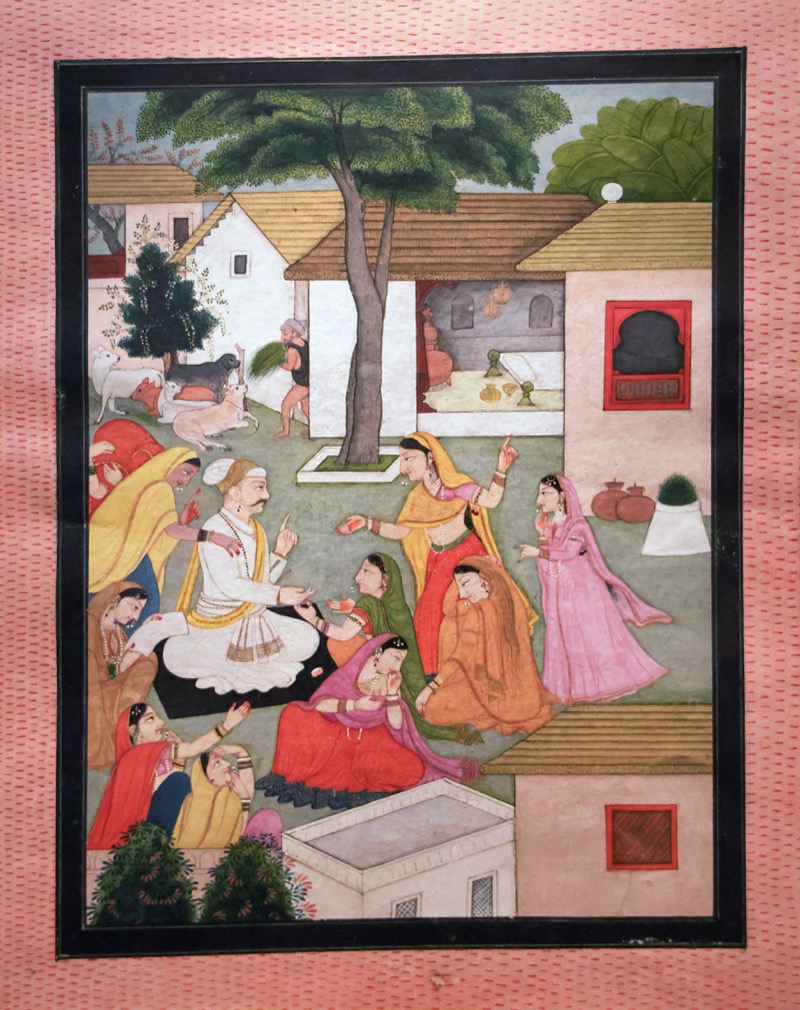
The cowherds of Vraja saw the chariot coming down the dust road from Mathura and their hearts leapt before their eyes had even made out the rider's face, because the man standing in it held himself exactly the way Krishna held himself, and for one unbearable heartbeat the whole pasture believed their Kanha had come home. Then the chariot drew close enough to see plainly, and it was not Krishna. It was Uddhava, Krishna's cousin and dearest friend, so like him in bearing and feature that strangers sometimes could not tell them apart, but the gopis of Vraja could tell the difference in an instant, because love always can. Their faces, which had opened in joy, closed again into the old grief they had been carrying since the day Krishna's chariot had left for Mathura and never come back. That single scene, the resemblance that raises hope and the recognition that crushes it, is where the story of Uddhava truly begins for anyone who wants to understand him, because everything else he ever did, his learning, his closeness to Krishna, his final teaching, only matters against the backdrop of that morning when the wisest man at Krishna's court had to stand in a field of weeping women and realize that he had brought them the wrong medicine.
By birth Uddhava belonged to the inner circle of the Yadu race itself. Tradition holds him to be the son of Devabhaga, a brother of Vasudeva, which made him first cousin to Krishna on the paternal side, raised inside the same Vrishni clan, moving in the same court at Mathura and later at Dwaraka. He was, by every account that has come down about him, extraordinarily gifted: a disciple of Brihaspati, the guru of the gods, and reckoned among the Vrishnis as their most trusted minister, a man the elders of the clan turned to for counsel the way one turns to a lamp in a dark room. He was not a renunciate by temperament. He was a scholar, a statesman, a man who could out-argue almost anyone in the assembly hall, and it is precisely because Krishna knew this about him, knew the strength and the limits of that kind of mind, that Krishna chose him, and no one else, for the errand to Vraja.
The errand itself was simple to state and almost impossible to carry out. Krishna had gone to Mathura to end the tyranny of his uncle Kamsa, and after that there had been no road back to the pastures where he had grown up stealing butter and dancing under the flowering kadamba trees. Nanda and Yashoda were aging without him. The gopis, the cowherd women who had loved him with a love that asked nothing and forgave everything, were wasting into shadows of themselves, singing his names to the cows, weeping into the Yamuna at dusk. Krishna could not go back himself, so he sent his cousin instead, and he sent him with a teaching: tell them, he said in effect, that I am not confined to this body they remember; I am the unborn, undying witness seated in every heart, nearer to them than their own breath, and if they understood this rightly they would see there is no separation to grieve at all. It was, by any measure, a magnificent piece of philosophy. It was also, as Uddhava was about to discover, entirely beside the point.
The gopis received him with a courtesy that had teeth in it. They did not dispute his logic, because they were not interested in logic. Instead, tradition remembers, one among them noticed a black bee circling near her and began speaking to the insect instead of to Uddhava, using it as a stand-in for Krishna and, by extension, for the polished messenger who had been sent to defend him. If you have come from that connoisseur of women in Mathura, she said in effect, keep your flattering words for someone he has not already abandoned; a bee, after all, drinks the honey of one flower and is gone to the next before the flower has even closed. Others joined her, turning Uddhava's careful lesson on the omnipresence of the Supreme back on itself with a kind of merciless wit: if your lord is truly everywhere, they said, then he is here in the shape of our grief too, and that grief is the only philosophy we require. In the Sanskrit text this voice belongs to gopis left mostly unnamed, one chorus among many; in the Braj devotional tradition that grew up around this scene for a thousand years afterward, above all in Surdas's celebrated Bhramar Git, that sharpest and most heartbroken voice is given a name, and the name is Radha's.
Uddhava had arrived expecting to teach. He left, by his own admission, having been taught. He had spent a lifetime mastering Vedanta and Sankhya under Brihaspati himself, and here were women who had never opened a scripture, whose entire theology consisted of the memory of a flute heard once at dusk, and their love for Krishna made his own understanding look thin by comparison. He said as much, in words the tradition has cherished ever since: that the wisdom of yogis and ascetics meant little to him now, that he envied not Lakshmi on Vishnu's breast but the dust these women's feet, and that if he could ask for one boon it would be to be born again in Vrindavan not as a man at all but as a shrub, a blade of grass, or a tuft of some humble forest creeper, so that when the gopis walked to the river for water their feet might sometimes brush him and their footdust, the same dust their Kanha's feet had also touched, might finally fall on his head. A minister of the Vrishnis, a scholar trained by the teacher of the gods, kneeling in his heart before cowherd women and asking to become grass under their feet: it is one of the most complete reversals in the whole literature of bhakti, and it is why Uddhava is remembered less for his learning than for the moment he was glad to lay that learning down.
Some retellings say he lingered in Vraja for months after that, unable to tear himself away, listening to Yashoda's stories of Krishna's childhood and to Nanda's quiet, uncomplaining sorrow, before duty finally called him back to Dwaraka a changed man. What is certain is that he carried Vraja inside him for the rest of his life, and that this humbling was not a detour in his story but its center, the thing that made him fit, later, to receive the last and greatest teaching Krishna would ever give.
That teaching came many years afterward, when the glittering city of Dwaraka had begun to fill with omens no one could any longer explain away. The Yadu princes, drunk and reckless, had provoked a curse from a company of sages, a curse that an iron pestle would be born among them and would end their entire race; rats gnawed the fletching of arrows in their quivers, vultures gathered on golden rooftops, and Krishna, who alone among them understood what was coming and why it had to come, chose this moment to sit privately with Uddhava and speak to him as he had never spoken before. Over what tradition preserves as many long chapters near the end of the Bhagavata Purana, sometimes called the Uddhava Gita and elsewhere the Hamsa Gita, Krishna laid out for his cousin the whole architecture of liberation: the nature of the self that is never born and never dies, the paths of knowledge and of disciplined action, and above all the supremacy of bhakti, loving devotion, as the surest of all of them. He taught partly through direct instruction and partly the way he loved best to teach, through story: at one point in these discourses he tells of a wandering avadhuta who had found twenty-four teachers in the world without ever entering a classroom, the patient earth, the restless wind, a moth destroyed by the very flame it could not stop loving, a bee that gathered honey it would never taste, a young girl alone in her house whose bangles clashed and gave her away, each one silently teaching a seeker willing to watch closely enough to learn.
Beneath the philosophy ran a harder and more personal purpose. Krishna knew that within days the Yadu princes would march to Prabhasa on the shore of the Saraswati, drink themselves into a killing rage, and tear each other apart to the last man with the very iron shards born of that curse, Balarama's brother among them, the whole golden dynasty devouring itself in an afternoon. Uddhava alone of the Yadus, purified now by everything Vraja and Krishna between them had taught him, was spared from that slaughter. Krishna would not let him stay and die with the others, and he would not let him die by his own hand out of grief either, though Uddhava begged to be allowed to follow his Lord into whatever came next rather than live on without him. Go north, Krishna told him, to Badarikashram in the high Himalaya, and hold what I have given you in your heart until you are free of the body entirely. It is a scene almost too tender to read without a catch in the throat: God commanding his dearest friend to survive him, because that friend still had work left to do that even death should not be allowed to interrupt.
Uddhava obeyed, but obedience did not silence love. On the road north he heard what had befallen the Yadus at Prabhasa, and rather than pressing on he turned back, unable to bear not knowing, and there on the empty shore of the Saraswati he found Krishna alone at last, seated in yogic stillness beneath a tree, the massacre finished and the great city already beginning to sense what was coming for it too. What passed between them there, tradition treats as sacred rather than reportable in full, but Uddhava received it, wept, and turned north again, and it is said that soon afterward a hunter named Jara, mistaking a glint of Krishna's foot in the undergrowth for a deer, loosed the arrow that let Krishna leave his body and this world altogether.
Somewhere on that long walk north, at a meeting place where the rivers run toward the Himalaya, Uddhava crossed paths with Vidura, who had himself been wandering the length of India in a pilgrim's grief, not yet knowing what had become of the family and the Lord he loved. The two men, kinsmen and old friends both devoted to the same cousin, embraced on the riverbank, and it was there, choking on his own tears, that Uddhava first spoke aloud everything Krishna had told him: the fall of the Yadus, the departure of the Lord, and beneath both griefs, patient and unshaken, the entire teaching on the self and on bhakti that Krishna had entrusted to him for exactly this purpose, to be carried onward by a grieving man to another grieving man until it reached everyone still living who needed to hear it. Through that riverbank conversation, tradition holds, the last teaching of Krishna passed out of the dying Yadu world and into the world of ordinary seekers, where it has stayed. Uddhava himself continued on to Badarikashram, took up the austerities Krishna had prescribed for him, and is remembered to have attained, in that high solitude, the very absorption in the Supreme that his own learning had once made him proud of and that a field full of weeping cowherd women had first taught him he did not yet possess.
Nabhadas, singing the roll call of Hari's beloved ones, names Uddhava in the same breath as Akrura and Sudama, as Vidura and the five Pandavas, as Kunti and her stricken daughter-in-law Draupadi whose honor Krishna guarded when Duhshasana tried to strip it from her, as Gajendra the elephant king and the very crocodile that once seized his leg in the river: a garland of very different souls strung on a single verse, each one complete on its own terms. It is a fitting company for Uddhava to keep, because his own story is really one long meditation on the same truth that runs through all of theirs, that the love of God cannot be earned by cleverness and is not the private property of scholars, that a bee's flattering hum is worth less than a single tear shed for the Beloved, and that the wisest thing the wisest man in Krishna's court ever did was to ask, quite sincerely, to be reborn as the dust under someone else's devoted feet.
The Gopis' Love Surpasses All Philosophy
Uddhava arrived in Vrindavana carrying the finest tools of Vedantic knowledge. He knew that the Absolute pervades all things, that the self is eternal, that attachment to any single form is a limitation. He was prepared to console the gopis with these truths. But the gopis did not argue with him. They simply loved. One of them addressed a passing black bee as if it were Krishna's messenger, pouring out her grief in the Bhramara Gita, the Song of the Bee. Uddhava stood there and discovered that a love which does not want to be consoled, because it is already complete in itself, cannot be reached by philosophy at all. The gopis were not on a path toward God. They were already arrived. What Uddhava witnessed in Vrindavana was this: knowledge without love is a lamp without oil. Bright for a moment, then dark.
Srimad Bhagavatam 10.47 (Bhramara Gita)
True Humility Is Earned, Not Performed
After six months in Vrindavana, Uddhava made a single prayer. He did not ask for liberation. He did not ask for greater knowledge or closeness to Krishna. He prayed to be reborn as a creeper, a blade of grass, or an herb along the pathways of Vrindavana, so that the gopis might walk over him and the dust of their feet might settle on his head. This was Uddhava at his most genuine. Before the gopis, his scholarship, his proximity to Krishna, his reputation as the wisest man in Dvaraka: all of it was revealed as a lesser thing. Real humility is not practiced as a virtue. It arises spontaneously when one comes face to face with something greater than oneself. The seeker who encounters a love far beyond their own capacity can only bow down and ask to receive even the dust of that love.
Srimad Bhagavatam 10.47.61
The River That Reaches the Ocean Does Not Return
One gopi spoke quietly to Uddhava. She said that her mind had gone to Krishna and would not come back, the way a river that has reached the ocean does not return to its source. She did not debate him. She did not claim that his teaching was wrong. She simply described where she was. This image holds a teaching for the seeker on the devotional path: there comes a point in love where the question of whether to love, or how to love, or why to love, simply disappears. The current has carried you all the way. From the outside this may look like stubborn grief. From the inside it is rest. Uddhava spent his career cultivating detachment. The gopi showed him that a love so total it leaves no remainder behind is not attachment at all. It is a different kind of freedom.
Srimad Bhagavatam 10.47
The Wisest Student Knows When to Stop Teaching
Uddhava was sent to Vrindavana to console and instruct. He arrived as a teacher. He left as a student. The tradition marks this transition not as a failure but as the highest kind of success available to a learned person: the willingness to be completely undone by something one did not expect to find. For six months he watched the gopis weep without embarrassment, address the trees and the river Yamuna and the peacocks as though each one held a fragment of Krishna, and refuse to let their grief become philosophy. He could not leave. Something in him knew that what was happening in front of him was more important than anything he had come to say. The teaching for every seeker is this: bring your best understanding to every encounter, and then remain open to the possibility that what you encounter will dissolve your best understanding and offer you something truer.
Srimad Bhagavatam 10.47; Bhaktamal tika
Knowledge and Love Are Not Two Separate Rivers
Uddhava was the most learned man in Dvaraka. The gopis of Vrindavana could not have named a single philosophical text. Yet the Bhagavata Purana places them above the greatest scholars, saying that even Brahma and Lakshmi could not obtain the grace the gopis obtained. Uddhava's life is the tradition's way of saying that these two facts are not in conflict. He did not abandon his learning when he understood the gopis' love. He allowed his learning to be completed by it. Jnana and bhakti, knowledge and devotion, are not rivals. They are two streams that must eventually find the same ocean. But the gopis showed Uddhava which one runs deeper. The seeker who trusts only the mind will build walls of concept where a door of love would have served far better.
Srimad Bhagavatam 10.47; Uddhava Gita, Canto 11
Separation Can Be Its Own Form of Union
The gopis never stopped loving Krishna after he left Vrindavana. They did not recover. They did not find peace through acceptance or redirection of feeling. Every kadamba tree, every passing cloud, every black bee recalled him to them. And yet the Bhagavata presents their state not as a wound but as an attainment. The ache of their longing was itself the shape of their devotion. Uddhava saw this and slowly understood: viraha, the pain of separation, is not the absence of love. For the gopis it was love's most concentrated form. The beloved fills the entire space left behind. Every object becomes a doorway. Every moment of longing is also a moment of remembrance. The seeker who finds that missing God burns more fiercely than the one who feels comfortably close to him has not lost the path. He has found its sharpest edge.
Srimad Bhagavatam 10.47; Bhaktamal tika on Uddhava
To Serve the Servants of God Is the Highest Aspiration
Uddhava's final prayer was not to be equal to the gopis. It was to be beneath them, literally: a creeper they might tread upon, a blade of grass that might receive the dust of their feet. He did not ask to stand beside them or to be included in their circle of intimacy with Krishna. He asked to serve the ground they walked on. This is the teaching of the servant of the servant, which later traditions of Vaishnava devotion would develop into a formal principle. The gopis served Krishna. To serve them, even in the most ordinary way, to receive even the dust of their path, was to Uddhava's mind a fortune greater than anything his years of study and proximity to Krishna had brought him. Closeness to those who love God purely is itself a form of grace. The seeker does not need to leap all the way to the summit. Standing in the shadow of those who have is already a gift.
Srimad Bhagavatam 10.47.61; Bhaktamal tika
Hindi text from OCR scan (Khemraj Shrikrishnadas Prakashan, CC0). May contain errors.