The Song Enters the Common Tongue
Bala Kanda, Shloka 7
Mangalacharan Shlokas 1–7 · Movement 7 of 7
Keep this contemplation
Preserve, print, or share
Ancient streams converge around Tulsidas as he prepares to begin. The Vedas descend with their primordial resonance. The Puranas carry memories across the ages. The Agamas preserve the ordered ways of worship, and Valmiki's Ramayana moves among them like a mighty river whose course is already known across the sacred land.
Tulsidas stands beside these waters in humility. He has not come to silence the older voices or claim their authority as his own. He gathers from them with joined hands, drawing their current toward the language heard in village lanes, temple courtyards, kitchens, fields, and crowded markets. The story of Raghunath will travel where learned speech alone may never reach.
The undertaking is immense, yet its first purpose is intimate. He writes for the joy of his own heart. Before the Manas becomes a scripture recited beneath countless roofs, it is one devotee preparing an inner dwelling for Ram. The reed is lifted. Familiar speech waits to receive an immeasurable story.
The reed touches the page, and the story of Raghunath enters the speech of the people.
Read the passage from the Manas
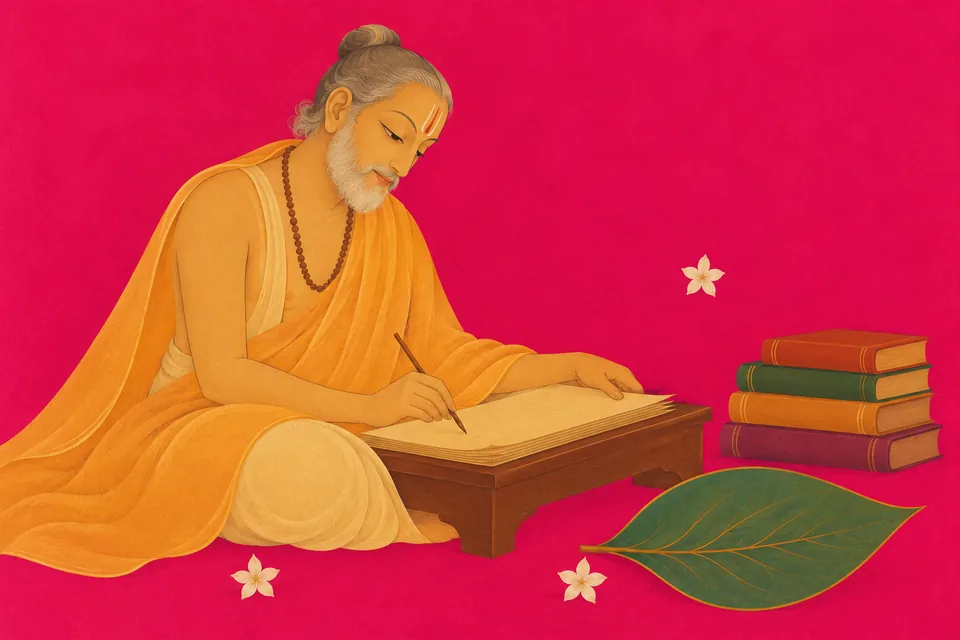
AI-created devotional illustration · Shloka 7
Imagined portrait of Tulsidas composing beside a blank manuscript and closed books, against a quiet pink field.
Source reference and artistic choices
Gita Press code81 undated · PDF pages 20 · printed pages 18. Reader passage: bala-kanda-shloka-007. Printed numbering may differ.
Source facts
- Tulsidas composes Raghunath story in common speech for inward joy
- Sources named Puranas Vedas Agamas Ramayana and elsewhere
Artistic choices
- Imagined author portrait, age appearance, pose stylus blank manuscript closed books and leaf; no documented location claimed
An imaginative interpretation, not a historical portrait or documentary evidence.
नानापुराणनिगमागमसम्मतं यद् रामायणे निगदितं क्वचिदन्यतोऽपि। स्वान्तःसुखाय तुलसी रघुनाथगाथा- भाषानिबन्धमतिमञ्जुलमातनोति।।7।।
That which is affirmed by the various Puraanas, the Vedas, and the Aagamas, that which is told in the Raamaayan and gathered from other sources as well: for the joy of his own heart, Tulasee now weaves this most beautiful composition in common speech, the story of Raghunath.