A Master Cannot Battle His Servant
Bala Kanda, Doha 281
Doha 281 · Movement 2 of 2
Keep this contemplation
Preserve, print, or share
Ram asks how battle can exist between a master and his servant. If Parashurama accepts the relationship Ram offers, combat loses its ground before any weapon is raised.
Let the best of Brahmins release anger. The apparent offence arose because the sage saw youthful form and the younger prince answered from childhood's fearlessness. A child should not bear final blame.
Ram neither disputes Parashurama's power nor defends his own deed through power. He changes the relationship in which the conflict is understood. Enemy becomes servant, challenger becomes child, and fury is invited to remember the Brahmin beneath the warrior. The offer is not weakness. It is a doorway out of violence that leaves honour intact.
Ram removes the enemy from the encounter and leaves Parashurama facing only a servant and a child.
Read the passage from the Manas
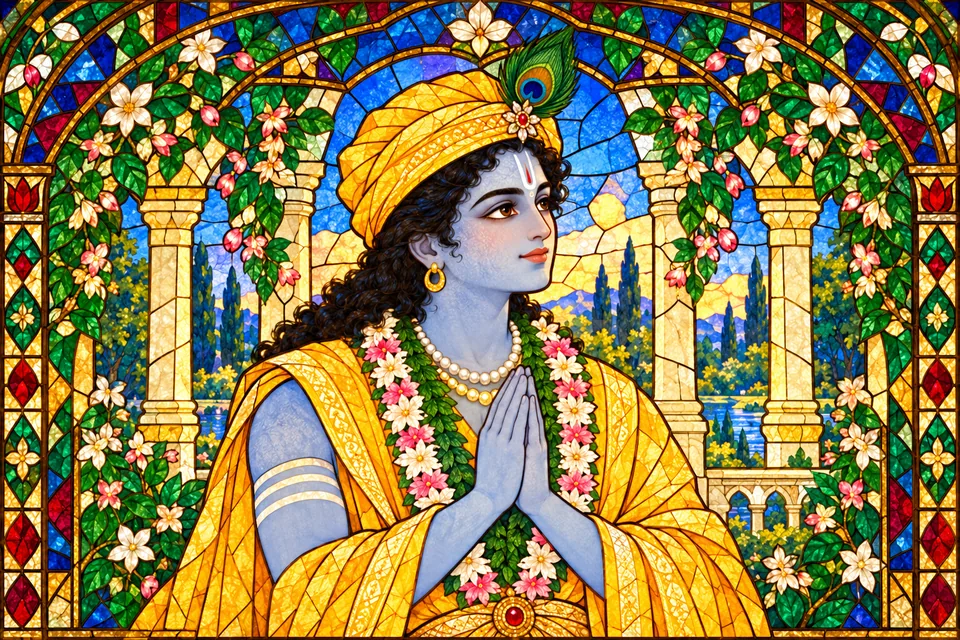
AI-created devotional illustration · Doha 281
Full Doha281, stableID282. Select Rama respectful master/servant appeal; second line retained offcrop.
Source reference and artistic choices
Gita Press code81 undated · PDF pages 271 · printed pages 269. Reader passage: bala-kanda-doha-282. Printed numbering may differ.
Source facts
- Rama asks how master and servant can battle and asks best Brahmin to abandon anger.
- The boy Lakshmana spoke after seeing Parashurama's warrior dress and is not at fault; not sage seeing Rama youth.
- The confrontation continues; no completed resolution certificate.
Artistic choices
- One Rama head, two own connected arms and two palms joined at chest; actual open eyes up-right and closed lips calm brows. Blue-grey complexion current cap/feather, pearl necklaces, partly hands-occluded green Tulsi, distinct white-pink victory flower chest loop. No other figures, weapons or battle.
- Exact poses/gazes/numericalages/clothes/ornamentcounts/geargeometryfastening/materials/spatialframing artistchoices not history or wholeparticipant/anatomy/motion/audible/emotionmotive census. Fullsourceoffcrop facts retained noabsenceinference/corpuscorrection/inventedHindi/publishing. Source comparisons/characterinsults/threats not physicaltransformations/violentevents.
An imaginative interpretation, not a historical portrait or documentary evidence.
प्रभुहि सेवकहि समरु कस तजहु बिप्रबर रोसु। बेषु बिलोकें कहेसि कछु बालकहू नहिं दोसु।।281।।
How can there be battle between a master and his servant? Release your anger, O best among Brahmins. Seeing my youthful form, you speak as you do. A child bears no fault in this.