Shiva Names the Prince as His Lord
Bala Kanda, Chaupai 51
Doha 51 · Movement 1 of 3
Keep this contemplation
Preserve, print, or share
Sati reasons that Vishnu, descended for the welfare of the gods, must be all knowing. Why then would the abode of wisdom, Lord of Lakshmi and destroyer of asuras, search like one ignorant of Sita's place? Yet Shiva's words cannot be false. Between these certainties, doubt expands until understanding finds no room to enter.
She says nothing, but the knower of every heart hears the unspoken conflict. Shiva tells her not to shelter such suspicion. The Ram whose story Agastya sang, the Ram whose devotion Shiva himself explained to the sage, is this very Raghubir walking in the forest.
Mahadeva names him without hesitation as his chosen Lord, eternally served by steadfast sages. The prince's sorrow is not evidence against divinity. It is the depth to which divinity has entered the Leela.
Shiva points toward the forest road and names the grieving prince as his eternal Lord.
Read the passage from the Manas
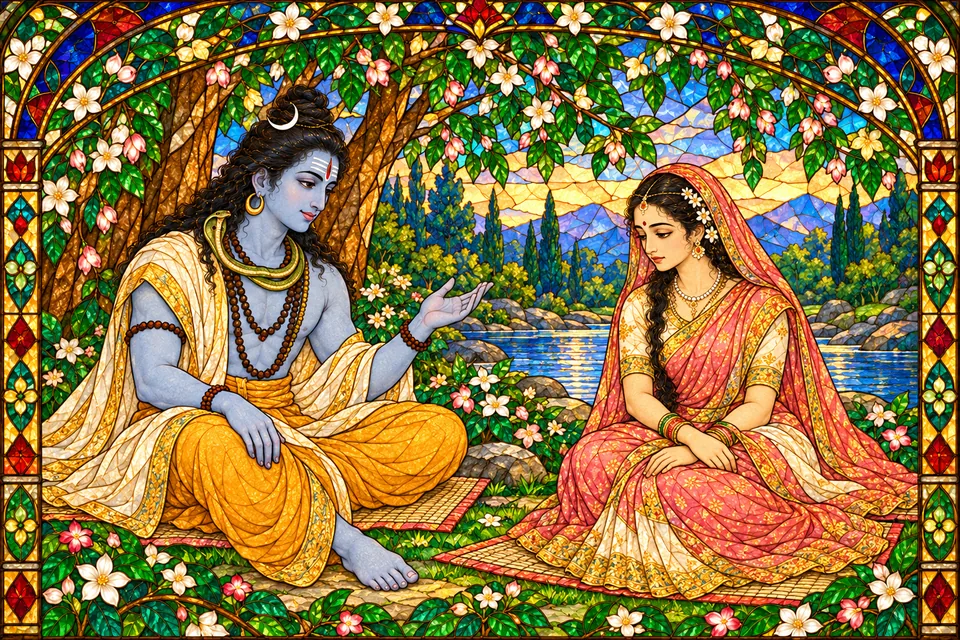
AI-created devotional illustration · Chaupai 51
Shiva offers gentle counsel while Sati sits with a thoughtful lowered gaze, before she tests Rama.
Source reference and artistic choices
Gita Press code81 undated · PDF pages 74 · printed pages 72. Reader passage: bala-kanda-chaupai-051. Printed numbering may differ.
Source facts
- Sati inwardly doubts whether the all-knowing Lord could search for his wife like an ignorant man; she does not voice the doubt
- Shiva understands her thoughts, gently warns against doubt and identifies Rama as his chosen Lord whose story Agastya recounted
Artistic choices
- Select Shiva's gentle counsel with Sati's inward uncertainty, before any testing episode
- Conventional imaginative Shiva and female appearance continued; female is Sati daughter of Daksha here
- Seated poses, explanatory open hand, beads and serpent, ochre/cream and pink drapes, mats, forest bough, river, hills and stained-glass colours imagined
An imaginative interpretation, not a historical portrait or documentary evidence.
बिष्नु जो सुर हित नरतनु धारी। सोउ सर्बग्य जथा त्रिपुरारी।। खोजइ सो कि अग्य इव नारी। ग्यानधाम श्रीपति असुरारी।। संभुगिरा पुनि मृषा न होई। सिव सर्बग्य जान सबु कोई।। अस संसय मन भयउ अपारा। होई न हृदयँ प्रबोध प्रचारा।। जद्यपि प्रगट न कहेउ भवानी। हर अंतरजामी सब जानी।। सुनहि सती तव नारि सुभाऊ। संसय अस न धरिअ उर काऊ।। जासु कथा कुभंज रिषि गाई। भगति जासु मैं मुनिहि सुनाई।। सोउ मम इष्टदेव रघुबीरा। सेवत जाहि सदा मुनि धीरा।।
It is Vishnu who has taken human form for the welfare of the gods. He is all-knowing, just as Tripuraari (Shiva, the destroyer of Tripura) is all-knowing. Would He, the abode of wisdom, the Lord of Shri, the vanquisher of the asuras, search for Sita like one who is ignorant? He does so only as part of His divine play.