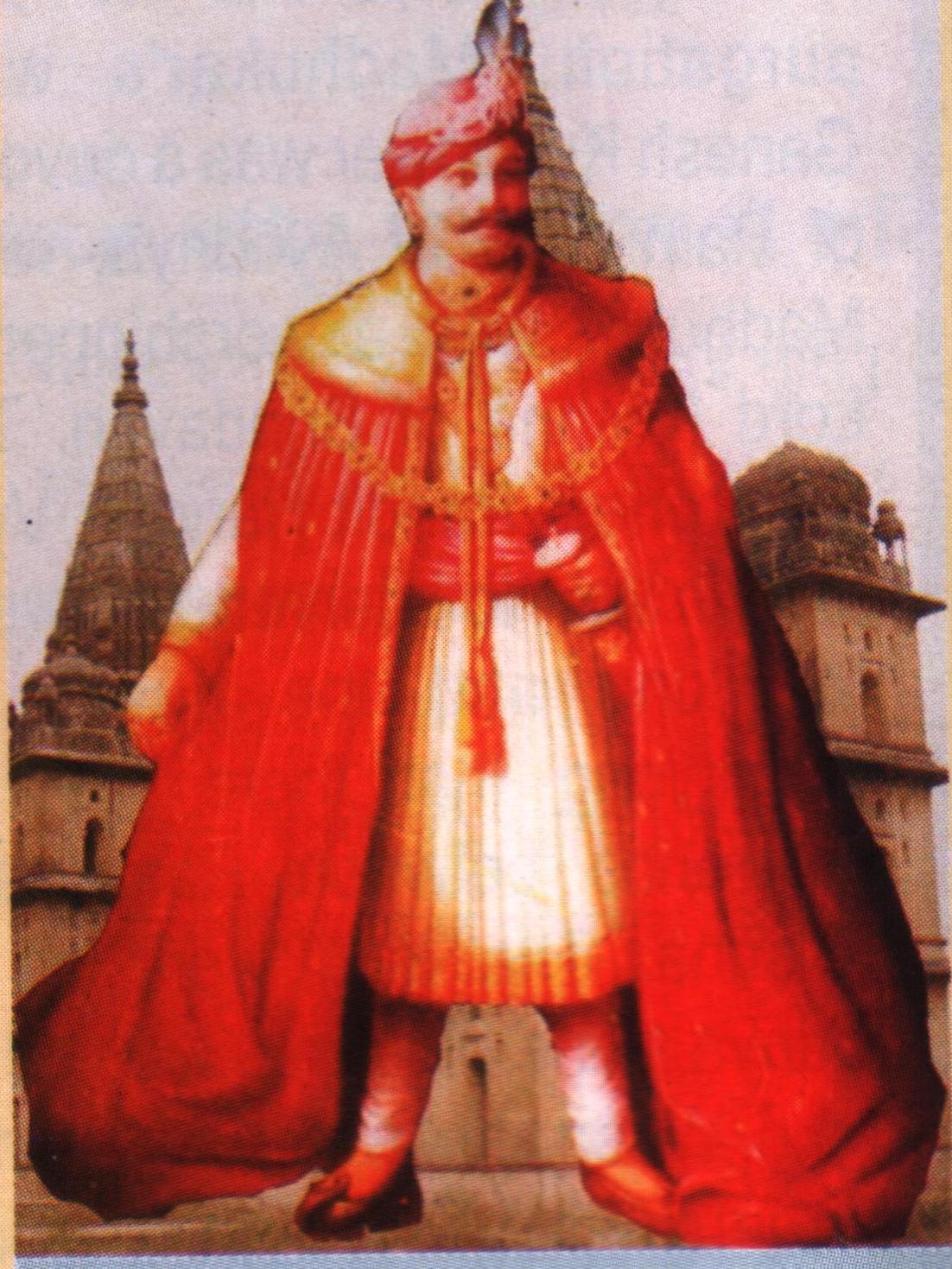
The king's litter was lurching. Four bearers kept an even, practiced rhythm, but the fifth, a broad-shouldered stranger the chief bearer had pressed into service only that morning on the bank of the river Ikshumati, kept breaking stride: half a step forward, a pause, a small sideways shuffle, then forward again, as though he were picking his way across broken glass. He was watching the ground. Every few feet he seemed to be searching the dust for something too small for anyone else to see, and adjusting his footfall around it. King Rahugana of Sindhu-Sauvira, riding to the hermitage named for the sage Kapila to seek a teaching of his own, felt the tilt each time and finally lost patience. He leaned out and hurled abuse at the new man: was he tired already, was he too weak for a man's work, did he think a king could be jostled about like a sack of grain by some half-witted laborer dragged in from a field. The stranger said nothing. He only kept walking his strange, careful walk, because what he was avoiding, step after step, were ants.
What the king could not have known was who he was insulting. This was Jada, the one the world called dull or inert, but in an age two lifetimes behind him, before dullness was ever laid over him like a disguise, he had been Bharata, a king so renowned that a wide swath of the earth is still remembered in the old chronicles by his name, Bharatavarsha, though how much of that memory is history and how much is the reverence later ages paid to a great soul, no one can now fully untangle. He was the son of the sage-king Rishabhadeva, and when his own long reign was done he did what few emperors ever choose to do: he gave his kingdom to his sons without a backward glance, walked into the forest, and settled at the hermitage of the sage Pulaha to spend what remained of his life in worship, eating only what the land gave him, wanting nothing else.
He very nearly succeeded. Then, one ordinary afternoon at the river, a pregnant doe came down to drink, and a lion roared somewhere close in the reeds. Terror threw her across the water in a single leap; the shock of the leap tore her fawn from her body straight into the current, and the doe herself, spent and broken by her own fear, did not survive the crossing. Bharata, watching from the bank, could not turn away from an abandoned newborn thrashing in the water. He waded in, lifted it out, dried it, and carried it home to his hut of reeds. It seemed such a small mercy. It cost him everything he had built.
The fawn grew up in his care, and so, unnoticed, did his love for it. He fed it by hand, worried when it wandered too far to graze, lay awake if it did not return by dusk, and found himself thinking of its safety during the very hours he had once given entirely to remembrance of the Divine. His tapasya did not stop; his heart simply stopped being fully inside it. And because it is said that whatever fills the mind in the last moment of life shapes the birth that follows, when death came for Bharata, it was the deer he was thinking of, not God. A man who had renounced an empire without flinching was carried into his next body by his tenderness for an animal.
He was born a deer himself, and yet even this fall could not undo what decades of sadhana had built in him. He came into that body as a jatismara, one who remembers, and he could not forget for a moment what he had thrown away nor why. He would not run with the herd. Instead the deer that had once been an emperor returned, of all places, to graze in the clearings around Pulaha's own hermitage, staying close to the chanting and the fire-smoke of the sages, grieving in a wordless animal way for the discipline he had let slip. When death finally came again, it found him still there, at the one place on earth where he had once been most himself, and this time it released him into a human womb, the youngest wife of a devout brahmin of the Angirasa lineage.
He arrived in that third body having made, it seems, an unshakeable resolve: never again would he let the world close its hand around his heart, not through a throne, not even through something as innocent as a fawn. So this time he simply refused it all from the start. As a boy he would not speak properly, would not learn the sacred verses however patiently his father tried to teach him at the sacred-thread ceremony, would not behave as a brahmin's promising son was expected to behave. To everyone around him he seemed slow, perhaps deaf, perhaps simply born wrong, and they began calling him Jada, the inert one, the dullard, never guessing that behind the vacant face was a mind absorbed so completely in the Self that ordinary speech and ceremony had become beneath his notice. His father, to his credit, sensed something in the boy that could not be measured by how well he recited a mantra, and let him be.
When the father died, the half-brothers who inherited the household had no such patience. They saw only a grown man who could not or would not work like other men, fed him whatever was left over, and set him to guard their fields of grain through the night against wild pigs and deer that came to raid the crop. He never once complained. Mud, thorns, cold, hunger, none of it touched him the way it would touch a man who still believed himself to be his body; he simply sat where he was told and watched the field, indifferent to comfort because he had long since stopped mistaking comfort for anything worth wanting.
It was in that same field, one night, that a band of dacoits found him. Their leader, desperate for a son, had vowed a human sacrifice to the fierce goddess Bhadrakali in exchange for the blessing, and his men, scouting for a suitable victim, took one look at this silent, powerfully built stranger keeping watch alone in the dark and thought their search was over. They seized him, bathed him, dressed him in fine cloth and garlands as though preparing a bridegroom rather than an offering, and led him singing to the goddess's shrine. He offered no resistance and spoke no plea, because the man they were binding did not believe there was a man there to save. But what they intended was never sanctioned by any true rite, and the goddess they thought they were honoring would not accept it. As the sword was raised, the very image on the altar is said to have split open, and Bhadrakali herself rose from it blazing, and in one motion cut down the men who would have killed her devotee.
Years after that, still wandering with the same unhurried indifference to his own fate, he was the one dragged in off the road to carry a king's litter, which returns us to where this story began. As the abuse kept coming at him on that riverbank path, something in Jada Bharata finally answered, not in anger but in the plainest possible terms. He told the king that he could order this body to walk faster if he wished, since a body is only a cart of flesh built from earth and water, but that no order given to a cart could ever reach the one who merely rides in it. The senses are its unsteady horses, he said, the mind wrenched about by the three gunas is the driver forever losing the road, and it is this driver, not any bearer of a palanquin, whom the king had truly been scolding all along. As for the passenger who only watches, untouched by the cart's jolting, there was nothing that could be commanded of that at all.
Something broke open in Rahugana as he listened, some hard knot of pride and self-importance that a lifetime of being obeyed had built around him. He stopped the procession, climbed down from the litter he had just been defending, and lay flat on the ground with his forehead at the feet of the man he had been mocking only moments before, begging to be forgiven, wondering aloud whether this could be an ordinary brahmin at all or one of those free avadhutas who wander the earth answerable to no one, kin in spirit to the sage Dattatreya. Whatever the tradition would later call him, teacher of kings, dullard, deer, emperor, the label mattered less than what those three lives together were saying to anyone willing to hear it: that a soul can build an empire and give it away without a flicker of regret, and still be pulled back into the world by something as gentle as love for a stray fawn, and that the only road out is to stop protecting every mask the world hands you, even the mask of being thought a fool, a beast of burden, or a sacrifice. What the manuscript tradition preserves of Nabhadas's own couplet on this figure has come down too fragmentary and worn to quote with confidence, tangled in places with the entries around it. What has survived whole, carried forward for a thousand years through Vyasa's telling to Shukadeva and Shukadeva's telling to the dying king Parikshit, and repeated since by teachers all the way down to Vivekananda, who used it to warn his own students against mistaking any attachment for a safe one, is simply the story itself, still walking its careful path around the ants, still asking whoever is riding through their own life at someone else's expense: who exactly do you think is carrying whom?
One Thread of Attachment Can Undo a Lifetime of Renunciation
Bharata Maharaja renounced an entire empire without a backward glance. He walked away from the throne, divided his kingdom among his sons, and retreated to the forest to worship Bhagavan Vasudeva. He had reached the stage the scriptures call bhava, the penultimate rung before prema. And then a motherless fawn fell into the river, and he pulled it out. What began as compassion became tenderness, and tenderness became attachment, and attachment became a chain. His daily worship slackened. His japa grew thin. His dhyana wandered from the lotus feet of Vasudeva to the whereabouts of a small deer. The teaching is not that compassion is wrong. It is that any fondness, if left unwatched, can grow into an anchor. The mind does not need a grand temptation to lose its way. It only needs one small tenderness allowed to go unexamined.
Srimad Bhagavatam, Canto 5, Chapters 7-9; Bhaktamal entry 51
The Seed of Devotion Cannot Be Destroyed
When Bharata died with the thought of a deer, he was reborn as a deer. The fall seems absolute: from emperor to beast, from bhava to an animal birth. Yet the Lord's grace does not forget a devotee even when the devotee forgets himself. Because Bharata had cultivated so much devotion across lifetimes, he retained memory of his previous birth even inside the deer body. He understood exactly what had happened. That deer left its mother and returned to Pulaha ashrama, grazing quietly at the edge of the gatherings of sadhus, listening to their recitations, waiting for death to release it. From the deer body he took birth again as a brahmana. Three births, and through all three the same soul burning its way back to God. The Bhagavatam shows us that the path is real even when we stumble off it. The seed of devotion, once planted, cannot be destroyed by death, by an animal body, or by the scorn of the world.
Srimad Bhagavatam, Canto 5, Chapters 8-9; Bhaktamal entry 51
The Paramahamsa Wears No Recognizable Form
When Jadabharata returned in human birth, he had learned from his fall. He would not allow attachment to take root again. So he put on the most radical disguise available to a person who wishes to be left alone: he pretended to be a fool. He would not speak, would not respond to instruction, did not bathe unless pushed into water, ate whatever was placed before him whether fine rice or rotting scraps. His stepbrothers fed him broken grains and oil cakes and treated him as a simpleton fit only for hard physical labor. He accepted all of it without complaint or resistance. Inwardly he was an ocean of stillness. Outwardly he was a scarecrow. The story holds this before us: we cannot measure spiritual depth by outward manner, speech, social function, or the opinions of those around us. The one who sits silent and appears most dull may be the one most fully awake.
Srimad Bhagavatam, Canto 5, Chapter 9; Bhaktamal entry 51
The Self Neither Carries Burdens Nor Grows Tired
When the king's palanquin bearers pressed Jadabharata into service, he walked with great care, stepping aside to avoid crushing ants and insects. Each small detour made the palanquin lurch. The king, irritated, shouted at him: you are stout enough, what laziness is this? And then the fool opened his mouth, and what came out was the most luminous discourse on the Self that any king had ever heard. You say I am stout, but stoutness belongs to the body, not to me. You say I carry a burden, but the body carries the palanquin, not the Self. You say I am tired, but the Self is never tired, never born, never diminished. The palanquin is earth. The body carrying it is earth. The king inside imagining himself a king is earth. The question Jadabharata left the king with, and leaves us with, is simply this: where in all of this is the Self?
Srimad Bhagavatam, Canto 5, Chapter 10; Bhaktamal entry 51
Liberation Is Not a Future Attainment But a Present Recognition
After King Rahugana descended from his palanquin and fell at Jadabharata's feet, begging forgiveness and guidance, Jadabharata continued to teach. He explained how the jiva wanders through countless births, driven by the three gunas. He taught that the mind, enslaved by its own projections, creates a world of suffering that has no more substance than a dream. And then he said something that cuts to the heart of all seeking: liberation is not something to be gained in the future. It is something to be recognized in the present, once the layers of false identification are seen through. We do not need to become something other than what we are. We need to stop insisting that we are something other than what we are. The king listened, and his life was changed. The teaching was not about adding something new. It was about removing every last assumption about who is doing the seeking.
Srimad Bhagavatam, Canto 5, Chapters 11-12; Bhaktamal entry 51
Hindi text from OCR scan (Khemraj Shrikrishnadas Prakashan, CC0). May contain errors.