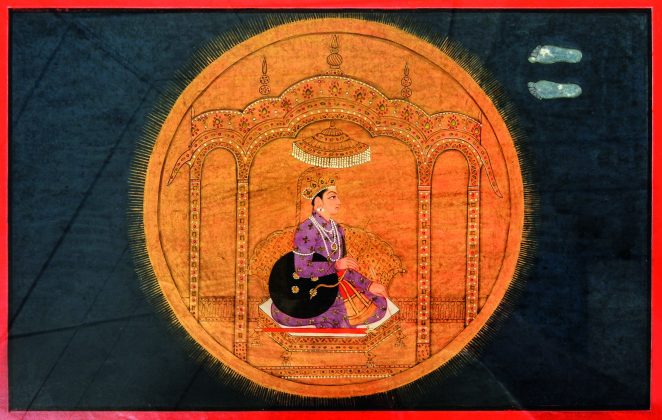
"Dhruva became a bhakta of Hari through her inspiration."
"Leave your home and go to the forest. Immerse yourself in love for the feet of Raghupati. Shri Hari alone, along with the Sanaka sages, is the one who delivers. No other protector or refuge is there for you."
"Making Hari her resolve, she showed no attachment. At the tender age of five she sent her boy forth, letting go of affection. Ascending a splendid vimana, accompanied by celestial companions, she departed for Vaikuntha to the sound of divine instruments. Dhruva looked up and beheld his own mother going on before him."
"Blessed indeed in all the world is that woman whose son becomes a bhakta of Raghupati."
अलक (सबाह ) मेरे लिये रहने दो कि राजकाजफ्रवृत्ति नीति सौख सके । वचनवश रानी ने यह बात स्वीकार की । ओर एक श्लोक लिख के एक यन्त्र अपने इस लघुतम पृत्र सवाहु के दक्षिणहस्त में बांधके यह सिखा दिया कि वत्स | जब तुकपर कोई कष्ट पड़े तो तू इस यन्त्र को
The hall was full of ordinary evening warmth when it happened. King Uttanapada sat with his younger son Uttama settled against his chest, and when five-year-old Dhruva came running up in the unthinking way small children do, reaching to climb into the same lap, no one expected the room to go quiet. It was Suruchi, the king's second and favored queen and Uttama's mother, who stopped him. Her voice was not raised, which somehow made it worse. If you want to sit where my son sits, she told him, you should have been born from my womb; go ask Bhagavan for that birth if you truly want this seat, because it is not yours. Uttanapada, who loved Suruchi more than he loved his own composure, said nothing to soften it. Dhruva did not cry in front of the court. He turned and ran, past the guards and the pillars, all the way to the one room in the palace where he still expected comfort: his mother's.
That mother was Suniti, Uttanapada's first queen, and by every account the less loved of the two. Her name itself means something like "she of right conduct," while Suruchi's means "she of pleasing charm," and the small tragedy of that household was that the king had let the second quality outweigh the first for years. Suniti had absorbed this quietly. She was not scheming against her rival, not building factions in the corridors; she had simply learned to live in her own house at a slight distance from her husband's affection, the way a woman does when she has stopped expecting to be first in someone's eyes and has decided not to let it curdle her. When her son burst into her chamber shaking, half from humiliation and half from a grief too large for a five-year-old's chest, she was the one who had to decide, in that instant, what kind of woman his wound would make of him.
She could have told him to hate Suruchi. She could have told him the throne would be his in the end and to be patient and clever until it was. She did neither. She held him, let him finish sobbing, and then said something that Nabhadas would later fold into two lines of verse and that generations of retellings have kept close to word for word: leave this house, go to the forest, and steep yourself in loving devotion at Raghupati's feet, for it is Shri Hari alone who can cut through what binds you; you have no other protector, no other refuge, in this world or beyond it. It was not vengeance she offered her son. It was the one thing she herself had learned to lean on when the palace gave her too little: that a human being's dignity does not have to depend on who is favored in someone else's lap, because there is a lap that never plays favorites.
What happened next is the part that still startles people who hear it for the first time: the boy actually got up and left. A five-year-old, alone, walked out of the only home he had ever known and started toward the forest. On the road he met the wandering sage Narada, who took one look at this small figure and tried, gently, to talk him out of it, telling him this was no age for such austerity. Dhruva would not be moved. Narada, won over by a child's stubbornness in matters of the spirit, gave him the mantra Om Namo Bhagavate Vasudevaya and pointed him toward Madhuvan on the bank of the Yamuna, a forest already sanctified by older sages before him.
There, in that grove, Dhruva did what almost no one his age has ever been recorded doing. He lived first on roots, then only on leaves, then only on water, and at last on nothing at all, holding his breath and his footing on one leg while his mind stayed fixed on the form Narada had described to him. Accounts say the earth itself began to tremble under the pressure of that concentration and that the celestial beings grew uneasy watching a child out-discipline their own ascetics. Bhagavan Vishnu came at last, touched his conch to the boy's forehead, and gave him not merely the throne he had first set out chasing but something no throne could rival: Dhruva-pada, a fixed station among the stars that will not be shaken even when the universe itself dissolves at the end of an age. It is why the pole star still carries his name.
What is easy to forget, in the drama of a child's tapasya, is what his mother was doing during those months. Suniti had let her son walk into a forest not knowing whether he would return alive, on the strength of nothing but her own conviction that Hari does not fail those who turn to Him completely. That is its own kind of austerity, the waiting kind, performed in a palace room rather than a wilderness, with no one composing verses about it. She had staked her son's whole future, and her own peace, on a teaching she had only ever half-tested in her own life. When word finally came that he was alive, that the Lord Himself had appeared to him, it must have felt like the one prayer of her life being answered all at once.
Uttanapada, ashamed and overjoyed in equal measure, welcomed his son home and in time set him on the throne in truth, not merely in a five-year-old's imagination. Dhruva ruled with a justice long enough and steady enough that the tradition remembers his reign as spanning thirty-six thousand years, a number meant less as arithmetic than as a way of saying no living memory could recall a time before his fairness. The seat Suruchi had told him was not his had become, almost as an afterthought to his devotion, entirely his; bhakti had not cost him the kingdom, it had simply refused to let the kingdom be the point.
In old age, Dhruva handed the throne to his own heir and withdrew to Badarikashram, where he gave himself over completely to remembrance of Bhagavan. When his time came, two radiant messengers of Vishnu, Nanda and Sunanda, descended in a celestial vimana to carry him home. As he stepped toward it, Death himself rose to bar the way, and Dhruva, entirely unafraid, simply set his foot upon Death's head and walked past him onto the waiting car, a single gesture that said more about what a lifetime of surrender had done to him than any speech could have.
And then, rising into the sky, he stopped. He could not bear to go to Vaikuntha and leave his mother behind on the earth. The attendants told him not to grieve, that Suniti too was even then being lifted toward the Lord's own country in a car of her own. Dhruva looked up, and there, ahead of his own chariot, sailing on before him to the sound of conch and drum, he saw her: his mother, going first.
That single image is the reason Nabhadas gave Suniti a place of her own in the Bhaktamal, distinct from her famous son. She performed no tapasya in the wilderness, faced no trial of hunger or one-legged stillness, worked no visible miracle. Her whole sadhana was a sentence spoken once, in grief, to a wounded child who might just as easily have been raised to nurse a lifelong resentment instead. In the language the tradition uses for such a person, Narada was Dhruva's diksha-guru, the one who gave him the mantra, but Suniti was something the Puranas call his patha-pradarshaka-guru, the one who first showed him which way to walk. It is why the closing couplet attached to her insists that a woman is blessed in this world not by the throne her son inherits but simply because that son becomes a bhakta of Raghupati; and it is why, in the telling that has come down through the centuries, it is finally she, and not the disciplined child of thirty-six thousand years' reign, who is seen entering the Lord's country first.
Point to God When the World Closes Its Doors
When every worldly door shut on her son, Suniti did not console him with false hope. She did not promise that his father would come around or that the court would change. She was the less-favored queen, powerless to alter the succession. What she possessed instead was clarity. She told the five-year-old Dhruva plainly: leave your home and go to the forest; immerse yourself in love for the feet of Raghupati; Shri Hari alone is the one who delivers; there is no other protector or refuge for you. This is the teaching of a mother who understood that no human arrangement could give her child what he truly needed. When all ordinary remedies fail, the right response is not to find a cleverer worldly strategy. It is to point the suffering heart directly toward the one refuge that cannot be taken away.
Bhaktamal entry 47 (tikaEn); Bhagavata Purana Canto 4
The Highest Love Directs, It Does Not Only Shelter
Every instinct of parenthood commands a mother to shield and hold and protect. Suniti overrode every one of those instincts and sent a five-year-old child alone into the wilderness to seek God. This was not cruelty. It was love of a different order entirely. She saw that the wound Dhruva had received from his stepmother Suruchi was not really a wound. It was a door. The humiliation was the precise pressure that could propel the child beyond anything a royal throne could ever offer. Rather than cushion him from that pressure, she leaned into it. She told him to walk through the door. The tradition that confuses love with mere shelter misses this teaching entirely. The highest love a person can offer another is not protection from suffering but direction toward the eternal.
Bhaktamal entry 47 (tikaEn)
Bhakti Is Open to Every Age and Station
Suniti understood something that ritualists of her era frequently missed: the path of karma-kanda, of elaborate ceremonial action, requires maturity, learning, and social standing. A five-year-old child of a neglected queen had none of these. But bhakti-yoga requires none of them either. This is what made her counsel so precise. She did not tell Dhruva to wait until he was older, or to study the Vedas, or to accumulate merit through ritual. She sent him directly to the feet of the Lord. Narada Muni, when he met the boy on the road, confirmed that the instruction Suniti had given was exactly suitable for the child. Bhakti is the one path whose door stands open regardless of age, caste, station, or the favor of kings.
Bhaktamal entry 47 (tikaEn); Vaniquotes on Queen Suniti
The Merit of Raising a Devotee
The mool verse of the Bhaktamal honors Suniti with a single declaration: blessed indeed in all the world is that woman whose son becomes a devotee of Raghupati. The verse does not praise her for her patience under injustice, her endurance of a neglected life at court, or her years of suffering. It praises her for one thing alone: producing a devotee. In the logic of the Bhaktamal, this is the supreme accomplishment of any parent. Not wealth passed on, not a kingdom secured, not even a life made comfortable. The tradition's measure of a life well lived is whether it kindled the love of God in another soul. Suniti, with nothing but words and a pointed finger, sent Dhruva to the forest and created the Pole Star.
Bhaktamal entry 47 (moolEn, tikaEn)
The Guru Who Shows the Way
In the Vaishnava tradition, Suniti is remembered as Dhruva's patha-pradarsaka-guru, the teacher who shows the direction. Narada gave the boy the mantra and the method, the formal tools of sadhana. But Suniti gave him something that precedes all technique: the initial turning of the face toward God. Without that first pointing, no mantra has a target. The spark that set everything in motion came from a grieving mother in a palace quarter, who looked at her weeping child and said: there is only one who can help you, and it is not me, and it is not your father, and it is not this court. Go to Him. This is the irreplaceable function of the patha-pradarsaka-guru: not to carry the seeker to the destination, but to ensure the seeker begins walking in the right direction.
Bhaktamal entry 47 (tikaEn)
Hindi text from OCR scan (Khemraj Shrikrishnadas Prakashan, CC0). May contain errors.