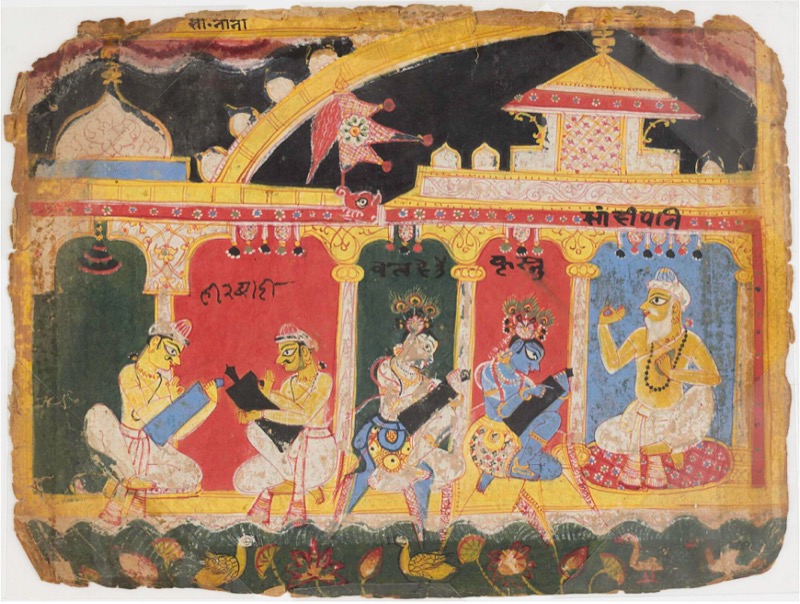
The name of Raja Shri Prithviji has already appeared among the twenty-four avataras. He was such a great lover of Bhagavan's yasha that, for the sake of hearing it, he asked for and received the capacity of ten thousand ears.
राजा श्रीपृथुजी का नाम पहिले चौबीस अबतारों ( मूल ५ छप्पय १ पृष्ठ ७७ ) में आ चुका है ॥ भक्षिसुधास्वाद तिलक । १३६ आप भगवद्यश के ऐसे बड़े प्रेमी थे कि उसके श्रवण के निमित्त अपने
The dust of a royal chariot was still rising on the road into Mithila when a poor priest named Shrutadeva came running out of his mud house without his sandals. He had not even had time to set out a seat for the guest walking up his lane, and it did not matter, because the moment his eyes fell on that dark, smiling face, Shrutadeva forgot he had feet to put sandals on at all. He threw his one good shawl over his head and began to dance, spinning in the dirt in front of his own door, tears running down into his beard, laughing the way a man laughs when grief and joy arrive at once and cancel each other out. He had prayed his whole life for exactly this and had never really believed it would happen to a man like him.
Who was Shrutadeva before that afternoon? A Vedic scholar of no means whatsoever, a householder priest in the city of Mithila who supported his wife and children on whatever the day brought him unasked. He did not go begging for alms and he did not hoard what came. If a patron gave him grain, he ate; if no one gave him anything, he and his family ate less, and either way he considered himself the most fortunate man alive, because his mind never once left the thought of Bhagavan long enough to notice what was missing from his plate. This contentment was not resignation. It was, in its own quiet way, the very discipline other men travel to forests and mountains to learn, and Shrutadeva had it in a hut at the edge of a capital city, unnoticed by anyone who valued a man by the size of his house.
In that same Mithila, in the same Videha kingdom that had once been ruled by the line of Janaka, there lived another devotee who could not have looked less like Shrutadeva if the two had been chosen deliberately to make a point. His name was Bahulashva, and he was the reigning king. He had palace walls of polished stone, more cattle and gold than he could count, and every morning he performed elaborate worship before the deity of Krishna installed in his own household shrine. Nothing about Bahulashva's outward life touched Shrutadeva's, except that when Krishna, far away in Dwaraka, thought of the two of them, he thought of them with the same tenderness, because he did not measure a devotee by his roof.
So Krishna decided to visit them both. He mounted his chariot and set out from Dwaraka toward Videha, and he did not travel alone. Around him rode some of the great sages of the age, Narada foremost among them, with Vyasa, Parashurama, Asita, and others whose very presence was said to be a pilgrimage in itself. As the chariot passed through towns and villages along the way, ordinary people ran out with garlands and fruit and whatever small offering they had, and Krishna received each gift with the same unhurried, affectionate glance, whether it came from a farmer's calloused hand or a merchant's jeweled one.
When at last the party reached Mithila, both King Bahulashva and the brahmin Shrutadeva fell at Krishna's feet in the very same moment, each one begging, with folded hands, that the Lord honor his house as a guest. Krishna would not choose between them. He would not let one man's love be answered and the other man's love be quietly set aside for another day. So he did what only Bhagavan can do: he expanded himself into two identical forms, indistinguishable from each other in every particular, and walked at the same instant into the palace and into the hut, complete and undivided in each place, so that neither host had the faintest idea the other was receiving the very same guest. Later tradition would give this feat of divine opulence a name of its own, vaibhava-prakasha, the manifest glory of the Lord multiplying himself out of love rather than division.
Inside the palace, everything unfolded as royal hospitality should. Seats of honor were prepared for Krishna and the sages. Bahulashva knelt and washed their feet with his own hands, then sprinkled that water, now sanctified, over his own head and the heads of his family. He anointed his guests with sandal paste, dressed them in fine cloth and ornaments, lit incense and lamps before them, and gave away bejeweled cows in charity. After a feast prepared with everything his kitchens could offer, the king took Krishna's feet into his lap and massaged them, weeping, and begged the Lord and his sages to remain in Mithila and bless his people a while longer.
Across the city, in a hut with a thatched roof, the very same drama was playing out in a different key. Shrutadeva had nothing resembling a royal seat to offer, so he ran to his neighbors and borrowed mats of grass and woven straw, since his own house held none worth spreading before a guest. He washed Krishna's feet just as carefully as the king had, and sprinkled that same water over himself and his wife and children. In place of sandalwood and ornaments he offered what a poor priest's house actually held: fruit, a little water, fragrant clay, tulasi leaves, kusha grass, lotus flowers, and a plain meal of rice and lentils his wife had cooked that morning for her own family, now given away entire. Massaging the Lord's feet with trembling hands, Shrutadeva could only ask, through his tears, what any true bhakta eventually asks and expects no answer to: "You are the Supreme Soul, and we are only your servants. What could I possibly give you that was not already yours to begin with?"
It was there, in the middle of Shrutadeva's joy, that Krishna offered him something sharper than praise. In his ecstatic dancing, so overcome that he had barely managed to seat his own guest, Shrutadeva had paid no attention at all to the sages who had traveled in Krishna's company; he had eyes only for the Lord. Krishna gently pointed this out, and then went further than a rebuke. He told Shrutadeva that pilgrimage to holy rivers and worship at temple shrines purify a soul only gradually, across many lifetimes, but a single glance from a soul like Narada or Vyasa can accomplish the same purification in an instant, because such sages carry Bhagavan within them wherever they walk. And then he said the thing that has been remembered as the heart of this whole story: that he counts the honoring of his devotees dearer than being honored himself, that a man who bows to these sages has, in that very bow, already bowed to Krishna. Shrutadeva did not hear this as correction so much as release. He turned at once and fell at the feet of every sage in turn, and something in him settled that had never had room to settle before, the understanding that love of God is never complete until it opens out into love of God's people.
All this while, the same Krishna, entire and undivided, was still seated in the king's hall across the city, and neither host so much as suspected it. Some who tell this story remember the Lord's twin presence lingering through the four months of chaturmasya, the rains-bound season when sages traditionally do not travel; others simply say he stayed as long as love asked him to. Either way, in the palace Bahulashva was certain he alone held the Lord as his guest, and in the hut Shrutadeva was equally certain of the very same thing, and both were right, and neither knew it.
When the day finally came for Krishna and his sages to leave Mithila, they are remembered as rising from both doorways in the very same hour, the king's marble threshold and the brahmin's mud one, so that the going matched the coming in its perfect, hidden symmetry. Nothing about Shrutadeva's outward circumstances is recorded as having changed after that: no sudden wealth came to him, no title, no house of stone. What survives of him instead is the tradition's quiet insistence that he was afterward counted among those who remained near Krishna for the rest of his years, a soul who had, in one unguarded afternoon of undignified dancing, been drawn permanently into the innermost company of the Lord he loved. Beyond this single story, honestly, almost nothing certain is known of him. No independent record fixes where he was born or how his life ended, and it would be dishonest to invent such details simply because a life feels incomplete without them. It seems that for Shrutadeva, one radiant afternoon of hosting Bhagavan with borrowed straw mats was itself the whole of what needed to be remembered.
When the sage Shukadeva told this story to the dying king Parikshit, centuries of listeners understood exactly what he meant them to take from it: that a queen's ornamented cow and a beggar's borrowed straw mat, offered with an equally wet-eyed heart, arrive before God as the very same gift. Nabhadas, remembering Shrutadeva in a single line of his own devotional roll call many centuries later, was pointing at the same truth from a different angle. It was never that Krishna happened to visit a poor man's house. It was that when Krishna came, this particular poor man forgot every rule of decorum a proper host is supposed to observe, and could do nothing in the world except dance.
Poverty Is Not an Obstacle to Receiving the Lord
Shrutideva was a Brahmana in Mithila who accepted only what came to him by providence each day. He did not seek wealth or the patronage of kings. Whatever he received, he offered to his family and to guests, and that was enough. His poverty was not deprivation; it was the natural posture of a life turned entirely toward the Lord. Across the same city lived King Bahulashva, who ruled with immense wealth and yet with equal inner simplicity. Krishna went to both of them. He entered the palace and the hut in the same moment, with the same fullness, without preference. The Bhagavata makes this unmistakably clear: what the Lord weighs is not the size of the offering but the wholeness of the love behind it. Shrutideva's story stands permanently against the human tendency to believe that we need to be richer, readier, or more prepared before we can receive the divine fully into our lives.
When Love Is Absolute, Decorum Falls Away
The moment Shrutideva saw Krishna standing at his threshold, his mind was flooded with such prema that he lost all composure. He raised his arms, pulled at his own garments, and began to dance in uncontrollable ecstasy. He was so consumed by the sight of his Lord that the world around him vanished entirely, including the great sages who had accompanied Krishna. He did not bow to Narada. He did not honor Vyasa or Parashurama or Brihaspati. His eyes saw only Krishna, and everything else dissolved. The tika does not call this a sin. It calls it beautiful. There is a kind of lapse that only the deepest love can produce, a lapse so complete that it is itself a form of perfect attention. Shrutideva forgot every protocol of respectful conduct because he was entirely present to the one presence that mattered to him. This is the paradox at the heart of pure bhakti: when love reaches its fullest point, even good behavior can be swept away by something greater than good behavior.
The Saints Are Non-Different from the Lord
Krishna gently corrected Shrutideva for ignoring the sages who had traveled with Him. The correction was not a scolding. It was an expansion. Krishna said: these sages purify all the worlds with the dust of their feet. Know them as non-different from Me. Even My four-armed form is no dearer to Me than a Brahmana who has realized the truth. The instruction asked Shrutideva to let his love for Krishna flow outward to include those in whom Krishna also dwelt. Shrutideva accepted this teaching instantly and without resistance. He turned to the sages with the same overflowing love he had poured upon Krishna and offered them full prostrations, worship, and care. There was no wounded pride, no sense that his moment of divine encounter was being interrupted. The love simply extended itself to a wider field. The teaching for seekers is direct: to love God and to ignore the saints in whom God lives is to hold the love in too small a container. True bhakti keeps expanding.
The Lord Comes in Full to Each Heart That Opens Completely
When both Bahulashva and Shrutideva invited Krishna and the sages, the Lord accepted both invitations simultaneously. He expanded into two identical forms: one entering the palace, one entering the hut. Neither host knew the other was also hosting the Lord. Each believed Krishna had come to him alone. And in a sense, each was right. This is not a story about Krishna performing a clever trick to avoid disappointing either host. It is a revelation about the nature of divine love. When a heart opens to the Lord without reservation, the Lord does not offer a fraction of Himself as a courtesy. He comes in full. He cannot do otherwise. Love responds to love with its whole being. The palace and the hut were equally honored, not because Krishna was being fair, but because Bahulashva and Shrutideva were equally open. The size of the dwelling has nothing to do with it. The size of the opening is everything.
A Handful of Grain Offered with Trembling Hands
When the sages were seated in his simple home on mats of darbha grass, Shrutideva offered them what little food he had. He had no royal feast, no abundance of provisions, no servants to arrange an elaborate ceremony. He had his bare rooms, his willing hands, and his wife beside him. He washed the feet of the sages himself, and the water that flowed from that washing, the Bhagavata tells us, was potent enough to purify the entire world. He sprinkled it on himself and his family. What the Lord receives in any offering is not the object but the love carried within it. This is one of the oldest teachings in the devotional tradition, and Shrutideva lives it without argument or commentary. He does not apologize for the smallness of what he has. He offers it entirely. The trembling hands are not a sign of inadequacy. They are a sign that the giver is fully present, fully giving, holding nothing back for later.
Hindi text from OCR scan (Khemraj Shrikrishnadas Prakashan, CC0). May contain errors.