English rendering in progress
( 9छउद ) छप्पय | ( ६४ ) निदिकिंचनभक्ननि भजे, हरि ग्रतीति .“हरिबंस” #£ “मुजरा | 5० <जुहा?, प्रणाम !| + “बाजे हैं”न्थ्रसज्न, सुखी हुए ॥
When Nabhadas sat down around 1585 to gather into one garland the lives of the devotees he judged worthy of remembering forever, he reached for a story that had nothing to do, on its surface, with the man he was describing. Once, he wrote, a king came down to bathe in the Ganga, and there on the ghat he gave away alms worth lakhs of rupees: gold, cloth, grain, more wealth than most villages would see in a generation. On that same morning, on that same stretch of riverbank, a grass-cutter who owned nothing in this world but a sickle and a worn hand-blade made his own offering: he gave the sickle, and he gave the blade. When the account of that day's giving was read out in heaven, it was the grass-cutter, not the king, whose name was set above the other. The king had given a fortune and still gone home with a fortune left. The grass-cutter had given everything he had. Nabhadas closes the comparison with a single line about the man this chhappay actually honors: this is how Sri Harivansh gave. Not that he was poor, and not that his gift was small. That he held nothing back. The verse calls him a servant of nishkinchan bhaktas, of renunciates who had let go of every possession, and it insists he served them the way one nishkinchan serves another, out of an emptiness he had already made complete in himself, not out of surplus he could spare.
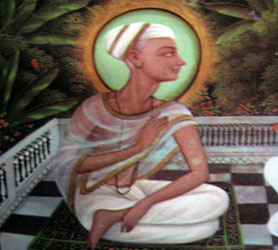
The man behind that line is remembered across Braj as Hit Harivansh, or Hit Harivansh Mahaprabhu, the founder of what grew into the Radhavallabh Sampradaya, one of the great devotional households of Vrindavan. Even his own tradition cannot settle the year he was born; some keepers of that memory set it in the 1470s, others some thirty years later, closer to 1502, on an Ekadashi in the bright half of the month of Vaishakh. What the accounts agree on is the place: a village called Baad, a few miles outside Mathura, where his father Vyas Mishra worked as an astrologer attached to the Mughal camp and his mother, Tararani, raised her son through the ordinary business of a household that had no idea yet what it was raising. His boyhood years were spent at Deoband, further north, and it is there that the family kept the stories that first marked him as unusual.
The best known of those stories has him playing with the other children of the village when his ball rolled into a deep well. He went in after it without a pause. When he came up, he was not holding the ball. He was holding a small dark image of the Lord, two armed, a flute at his lips, as though it had been waiting in that water for someone who would not think twice about diving after what was lost. He named the image and, still a child, began the daily choreography of caring for it: waking it, dressing it, feeding it, singing it to sleep, the whole rhythm of temple worship performed instinctively by a boy who did not yet have the words for bhakti to explain why any of it mattered to him.
At eight he underwent the sacred-thread rite that marked a boy's passage into formal learning, and not long after, still young, he married a woman named Rukmini. Marriage did not slow him down. The tilak that comes with Nabhadas's verse lingers on the texture of those years: a man supremely content, well mannered, unable to take pleasure in gossip whether as speaker or listener, who let no part of any day pass in waste, who kept singing the qualities of Govind without interruption. These are not the marks of someone performing austerity for an audience. They read like a description of a man for whom ordinary time had quietly stopped being about anything except the one subject he could not stop returning to.
Everything is said to have turned when he was thirty-two. His parents were gone by then, and something in him had already begun leaning toward Vrindavan the way a plant leans toward a window. Asleep one night beneath a peepal tree, he found himself in the presence of Radha, not as an idea to contemplate but as someone standing before him. She plucked a red leaf from the tree and gave it to him as a mantra, the yugal mantra that bound him to the divine pair together rather than to either one alone, and she named him Hit, meaning a tenderness that seeks only the good of the beloved and asks for nothing in return. From that night the astrologer's son who had simply been Harivansh became Hit Harivansh, and by every account he understood the name less as an honor than as an assignment.
Radha was not finished. In a further vision she told him of a household far north near Saharanpur where a man named Atmadev had kept, across generations, a murti that tradition says Shiva himself had shaped out of the sheer intensity of his own longing to look upon Krishna. Two daughters lived in that house, Krishnadasi and Manoharidasi, and Radha's word to Harivansh was that he should go there, marry them, and carry the image home to Vrindavan himself. He left Baad, left the household he had shared with Rukmini, and went, the way a man goes once he has stopped weighing his own preferences against an instruction he trusts completely. Whatever a reader today makes of a saint receiving that kind of instruction in a dream, the Radhavallabh tradition has never told this part of the story as a scandal needing explanation. It tells it as one more instance of a man who had already proven, at the Ganga and everywhere else, that he did not keep anything of his own life in reserve once Radha had asked for it.
The image he brought back was Sri Radha Vallabh Lal, and its name folds a small theological revolution into two words. Vallabh means beloved, cherished, held dear; the deity is not simply Krishna, he is Radha's beloved, defined by belonging to her rather than the reverse. Where a great deal of Vaishnava devotion had approached Krishna as sovereign, the sustainer of the universe surrounded by his six-fold majesty, Harivansh asked his devotees to approach him only as he exists inside her gaze: unguarded, undefended, wholly given over. The ideal devotee in this vision is not the one who wins the Lord's love for herself but the sakhi, the intimate companion whose whole happiness lies in arranging the meeting of two people who are not her. It is a theology built out of the same gesture as the grass-cutter's gift: you matter most in this world not when you keep something back for yourself, but when your entire use is spent making someone else's joy possible.
The Vrindavan he settled in bore no resemblance to the town of temples and pilgrims it has since become. It was river forest, tangled and half-lawless, and its terror had a name: a bandit chieftain called Narvahan, who ruled that stretch of ground with a violence nobody local dared cross. The story remembered of their meeting has the shape of every good bandit-conversion story in Indian devotional literature, and the tradition tells it without embarrassment. Narvahan came upon the ascetic seated alone in the forest, unguarded, and found that whatever he had come to do, he could not do it. Something in the man's stillness, in the light the tradition says gathered around him as he sang, stopped the bandit's hand before it moved. Narvahan did not merely spare him. He knelt, asked to be taught, and spent the rest of his life as one of Harivansh's most devoted followers, eventually spending his own wealth to raise a temple for the very deity he might once have plundered. Whatever the exact shape of that first meeting, the outcome is not in dispute: after Narvahan, the forest around Vrindavan stopped being something pilgrims needed to fear.
Harivansh installed Radha Vallabh Lal in a grove above the Yamuna and built around that single image an entire rhythm of devotion. In place of the older calendar of deity worship, heavy with injunction and prohibition, he set what came to be called Ashtayam Seva, eight watches of service through the day tuned less to ritual correctness than to the actual moods of a beloved child: woken gently, dressed for the weather, fed at the hours a child gets hungry, laid down for a rest in the afternoon, sung to sleep at night. He also named places in that forest that no earlier text had recorded: Ras Mandal, Seva Kunj, Vanshivat, Dhir Samir, Man Sarovar, as though the ground itself were being read for the first time for traces of a love story that had been unfolding there all along, invisible until someone finally had the eyes for it.
His own words for that love survive in Hit Chaurasi, eighty four verses in Braj Bhasha that read less like doctrine than like a diary, tender rather than triumphant, written to be sung rather than studied. His tradition also keeps a Sanskrit hymn cycle in his name, often called the Radha Sudha Nidhi. Other Vaishnava lineages trace a text of nearly that same title to a different poet-saint entirely, and this telling does not need to settle that old disagreement between traditions to honor what both sides agree on, that someone in that century put into words a longing for Radha sharp enough that centuries of singers have not worn it smooth. Harivansh went further than writing. He had local children dress as Radha and her companions and enact the eternal Ras Lila so that ordinary Brajwasis could watch with their own eyes a pastime the scriptures said only the gods could see, and he shaped a style of congregational singing, Samaj Gayan, that the singers of Vrindavan's havelis still carry forward. He seems, by every account, to have been unwilling to let devotion stay something merely read about. He kept building doors for people to walk through it instead.
Nabhadas's chhappay calls him a portion, an amsha, risen up from among the Lord's own eternal companions, and the tradition that grew out of Harivansh took the description literally: they remember him as an incarnation of Krishna's flute, the murali, an instrument whose entire nature is to carry someone else's breath into music and never once claim the song as its own. It is not a bad description of the life the sources actually show. A boy who dove into a well after someone else's idol. A husband and father who left a household he loved because a voice he trusted asked him to. A landowner's son who ended up owning nothing, the way the grass-cutter owned nothing, and was ranked higher in heaven for it. A theologian who built an entire school of worship on the conviction that the highest devotion serves a joy it will never itself possess.
Even his passing resists a tidy date. The sampradaya's own chronicle, the Rasik Ananya Mal, remembers him departing on a full moon night in the month of Ashwin, drawn by a fragrance of Radha he caught near Man Sarovar, following it into a hidden grove the tradition calls Bhanarini Bhavan until he simply did not come back out, gone into the pastime rather than out of the world. Scholars working from the language of his hymns tend to place his death a generation or two earlier than that. Nobody who reads both accounts closely comes away thinking the disagreement matters as much as the picture underneath it: a man last seen walking toward a scent he loved, unafraid, still following, still giving, right up to the edge of what could be written down. If a tired reader takes only one thing from this story, let it be the grass-cutter's sickle and blade, and the question Harivansh spent his whole life answering with his own hands: not how much do I have to give, but will I keep any of it back.
The Grass-Cutter's Gift: Giving from Nothing
Nabhadas opens his portrait of Shri Harivanshji with a parable. A raja bathed in the Ganga one auspicious morning and gave away lakhs of rupees in dana. That same morning, a grass-cutter arrived at the river with only a sickle and a scraper. He had nothing else. He gave both. In the celestial accounting, the grass-cutter stood above the raja. The raja gave from abundance; the grass-cutter gave his sarvasva, his everything. Shri Harivanshji is held up as this grass-cutter. He accumulated nothing, guarded nothing, calculated nothing. His hands were always open. The teaching is simple but unsettling: the value of a gift is not measured by what it contains but by what it costs the giver. When we offer to God what is truly our everything, even if it appears small to others, we give more than a king.
Bhaktamal tika on Shri Harivanshji (verse 175)
Nishkichana: The Freedom of Holding Nothing
The Sanskrit word nishkichana points to a very specific inner condition: not merely the absence of possessions, but the settled, peaceful absence of any attachment to things whatsoever. The nishkichana saint does not simply refrain from acquiring. He does not hold, does not guard, does not calculate, does not worry about material security. Shri Harivanshji lived this way completely, and Nabhadas says that this emptying of the hands made possible a filling of the heart. Love flows into spaces that possessiveness cannot enter. Where the fist is clenched around property, reputation, or comfort, there is no room for priti, deep devotional love, to move freely. The teaching for seekers is that inner spaciousness is not created by force or will. It grows naturally as the heart finds what it was always looking for. Desire loosens its grip on its own when something better has arrived.
Bhaktamal tika on Shri Harivanshji (verse 175)
Every Moment Belongs to Govinda
The tilak records that for Shri Harivanshji, not even a small amount of time went to waste. Every moment that passed without Govinda-guna-gana, the singing of the Lord's glories, was for him a moment lost. This is not a grim discipline imposed from the outside. It is the natural orientation of a heart that has tasted something so sweet that everything else becomes pale by comparison. He was also described as having no interest in asat talk: vain, idle, or purposeless conversation. Not because he judged others for it, but because his own inner palate had been so transformed that tasteless speech held no appeal. The seeker who wonders how to build a practice of remembrance may find here a gentle pointer: it is not about adding more effort. It is about letting the love you already carry grow until remembrance becomes the most natural thing in the world.
Bhaktamal tika and tilak on Shri Harivanshji (verse 175)
Seva to the Virakta: Serving Those Who Have Surrendered
One of the three great expressions of Shri Harivanshji's love was his devoted service to virakta bhaktas: those who had truly renounced the world and lived in complete dependence on Hari. He did not admire such people from a distance. He sought them out, cared for them, placed his life in their service. In Vaishnava understanding, the saint who has fully surrendered carries a particular grace. To serve such a person is to touch something of the divine presence directly. Shri Harivanshji recognized this and gave himself to it wholeheartedly. For those of us walking the path, this teaching is an invitation to look around for the company of genuine seekers, those further along than ourselves, and to offer them something real, not as a transaction, but as an act of love. Satsang is not a convenience. It is a form of sadhana.
Bhaktamal tika on Shri Harivanshji (verse 175)
Radha as the Heart of All Love
Shri Hit Harivansh Mahaprabhu came to Vrindavan carrying a sacred murti of Shri Radha Vallabha and established the Radha-Vallabha sampradaya. At the center of this tradition is a theological insight of great beauty: Shri Radhaji is understood as the supreme reality, the very source of all love, and Shri Krishna as her most beloved. All love in this universe is a ray of that original love between Radha and Krishna in the groves of Vrindavan. The eighty-four hymns of his Hita-Chaurasi are each a window into that intimate lila. For Shri Harivanshji, devotion was not primarily about asking for things or even about seeking liberation. It was about being drawn into that love as a participant, a companion, one who witnesses and serves the sweetness of the divine couple. This is the bhakti he modeled and transmitted: selfless, absorbed, and overflowing.
Hita-Chaurasi; Radha Vallabha Sampradaya tradition
Hindi text from OCR scan (Khemraj Shrikrishnadas Prakashan, CC0). May contain errors.