English rendering in progress
(७३२ ) छप्पय | ( १११ ) जसवंत भक्कि जयमाल की, रूड़ा राखी गाठपड़ भक्ति मों अति भाव निरंतर, अंतर नाहीं। कर जोरे इक पाय, झुदित मन आज्ञा माहीं ॥ औरुन्दावनवा
The horse came back long after the fighting had ended, in the dark hour before dawn, its coat black with sweat and its legs trembling, and no one in the stables could say who had ridden it. Its owner, Jaimal, had not moved from his seat of worship the entire night. Ten full ghadis, nearly four hours, was his fixed rule for puja, and during that time he would hear no news, however urgent, believing that whoever broke his concentration would pay for it with his life. On this particular night an enemy, a rival kinsman by some tellings, learned of this vow and used it: he brought an army and threw a ring of soldiers around the town while Jaimal sat with folded hands before his Thakurji. His own mother came running to warn him. He answered only that Shri Hari would see to it, and returned to his beads. By morning the invading force lay broken in the fields, and a wounded man carried in from among them, weeping with something closer to wonder than pain, described the warrior who had cut through the whole army alone: dark as a monsoon cloud, unbearably beautiful, mounted on a horse he swore was Jaimal's own. It is not Jaimal who tells us this story about himself. It is the story his household had to go on living inside of, and it fell hardest on the man Nabhadas names right after him in the Bhaktamal, his younger brother Jaswant.
The two belonged to the Rathore house of Merta, a fortress town on the Marwar-Mewar frontier whose ruling family also gave the world Mirabai. Tradition identifies this same Jaimal as the Rao Jaimal who commanded the last desperate defense of Chittorgarh against Akbar's forces in 1567 and 1568, and who fell, chronicles say, to a shot Akbar fired personally into the fort's defenses. Akbar is said to have honored his slain enemy's courage by setting stone elephants bearing statues of Jaimal and his fellow commander Patta at the gates of his own fort in Agra, a conqueror's monument to the man who had cost him so dearly. None of that, however, is what earns Jaimal, and through him Jaswant, a place in Nabhadas's garland of bhaktas. What earns them their place has nothing to do with a sword.
Nabhadas gives Jaswant a single chhappay, and its opening line does something the Bhaktamal rarely bothers to do for anyone: it defines a man entirely by what he preserved rather than by what he began. Jaswant, it says, took the bhakti of Jaimal and kept it roora, beautifully, holding the knot tied so it would never come loose. There is no miracle recorded for Jaswant himself, no vision, no army defeated by an unseen hand. His entire reputation, so far as the surviving verse and Rupkala's tilak let us see, rests on a quieter feat: when the fire that had burned in his elder brother's worship might easily have gone out with him, Jaswant refused to let it. He is remembered not as a founder of anything but as a guardian, and the Bhaktamal treats that as its own complete form of greatness.
If Jaswant did take up this charge after Jaimal had fallen at Chittor, as the commentary's phrase 'after him' suggests to many who have read it, then his guardianship of the family's devotion begins inside the rawest kind of grief a Rajput household could know: a brother, a ruler, a central pillar of the family, gone in a siege that ended in the mass death of the fort's women and a final suicidal charge by the men who remained. A warrior house had every cultural reason to answer such a loss with vengeance, or with the theater of mourning that Rajasthani chronicles love to record. Jaswant is remembered doing neither. He is remembered standing, quite literally, on one foot.
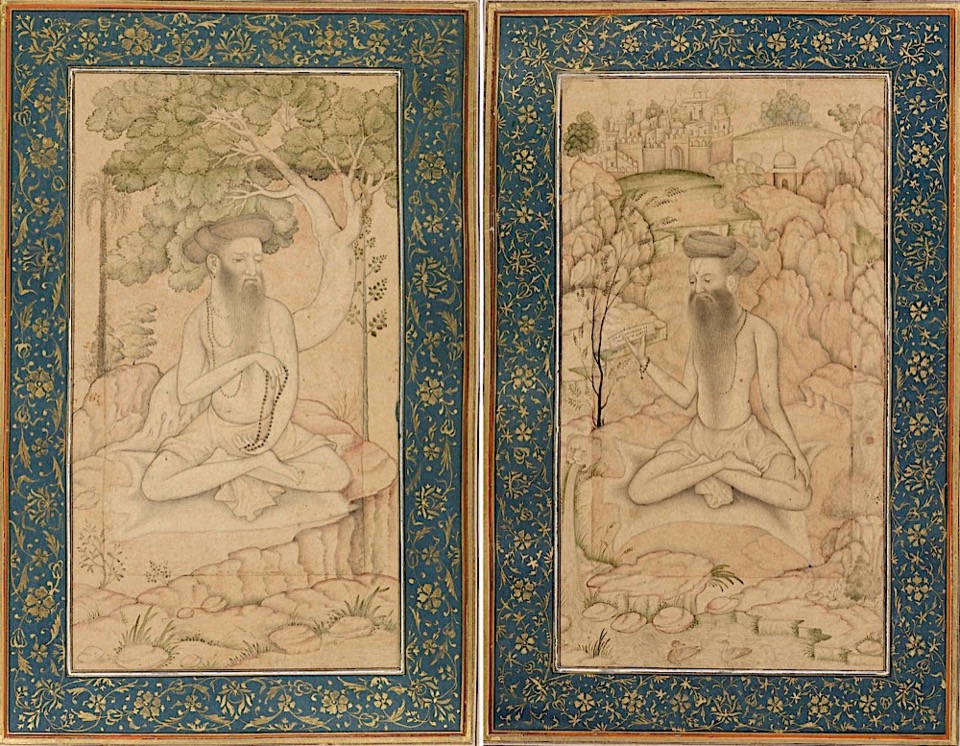
The chhappay's most striking image of him is physical: hands folded, weight balanced on a single foot, his mind restless with love yet his body locked into stillness, waiting on Bhagwan's aagya, the command, before he would move at all. This is an old and demanding shape of devotion called dasya bhava, the mood of the servant, and it asks more of a person than it sounds like it should. It asks him to surrender not his sins but his initiative, to live in permanent readiness rather than permanent action, to treat obedience itself as worship rather than as a precondition for it. For a noble raised from boyhood to command, to decide, to lead horsemen into the field on his own judgment, this was arguably a harder discipline to master than swordsmanship had ever been. Jaswant chose instead to stand before a power he could not see, one foot lifted, hands joined, for as long as it took that power to speak.
His devotion did not end at obedience. Nabhadas says he held the kunj-krida of Vrindavan, the hidden play of Radha and Krishna among the bowers and groves of Braj, to be sach, true, not a legend or a memory of something that happened once in a receding past, but a living present reality still unfolding beyond ordinary sight. This is the theological center of the current he belonged to: Vrindavan's lila is nitya, eternal, and a bhakta's task is not to imagine a story but to catch, through longing, a glimpse of something still actually happening. A man who believes that does not merely recite Krishna's pastimes as scripture. He waits for them the way one waits for a familiar footstep at the door.
That waiting had a specific address. Jaswant is described lovingly fussing over Shri Radha Vallabh Lal every single day, the text's own word for it being lad ladana, a kind of doting, wheedling indulgence usually reserved for a beloved child. Radha Vallabh, 'the one who belongs to Radha', is the deity that Goswami Hit Harivansh had installed in Vrindavan only shortly before, the founding image of what became the Radhavallabh Sampradaya, a school of Krishna bhakti remarkable in its own time for placing Radha above Krishna in the order of worship and treating Krishna's very identity as defined by his devotion to Her rather than the reverse. To lad ladana a deity in this mood is to relate to Him the way a doting elder relates to a cherished, willful, beautiful child: dressing Him, waking Him, feeding Him, indulging His moods, scolding Him fondly when He is troublesome, taking tender liberties that would be unthinkable toward a god approached only with fear. Jaswant's guru is named in the tradition as Sri Haridas ji, a teacher inside this same newly kindled Vrindavan circle gathered, in the brothers' own lifetime, around Hit Harivansh, a circle that would go on to produce Braj Bhasha poets such as Hariram Vyas and Dhruvdas, whose songs are still sung in Vrindavan's kunjas today.
Nabhadas closes the verse by naming what all of this amounted to: navadha bhakti, the ninefold path that scripture calls the essence of every dharma, held by Jaswant as pardhan, supreme, above any other value his lineage could have offered him instead. He is described gathering prem bhakti, loving devotion, like a great treasure and storing it in the storehouse of his own heart, sinking so completely into that love that he became jad sarikh, still as a piece of wood. There is a name in the old aesthetics of bhakti for exactly this symptom: stambha, the stunned paralysis that overtakes a lover so full of feeling that the body simply stops moving. It is usually described happening to a sixteen-year-old gopi in the middle of the rasa dance. Nabhadas applies it, without any apparent hesitation, to a grown Rajput nobleman standing in a private shrine room, and that alone says how seriously this tradition took the claim that devotion could undo, in anyone, the composure that rank and reputation are supposed to guarantee.
Outside this one chhappay and Rupkala's brief gloss on it, Jaswant leaves almost no independent trace. The Rajasthani chronicles that carefully preserve his brother's death at Chittorgarh, down to the detail of Akbar's own gun, have nothing further to say about a devotee named Jaswant; no separate hagiography, inscription, or Braj Bhasha pada in his own voice appears to survive outside the Bhaktamal tradition itself, and this account does not invent one for him. That silence is worth stating plainly rather than covering over with invented dates or battles. It may simply be the shape of the honor Nabhadas is paying him: a man who did nothing dramatic enough for the chroniclers to notice, whose entire achievement was fidelity rather than event, was still judged worthy of a place in the same garland as saints who moved rivers and argued with kings.
There is something here for a tired reader to take at the end of a long day. Most of us will not found a sampradaya, ride into a besieged fort, or receive a vision splendid enough to be written down. Most of us inherit our faith rather than originate it: a grandmother's evening lamp, a teacher's single remembered sentence, a household's old habit of turning toward God before turning toward anything else. Jaswant's entire recorded life is the quiet suggestion that guarding what was handed to you, without diluting it, without growing impatient with it, standing on one foot with your hands folded until you are shown what to do next, can be a complete path in itself, not a lesser consolation beside the achievements of founders and warriors. Radha Vallabh Lal, he believed, was being lovingly fussed over in Vrindavan's groves at that very hour, whether or not anyone else in Merta cared to notice. Jaswant noticed, apparently every day, for the rest of his life. That fidelity, small and mostly invisible, is the whole of what he left behind, and the Bhaktamal decided it was enough to earn him a name.
Carrying the Flame Forward
When Jaswant Singh ji's elder brother Shri Jaymal Singh ji had given his life to bhakti, the question that remained was whether the flame would survive the transition. Would the prema find a new home, or dissolve like smoke once the lamp went out? Jaswant Singh ji answered that question with his whole life. He received his brother's bhakti not as an inheritance of property but as a living seed, and planted it in his own heart, watering it with tears and attention until it grew into something full and flowering. The Bhaktamal praises this explicitly: he guarded the bhakti beautifully, so that it suffered no decline and no diminishment. This is no small matter. In the transmission of spiritual inheritance, things are easily lost. The outer forms get copied while the inner spirit evaporates. Jaswant Singh ji held both: the outer continuity and the inner fire.
Bhaktamal, chhappay 155; tikaEn commentary
Transparency Before the Assembly of Bhaktas
Jaswant Singh ji came from the Rathod clan of Rajputana, a lineage trained in the arts of the sword, the court, and the battlefield. In that world, tactics and strategy were honored qualities, the intelligence of those who survived. But the Bhaktamal records something quietly insistent about his conduct among the devotees of Bhagavan: he abandoned all trace of deceit. Before those who loved God, he brought no calculation, no managed impression, no performance of virtue. He was entirely open, entirely as he was. This distinction matters. It is one thing to be upright with strangers and to manage one's image with care. It is another thing altogether to be completely transparent before the assembly of bhaktas, to lay aside every protective layer and stand there simply, as you are. That transparency was itself a form of surrender.
Bhaktamal, chhappay 155; tilakHi and tikaEn commentary
One Foot, Folded Hands, Joyful Heart
The Bhaktamal paints a very particular image of Jaswant Singh ji in his service to the devotees: he would stand on one foot, hands folded in anjali, waiting with a joyful heart upon the bhaktas and upon the will of the Lord. In the language of bhakti, standing on one foot signals absolute one-pointed attention. The body itself speaks through this posture: I am not distributed across multiple concerns. I am here, fully here, awaiting only this. The hands in anjali add the dimension of reverence, of the self held as an offering rather than as a demand. And the word used to describe his inner state in that posture is ananda, joyful and light. This was not the bearing of grim penance. It was the posture of a heart so glad in its orientation toward the divine that even standing on one foot became easy, even natural.
Bhaktamal, chhappay 155; tikaEn commentary
The Treasure of Navadha Bhakti and Prema
In his heart, described in the verse as a sadan, a dwelling, Jaswant Singh ji kept as a nidhi, a great treasure, two jewels: navadha bhakti and prema-bhakti. The ninefold path of devotion taught by Prahlada in the Bhagavata Purana encompasses shravana, kirtana, smarana, pada-sevana, archana, vandana, dasya, sakhya, and atma-nivedana. It is the complete map of how a human being can turn toward God through every faculty and every moment. He did not practice one or two while neglecting others; he gathered all nine and kept them tended in his heart. And beyond the ninefold path, as its very culmination, he kept prema-bhakti itself. Not bhakti that hopes for liberation or seeks powers, but bhakti that wants only the beloved, only the nearness, only the sweetness of that love itself. This was the wealth he had gathered, stored, and protected through his years of practice and seva.
Bhaktamal, chhappay 155; tikaEn commentary
When Prema Fills You Completely
There is a condition described in the Bhaktamal for Jaswant Singh ji that is both mysterious and deeply recognizable to those who have touched the edges of deep absorption. When prema filled him to the brim, his body would cease to respond to the world. Someone could call his name and he would not turn. Someone could touch his shoulder and he would remain unmoved. The ordinary faculties of hearing and responding, the ones that keep a person anchored to the social world, would simply withdraw. The Bhaktamal calls this state jada: inert, still, like a stone. Yet the word carries no coldness here. Inside that stillness there was nothing absent. Everything was present. The infinite had simply filled what is ordinarily called a person until there was no room left for peripheral concerns. The stone the ocean has polished smooth is not empty. It is complete.
Bhaktamal, chhappay 155; tikaEn commentary
Hindi text from OCR scan (Khemraj Shrikrishnadas Prakashan, CC0). May contain errors.