English rendering in progress
( ४२६ ) छप्पय | ( ४१४ ) “बहूमान, “गंगल” गंभीर, उ् थंभ हरिभक्लि के ४ श्रीभागोत बखानि, अमृतमय नदी बहाईं। अमल करी सब अवनि, ताप्रहारक सुखदाई ॥ भक्कन सो अनुराग दौन
A wealthy man once came to the house of Gusainji Gokulnathji carrying, by one telling, lakhs of rupees, more gold than most of Gokul's households would see in a generation, and set it down before him with a single request: make me your disciple. Gokulnathji did not reach for the coins. He asked instead a question that must have startled the man more than any refusal could have: "Tell me, is there any single thing in this world to which you are bound by real love?" The man searched himself honestly and answered that there was none. Nothing he owned, nothing he had ever wanted, held him the way love holds a person. Gokulnathji sent him away with his fortune intact and his petition denied, and the reason he gave has outlived the money by four centuries: "If there is not even the seed of prem in you, I cannot make you a disciple. Had you loved even one thing in this world, that love could have been turned, gently, toward the feet of Shri Shobhadham, the Abode of Beauty himself. But there is nothing here to turn."
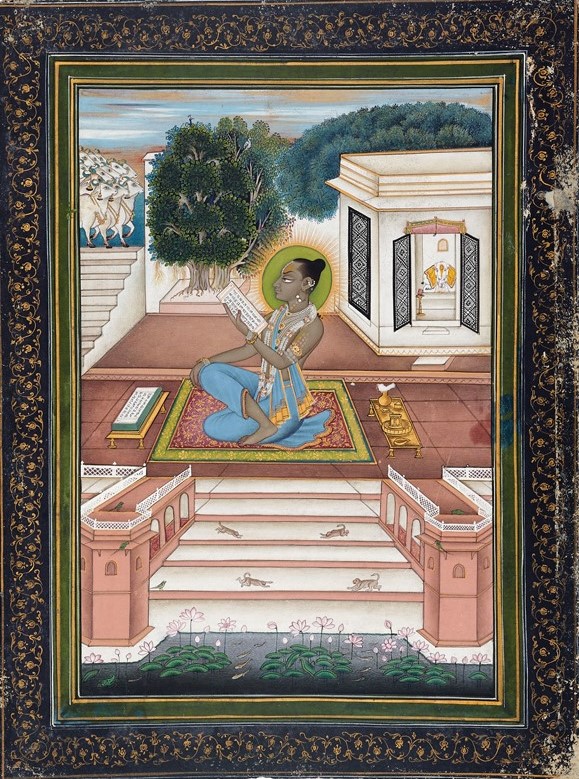
Not far from that house, at around the same hour perhaps, a man named Kanha was finishing the day's lowest labor, gathering up the sweepings and refuse from around the temple grounds, work the world had left to a man of his station and no one else. He owned nothing that could fill even one of the rich visitor's money bags. And yet Kanha had exactly what the rich man lacked. Each day, when his work was done, he would find the angle in the temple wall from which the sanctum's open doorway let him glimpse, just for a moment, the child form of Shrinathji at play, and at that glimpse he dissolved. Those who saw him said he wept without shame and stood rooted to the ground, a laborer transfigured by love into something closer to what a soul is actually for.
It happened that Gokulnathji, guarding the reverence due to the Lord's own child-form so that it would not be exposed to every careless glance from the street, had a new wall raised around that stretch of the temple. It was not built against Kanha; it was built for the deity. But it fell on Kanha like a door slammed shut on the one window of his life. With his single channel to the Lord bricked over, he grew wild with longing, refusing food, wandering distracted, until for three nights running Shrinathji himself came to him in dream and gave him a plain instruction: go and tell Gokulnath to bring that wall down. Kanha could not do it. He felt himself too small, too far beneath the master of Gokul's fourth house, to imagine walking up and making such a demand of him. So he did what frightened, faithful people often do: he told someone else, in a whisper, and let the truth travel on its own.
It reached Gokulnathji anyway. He sent for Kanha and asked him plainly what troubled him, and Kanha, no longer able to hide it, told him everything: the darshan, the wall, the three nights, the command he had been too humble to deliver himself. Gokulnathji did not rebuke him for the delay or question the dream's authority. He was, by every account, undone by it. He gathered the sweeper to his chest as a man of grace instantly recognized as such, and ordered the new wall torn down that same day, because a vision granted three nights running was proof enough for him, more binding than any wall he himself had raised. The phrase remembered from that day still circulates in Pushtimarg homes: victory to the receptivity of prem, victory to the lovers. It is, in miniature, the whole of what this man spent his ninety years teaching.
Gokulnathji was born in Gokul on the seventh day of the bright half of the month of Margashirsha in Vikram Samvat 1608, corresponding to December of 1551, the fourth of the seven sons of Vitthalnath, who was himself the son and successor of Vallabhacharya, the Mahaprabhu who had first opened the Pushti Marg, the path of grace, to Braj. When Vitthalnath came at last to divide his devotional inheritance among his sons, each received one image of Krishna and one household, or gruh, to build around it. Gokulnathji's portion was a four-armed golden Krishna that, by a coincidence too fitting to be only coincidence, already carried his own name, Gokulnathji, an image that had belonged, before it ever came into this family's keeping, to the household of Vallabhacharya's own wife. Around that image he raised the fourth of Gokul's seven great havelis, and there, a boy not yet grown, he began the seva that would occupy him for the rest of his life.
He did not withdraw from the world to do it. At sixteen he married a woman named Parvati, and the household they built together held three sons, Gopal, Vitthalrai, and Vrajratna, among other children. This, too, was doctrine as much as biography: the Pushti Marg that his grandfather had founded insisted that a householder's love, rightly offered, could carry a soul further than any renunciate's discipline, and Gokulnathji lived that claim rather than merely teaching it. His own disciples, tradition says, sometimes called him simply Vallabha, his grandfather's name, as if the founder's original fire had not merely passed down through a line but returned whole in this one grandson.
But it is as a teller of stories, not as a builder of walls or a father of sons, that Gokulnathji shaped the sampradaya most permanently. In satsang after satsang he wove into his teaching the remembered lives of the devotees who had gathered around his grandfather and, later, around his own father: eighty-four who had taken shelter with Vallabhacharya, and two hundred fifty-two more who had come to Vitthalnath. He seems to have told these as living illustration rather than formal doctrine, the way a teacher reaches for a story instead of an abstraction, and it fell to a younger kinsman in the line, Harirai, to gather what he had said, set it down in Braj Bhasha prose, and wrap each account in a commentary called the Bhavprakash, the illumination of its inner feeling. Together they became the Chaurasi Vaishnavan ki Varta and the Do Sau Bavan Vaishnavan ki Varta, and no telling of that literature's origin gives Harirai the story without also giving Gokulnathji the voice that first spoke it. What survives in those pages is a startlingly wide company: kings and beggars, Muslims and reformed wrongdoers, women running households no one else noticed, wanderers, drawn from Kabul in the north to the far Tamil country in the south, united by nothing but the one thing Gokulnathji had told the rich man he could not fake and had recognized instantly in a man with a broom. He was not inventing a theology when he wept over Kanha's story. He was watching, in his own courtyard, the very thing he had spent his life narrating about other people's courtyards.
Grief visited that fourth house too. Ghanshyam, the youngest of the seven brothers, kept in his own haveli an image called Madanmohanji, and one day it disappeared from its shrine without a trace. Gokulnathji's response was immediate and severe: whoever had taken his brother's Krishna, he vowed, would see their own line end with them. Ghanshyam himself never recovered from the loss; he gave up food in his sorrow and, tradition holds, died of that grief long before the image was ever found. It was only years afterward that Madanmohanji surfaced again, not in a thief's hands but in the quiet keeping of an old woman, one of the flower-women who strung garlands for Shrinathji's own daily worship, who had sheltered the small image in secret and gone on serving it with her own devotion the whole time it was believed stolen. Even here, in a story that began as theft and vengeance, the deeper current running underneath was the same one that had moved Kanha: love finding its way to hidden, unlikely custodians while everyone with more standing looked elsewhere.
His resolve was tested once more, publicly, late in his life. A rival ascetic named Chidrup, caught having diverted funds the emperor Jahangir had meant for the poor and for Brahmins, is remembered as having turned the emperor's anger away from himself by persuading him instead to strip Vaishnavas of their tulsi malas and their tilaks, the small rosary and the mark of clay on the forehead that carried no material value at all and, for a man like Gokulnathji, carried everything. Old by then, he set out on the long journey toward the emperor's camp regardless, prepared, those who preserved the story insist, to give up his home, his wealth, and his life itself over an ornament no bigger than a few beads and a smear of sandal paste. Word of that willingness is said to have reached Jahangir before Gokulnathji himself did. However the politics of the imperial court actually played out, the sampradaya's own memory of it holds that the emperor's heart changed, that Chidrup's deception came to light, and that the order was withdrawn, restoring to every Vaishnava in the empire the small sacred marks Gokulnathji had been ready to die rather than see stripped from anyone.
He lived to be about eighty-nine, dying in Gokul in early 1641 after more than seven decades spent almost entirely at the seva of the image that shared his name. Tradition remembers that dozens of his own disciples, as many as seventy-eight by one count, could not survive the news of his death and followed him within days; whether that number is meant literally or is simply the only language grief had for what he had been to them, it points at the same fact, that he had stopped being merely their teacher and had become, for many of them, the visible edge of what they loved. After him his followers divided into two streams, one that continued in the pattern of his brothers' houses, and another, called the Bharuchis, who came to hold even his personal belongings as sacred, venerating relics of the man himself alongside the image he had served, as though the Pushti Marg's own logic had arrived, in him, at its most literal conclusion: that a human being wholly given over to prem becomes, himself, a place where it can be found.
Two visitors came to that same threshold in Gokul: one carrying more wealth than the temple's own treasury, the other carrying nothing but a broom and a habit of looking up at the right moment. Only one of them got in. Nabhadas, writing of him within a generation, could spare only a single terse verse for a life this large, but a life does not need many verses if the story itself keeps being told, that the door does not open to what you bring, only to what you already love, however little that turns out to be. Anyone reading this at the end of a long day, with nothing much to offer and no lakhs of rupees to place at any threshold, is standing exactly where Kanha stood. The wall, whatever it is this week, does not have the last word. It never did.
Priti Is the Seed: Love Cannot Be Replaced by Renunciation
A wealthy man once came to Gokulnathji with an offering of lakhs of rupees, seeking initiation. When asked if he held any special love or attachment toward anything in this world, he replied proudly that he was attached to nothing. Gokulnathji turned him away. He explained: without a seed of priti, there is nothing to redirect. The guru's work is not to create love from emptiness but to take whatever love already flows in a person and turn it toward the feet of the Lord. A river that does not flow cannot be guided homeward. All the renunciation and all the wealth in the world cannot substitute for a living capacity to love. The Pushti Marg has always understood this. Grace does not enter an armored heart. The seeker who has extinguished every feeling in the name of detachment has left the teacher nothing to hold and nothing to turn.
Tilak commentary on Bhaktamal verse 89; Gokulnathji ke Chaubees Vacanamrita
The Wall That Had to Come Down: When Love Overrides Every Category
A sweeper named Kanha used to clean the path outside the temple of Shri Nathji. Each day, through the open gate, he would catch a glimpse of the Lord and be flooded with such love that he would stand weeping, unable to move. When Gokulnathji ordered a screen wall built to focus the congregation's attention, Kanha lost that glimpsed darshan entirely. For three nights in succession the Lord himself appeared to Kanha in dreams and commanded him to ask Gokulnath to have the wall removed. Kanha carried the message, trembling. When Gokulnathji heard it, he was overcome with prem. He embraced this sweeper before the assembly and ordered the wall torn down. Social standing, ritual purity, caste: none of these were the criterion. The one criterion was love, total, selfless, asking only to see the face of the beloved. The Lord himself had testified in three dreams. No wall may stand between a loving heart and its Lord.
Tilak commentary on Bhaktamal verse 89
The Varta Tradition: Ordinary Lives as Vessels of Extraordinary Grace
Gokulnathji gathered the spoken memories of the first disciples of his grandfather Vallabhacharya and shaped them into the great Varta texts: the Chaurasi Vaishnavan ki Varta and the Do Sau Bavan Vaishnavan ki Varta. Story after story shows how grace arrives without announcement to lives that seem ordinary, even disqualified. A grain merchant. A woman the world cast aside. A farmer. A sweeper. None of them had credentials. Each of them had a readiness to receive. In writing these lives in Braj Bhasha, the vernacular tongue of Vrindavan, Gokulnathji made the teaching available to everyone. The path of grace is not for the learned alone. It is for anyone in whom love has begun to stir. These stories are not merely history; they are mirrors. The reader is meant to see, in each transformed life, the possibility of their own transformation.
Chaurasi Vaishnavan ki Varta; Do Sau Bavan Vaishnavan ki Varta, compiled by Gokulnathji
Seva Is a Relationship, Not a Technique
In the Chaubees Vacanamrita, the twenty-four utterances recorded by his disciple Kalyan Bhatt, Gokulnathji returns again and again to a single point: the service of the Lord is not a set of methods to be mastered. It is a relationship to be entered, sustained, and deepened. The daily seva of the havelis, the aarti before dawn, the sringaar at midday, the shayan at night: these are not ritual performances. They are the acts of one who loves. When the heart behind them is absent, no outer correctness can substitute. And when the heart is present, even the simplest act, the lighting of a lamp, the offering of a flower, carries the weight of the whole path. This is the Pushti Marg understanding that Gokulnathji embodied and transmitted: bhakti is not earned through discipline. It is nourished through love, through presence, through the quiet daily turning of the heart toward the beloved.
Shri Gokulnathji ke Chaubees Vacanamrita, as recorded by Kalyan Bhatt
Grace Does Not Ask for Credentials
The Pushti Marg, the path of divine grace, was founded on a radical understanding: pushti, the Lord's nourishing grace, descends not because of merit, learning, lineage, or ritual correctness, but because of the soul's readiness to receive love. Gokulnathji spent his life demonstrating this. He shaped the Ashtachhap poets, whose bhajans still fill the havelis of Vraja, and he preserved the stories of disciples whose only qualification was an open heart. He taught that the acharya's role is not to manufacture devotion in someone who has none but to recognize genuine love wherever it appears and give it a direction. Whether the love arrives in the silk robes of a merchant or the torn cloth of a sweeper, the divine court accepts the same currency. Prem, real prem, overrides every category the world erects.
Bhaktamal verse 89 and tilak; Gokulanatha entry, Wikipedia; Varta Sahitya tradition, Pushti-Marg.net
Hindi text from OCR scan (Khemraj Shrikrishnadas Prakashan, CC0). May contain errors.