English rendering in progress
( ४१७ ) छप्पय | ( ४२६ ) अज्ञान ध्वांत अंतहिं करन, हतिय दिवाकर अवतस्थों ॥ उपदेशे वृपसिंह, रहत नित अज्ञाकारी। पक दत्त ज्यों नाथ संत पॉषक उपकारी ॥ बानी भालाराम सुहृदद
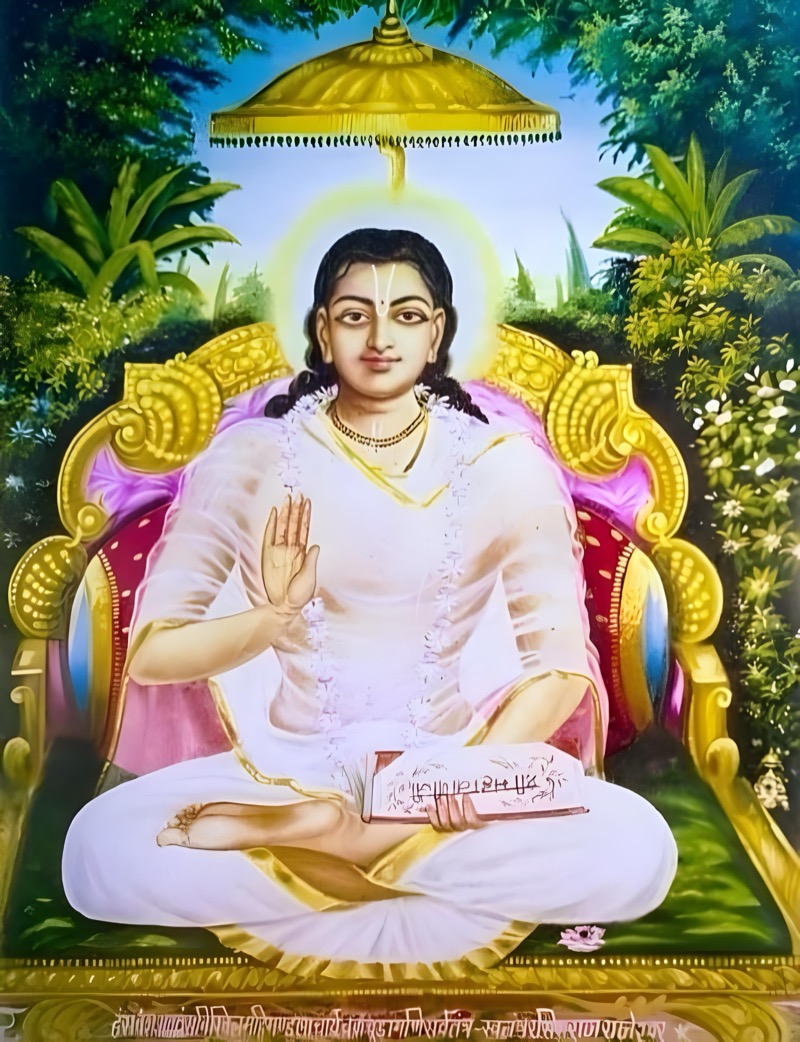
A young Brahmin walks into a hut on the outskirts of Vrindavan and asks Shri Bhatt Devacharya to make him a disciple. The old teacher does not open a scripture or ask his lineage. He simply seats the young man before him and says, look at my lap and tell me what you see there. The young man looks, looks again, and answers honestly: nothing, revered one, I see nothing at all. Any ordinary guru might have been offended by so plain a confession of spiritual blindness. Shri Bhatt only nods, as if he expected exactly this answer, and gives an instruction that sounds less like initiation than exile: go and circle Giriraj, the sacred hill of Govardhan, without pause, doing bhajan every step of the way, for twelve years. Then come back and tell me again what you see.
He goes. For twelve years the young man walks the parikrama path around Govardhan, through monsoon mud and summer stone, sleeping where night finds him, singing the names of Radha and Krishna into the dust with every footfall. When the twelve years are finished he returns to his guru, dusty and worn thin, and sits again in the same spot. Shri Bhatt asks the same question. And the answer that comes back is still, humbly, nothing. There is no anger in the young man's voice, no sense of a bargain unmet. So Shri Bhatt sends him back to walk the hill again, another twelve years, and he goes without a word of protest, because by now walking has stopped feeling like a sentence and has started feeling like a way of being alive.
Only after the second twelve years, twenty-four years of a single unbroken practice, does the young man sit again before his guru and, asked once more what he sees, give a different answer: I see Shri Radha and Krishn, seated together, on your lap. It is this answer, and not the earlier honest emptiness, that Shri Bhatt had been waiting a quarter of a century to hear, because it was never really a test of eyesight. It was a test of whether ceaseless remembrance can eventually reshape what the eye is capable of receiving. The seeker who could say nothing was still telling the truth; the disciple who could finally say Radha-Krishna was telling a deeper one. That disciple was Harivyas Devacharya, and this single, patient, twenty-four-year answer to a strange question is the seed from which the rest of his life as a teacher of Braj grew.
Tradition remembers him as born in Mathura into a family of Gaud Brahmins; Nabhadas's own verses in the Bhaktamal name his father Karamchand and compare that household, in the moment of Harivyas's birth, to the household of the sage Kashyap receiving a portion of the sun. The exact century of his life is genuinely contested. Manuscript evidence tied to his name has led some scholars to place him as early as the fifteenth century, living roughly between 1443 and 1543, while other careful readers of the Nimbarka lineage put him nearly two hundred years later, at the very end of the sixteenth century and the beginning of the seventeenth. What is not contested is that, unlike the acharyas before him in his line who had studied in the far south or in Kashmir, he was sent as a boy of eight to study in Kashi, in Varanasi, and remained there in rigorous study of scripture and logic until he was twenty-two, before Braj and its devotional world claimed him for good.
Within the Nimbarka Sampradaya's lineage of teachers, Harivyas stood at a hinge point. His guru's guru was Keshav Kashmiri Bhatt; his own guru, Shri Bhatt Devacharya, had composed a slender, intensely charged Braj-bhasha work called the Yugal Shatak, a hundred verses on the eternal amorous life of Radha and Krishna in Vrindavan. It was Shri Bhatt himself who set his disciple the labor that would define him: take these hundred terse verses and open them outward into a complete devotional world. What Harivyas produced in answer is the Mahavani, the work by which the whole Sampradaya still knows him. It unfolds in five limbs: Seva Sukh, on the daily rhythm of service to the divine couple through the watches of the day; Utsav Sukh, on the joy of festivals; Surat Sukh, on the intimacy of union; Sahaj Sukh, on the ache and sweetness of separation; and Siddhant Sukh, the small final section that gathers the philosophical ground beneath all the preceding rapture. He wrote it, and much of his other devotional life, under the pen name Hari Priya, beloved of Hari.
The theology beneath the Mahavani is not abstract. Harivyas taught, and lived, a devotion in which the practitioner does not simply worship Radha and Krishna from a respectful distance but learns to imagine herself, in the sakhi-bhava, as one of the sakhis, the female companions who serve the eternal, ongoing pastimes of the divine couple in a Vrindavan that never stops existing, hidden just behind the visible one. Every hour of the practitioner's day is folded into that unseen day: dressing the deities, feeding them, decorating the bowers, keeping festival, feeling the particular grief of separation and the particular fullness of reunion, not as metaphor but as a discipline of continuous inner attention. This is the same discipline the twenty-four years on the Govardhan path had already carved into him: devotion as the steady retraining of what one is capable of perceiving.
One story about him, preserved in the old commentarial verses, shows how far that discipline could travel outward into the world. Traveling with a company of sadhus, Harivyas came once to a village called Chatthawal, or in some tellings Katthawala, and found there a beautiful garden where he decided his party would take its evening rest and cook their one simple meal. But that same garden held a shrine to a village goddess, and someone had just slaughtered a goat there as an offering. Seeing the blood on the ground where he had meant to break bread, Harivyas and his companions were overtaken not by fear but by a kind of grief. They resolved, without argument among themselves, that they would touch neither food nor water in that place, whatever the cost. The cost was a night spent hungry.
By the middle of that night, the goddess of the shrine herself appeared before them in human form, radiant and strangely humbled, and asked them plainly why holy men were sitting starved rather than cooking their food. Harivyas answered her without softening it: how could they eat where a life had just been taken in her name, where such cruelty had been offered up as worship? Hearing this, the goddess did not defend the sacrifice. She knelt and asked to be initiated, to be made his disciple, so that she might learn a different way of being served. He granted it. What happened next is remembered as something closer to a small conquest than a quiet conversion: newly initiated, the goddess ran into the village, went straight to the headman's house, hauled him bodily off his cot and threw him to the ground, planted herself on his chest and announced that she was now Harivyas's handmaid and disciple, and that anyone in the village who would not likewise take initiation from him could expect the same treatment. Every soul in Chatthawal became his disciple that night. Later generations of the tradition remember this goddess by the name Chandika, and hold that she came in time to be venerated, under the name Vaishnavi Devi, in a shrine near Kashmir, though this is best understood as the tradition's own memory of her rather than an independently documented fact. What the story insists on, whatever its precise historical residue, is a teaching worth taking seriously on its own terms: that no power, however exalted or however accustomed to being feared, stands outside the reach of true bhakti, and that even a goddess can be humbled into discipleship by the sight of a saint who will not eat where cruelty has been served as devotion.
A second memory from that same body of commentary shows the same teaching turned toward a very different kind of outsider. A man who had spent his whole life believing that people like him were never permitted anywhere near sanctity came to Harivyas trembling, crying out for refuge, and fell flat on the ground before him. Harivyas did not hesitate, did not consult custom, and did not ask what the man had been before he arrived. He raised him up and gave him the same gift he gave to the kings who came seeking counsel, the mantra of the Divine Name, freely and completely. The point the old storytellers wanted remembered is unambiguous: the Name draws no lines that a frightened human being cannot cross, and a guru who has truly seen Radha and Krishna where he once saw nothing has no more use for the lines that ordinary society draws between one soul and another.
As he grew old, Harivyas became, almost against the grain of the solitary parikrama years that had shaped him, the head of a widening religious family. He sent twelve principal disciples out from Vrindavan to found their own branches of the tradition across the subcontinent, among them Swabhuram Devacharya and Parshuram Devacharya, the latter entrusted to carry forward the acharya's seat itself along with the shaligram deity known as Sri Sarveshwar Prabhu. Those twelve branches, several of them still active centers of worship today, are why saints descending in this line came to be called, simply, Harivyasi. Great and powerful men, princes among them, sought him out for instruction and, the old verses say, became as obedient before him as branches heavy with ripening fruit bow low of their own weight, needing no one to force them down. And yet those closest to him remembered something almost domestic alongside the grandeur: a small verbal habit, a phrase, Bholaram, Bholaram, that he would murmur as he spoke, a tiny human fingerprint left on an otherwise towering reputation.
He died, by the more commonly cited reckoning, around the middle of the sixteenth century, though as with his birth the exact date is not something scholarship can pin down with certainty. His samadhi stands at Narada Tila in Mathura, beside the resting places of his own guru, Shri Bhatt Devacharya, and his guru's guru, Keshav Kashmiri Bhatt, three generations of one teaching line lying together within sight of a statue of Narada, the wandering singer of Hari's praises among gods and men alike. His followers still mark his memory each year on Kartik Krishna Dwadashi. But the truest monument he left behind may still be that first, strange question asked of him in a hut on the edge of Vrindavan, and the twenty-four years of unhurried, uncomplaining walking it took him to earn a true answer. Anyone who has ever sat still and asked, honestly, what am I actually seeing when I close my eyes and look toward God, and had to answer nothing, nothing yet, is standing exactly where Harivyas once stood, on the near side of a patience that, given enough years and enough love, is remembered to have turned nothing into Radha and Krishna themselves.
Radha and Krishna: One Reality, Two Forms
The deepest teaching of Harivyas Devacharya flows from the Nimbarka tradition's understanding of Radha and Krishna as one inseparable reality. They are not two separate beings who happen to love each other. Radha is the very svaroopa, the essential nature, of Krishna expressed in feminine form, and Krishna is the very svaroopa of Radha. This is the heart of bhedabheda, the philosophy of simultaneous difference and non-difference. The soul and the supreme are distinct, yet never truly separate. In the nikunja groves of Vrindavana, this paradox does not create confusion; it creates sweetness. The seeker who enters devotion through this understanding finds that love itself is the resolution. You do not dissolve into the beloved and lose yourself. You meet the beloved fully as yourself, and that meeting is the highest rasa.
Mahavani (Srimadbhagavad Bhava Padavali), Harivyas Devacharya
Bhajana Has Its Own Radiance
The Bhaktamal records an event that speaks more clearly than any doctrine: a Devi who traversed the sky descended before Harivyas Devacharya and asked to become his shishya. The tradition does not tell this story to rank one tradition over another. It tells it to reveal what sincere, complete hari-bhajana does to a human being. When every fiber of longing is turned toward Shri Shyamasundara and Shri Radhika, when practice is not performance but genuine thirst, something accumulates that belongs not to the practitioner but to the current of devotion itself. That current carries the fragrance of every saint who has practiced before you. A goddess recognizing the teja of Harivyas Devacharya was recognizing the beauty of the source from which that light flowed. The invitation for every seeker is the same: enter the practice not to acquire power but to become transparent to something already luminous.
Bhaktamal of Nabhadasa, Chappaya 77; tikaEn commentary
The Mahavani: Entering the Eternal Groves Through Song
Harivyas Devacharya received from his guru Sribhatta Devacharya a garland of one hundred verses called the Yugala Shataka, describing the eternal lila of Radha and Krishna in the nikunja of Goloka Vrindavana. He was entrusted with opening those verses into their full fragrance, the way a bud opens at dawn. The resulting work, the Mahavani or Great Speech, became one of the high peaks of Vaishnava rasopasana literature. It was composed in Braj bhasha, the vernacular language of the cowherd country, because the language of milkmaids is itself a form of worship. The Mahavani is not commentary in the academic sense. It is an invitation to meditation. Each pada carries the practitioner toward the nitya lila, the eternal pastimes that are not past events but a present, ever-unfolding reality for those whose hearts have grown quiet enough to perceive it.
Mahavani; brajrasik.org biography of Harivyas Devacharya
The Guru's Dust and the Bowing of the World
The tradition says that when the charana-raja, the dust of his guru's feet, touched Harivyas Devacharya, the entire srishti, the whole of creation, came to offer namaskar. This image holds a teaching about the nature of spiritual transmission. Grace does not travel like information, from one mind to another through instruction alone. It travels the way pollen travels: by contact, by proximity, by the willingness to kneel before the source. The guru's grace is a living substance. It attaches to the one who bows in genuine humility and then spreads wherever that person walks. Harivyas Devacharya sent twelve shishyas in twelve directions, each carrying this living substance into different regions of the world. They did not create the longing they found in people's hearts. They recognized it and returned to it a name, a practice, and a path home.
Bhaktamal tilak commentary; tikaEn
Worship as Listening: The Vani That Was Heard
A tradition surrounding the Mahavani holds that its songs were not composed in the ordinary sense of literary crafting. They were heard. Harivyas Devacharya and his guru meditated on the nitya lila of Shri Radha Krishna, and in the stillness of that meditation the songs arose and were received. This understanding transforms how we relate to devotional poetry and to spiritual practice itself. The deepest bhajana is not performance but reception. The devotee who has quieted the noise of wanting and distraction discovers that the beloved is already singing. The Nimbarka tradition's rasopasana is built on this: the seeker does not manufacture love for Radha and Krishna but learns to become still enough that love already present can be recognized. The Mahavani is a transcript of that stillness.
brajrasik.org; Mahavani tradition within Nimbarka sampradaya
Hindi text from OCR scan (Khemraj Shrikrishnadas Prakashan, CC0). May contain errors.