English rendering in progress
(४०७ ) छप्पय। ( ४३६ ) केैशोमट” नरम॒कुटमणि, जिन की प्रश्चुता बिस्तरी ॥ कास्मीरिं की छाप; पाप तापनि जग मंडन। दइृठ हरिमक्कि कुठार, आन धर्म बिटप बिह-
On the road into Nadia the dust had barely risen before doors up and down the lane began to shut. Word had run ahead of the procession: elephants swaying under painted cloth, horses stamping at every crossing, a crowd of retainers and students thick enough to choke the street, and at the center of it all a covered chodol, an ornately carved palanquin, borne on the shoulders of men who never seemed to tire. Inside sat a scholar whose name alone was enough to empty a courtyard of pandits. He had come, as he always came, looking for someone left standing who would dare to argue with him, and in town after town across the length of India, no one had. The learned men of Nadia, proud of their own reputation for grinding rival logicians into silence, did exactly what every city before them had done. They bolted their doors and hoped he would pass through without noticing them.
The man in the palanquin was Keshav Bhatt, and the world called him Kashmiri, though the memory of his own lineage places his birth farther south, in the Deccan town of Pratishthana on the Godavari, known today as Paithan. It was in the valleys of Kashmir that he is said to have sharpened his Sanskrit into something like a blade, and it was there that Devi Saraswati's boon is remembered to have settled fully on his tongue, a fluency in poetics, grammar, and argument that no rival in the land could match. He carried the title digvijayi, conqueror of the four directions, and by the songs sung of him he had earned it three times over, having already humbled Vidyadharacharya, a formidable teacher of the Shakta path, somewhere in the mountains of Kashmir itself. His exact birth year is not something the tradition agrees on. One careful modern estimate places it near 1479, which, if it is close to true, would make him a man still in the vigor of his twenties or early thirties, not yet old at all, when the encounter that would decide the rest of his life took place on the bank of a river he had come only to praise.
Before Nadia, there was Mathura. Under the rule of Sultan Sikandar Lodi, worshippers at Vishram Ghat, the ghat where tradition says Krishna himself paused to rest after slaying Kansa, found themselves hemmed in by one restriction after another. The qazis who administered the town's religious law had never, in living memory, been made to yield an argument to anyone. Keshav Bhatt went to that ghat and did not flinch from them. He argued dharma and shastra against men trained in their own exacting jurisprudence, and where persuasion alone was not enough he simply refused to be moved, until, as Nabhadas himself sings of him, the very qazis who had conquered every challenger before him came to dread the sight of him arriving. The remembered history of that same ghat also places another great teacher, Vallabhacharya, at that same threshold in those same difficult years, each acharya credited in his own telling with helping to pry the restrictions loose. Whether the two men ever stood side by side, no source can say for certain. What the tradition insists on, and what it has never let go of, is that the ghat opened again, and that Keshav Bhatt's name was bound up with the opening.
That was the man riding into Nadia: a pandit who had already broken the nerve of qazis who broke everyone else, touring now through Bengal the way a monsoon moves along a coastline, expecting no more resistance here than he had met anywhere. He had heard that Nadia's scholars were unusually sharp, and he had come in part to see whether the reputation was worth anything. Chodol swaying, elephants and horses trailing behind, he wound down at last through Shantipur and on to Nadia's own ghats along the Ganga, the very river he intended to praise and, without knowing it yet, to be quietly undone beside.
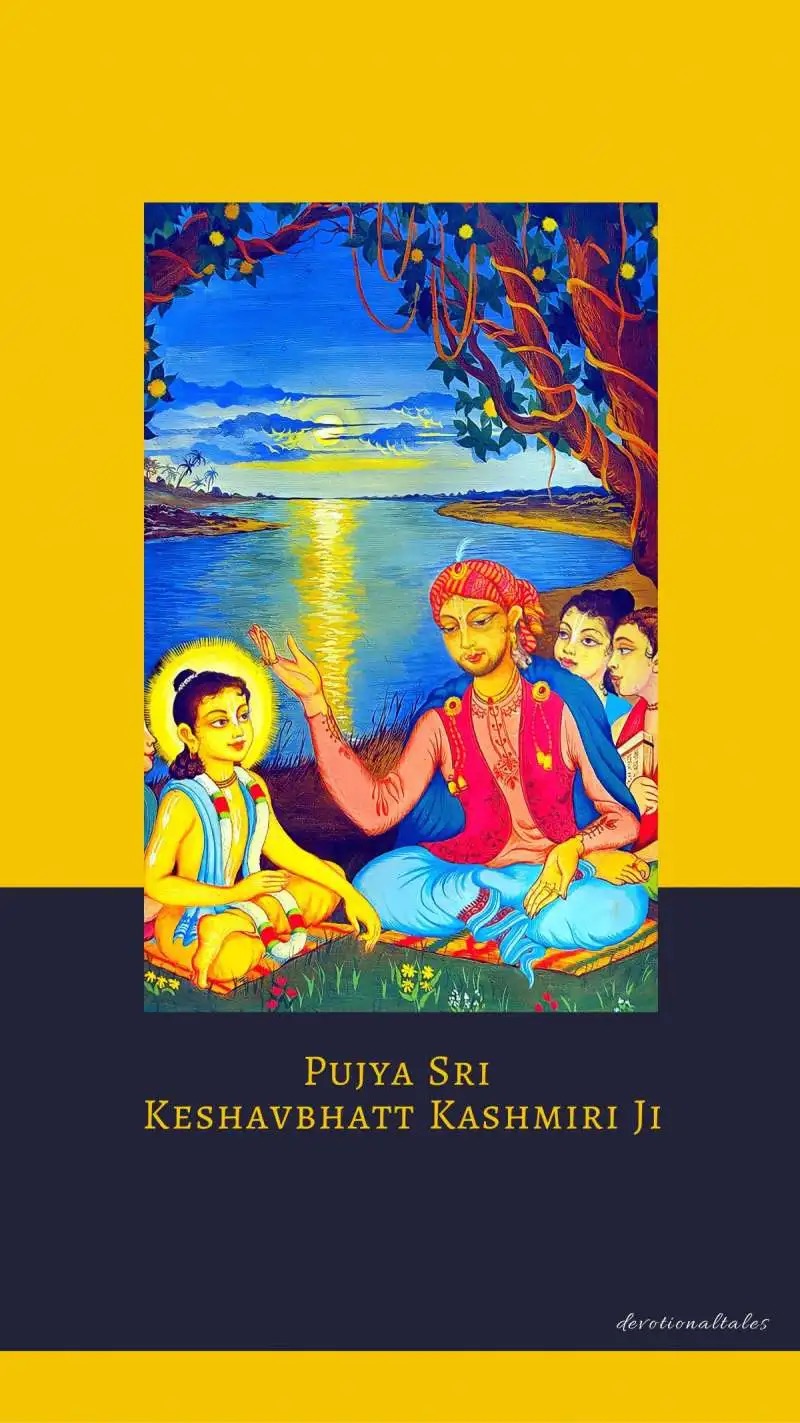
Every pandit in the city had barred his door except one. He was a slight young teacher of Sanskrit grammar who kept a small school of boys along the riverbank, still called by his boyhood name, Nimai, and not yet the figure the world would come to know as Chaitanya Mahaprabhu. Where every other scholar in Nadia hid, Nimai walked straight down to the water, folded his hands, and bowed at the great pandit's feet with none of the fear that had shut up the rest of the town. Your fame fills the whole earth, he said, and I have long wished to hear something of your learning from your own mouth.
Keshav Bhatt looked this soft-voiced young man over and could not resist a small jab. You spend your days teaching children their declensions, he said, and yet you come to me speaking of great matters? But there was something in the boy's gentleness, an utter absence of the vanity he was used to meeting in scholars, that disarmed him even as he teased. Very well, he said, ask what you like; your humility has pleased me. Nimai asked only this: what is the true form of Mother Ganga? What your own eyes rest upon, Keshav Bhatt answered, a little too simply, that itself is Ganga's form. Not satisfied, Nimai pressed him further. Compose something new on her, then, he said, not verses already carried in memory, something made fresh, right here, right now.
So Keshav Bhatt did what he had done in a hundred courts before this one. He composed on the spot, without a single pause, a hundred verses in praise of the river, each one turned and polished as if it had been sitting finished in his mind for years, difficult meter after difficult meter falling into place, image after image of Ganga's descent from Vishnu's foot and through Shiva's crown pouring out faster than any scribe could have written them down. He finished, pleased with himself, certain that no one standing on that riverbank had followed even half of what he had just done.
Nimai had followed every syllable. He recited one whole verse back to Keshav Bhatt, word for word, after hearing it exactly once, and then asked, quite gently, for its meaning to be explained. The great pandit, astonished now, wanted to know how a village grammar teacher had managed to hold an entire unrehearsed Sanskrit verse in memory after a single hearing. Nimai's answer was quiet. The one who gave you the power to compose it, he said, is the very one who taught it to me.
Then, Nimai said, tell me its merits, and its faults. The word fault landed on Keshav Bhatt like an insult. Where, he demanded, could there possibly be a fault in his poetry? Every composed verse carries some trace of imperfection in it somewhere, Nimai told him, and if you will permit me, I will show you where. Given leave, he did exactly that: he named the verse's ornaments one by one, and then, without cruelty, its flaws, among them, as later tellings of this meeting remember it, a single redundant phrase describing Shiva as the husband of Bhavani, a relation so already assumed by anyone hearing it that stating it outright folded back on itself and, read strictly, made the goddess sound as though she had more than one husband. Keshav Bhatt, a man who had never once in his life been asked to defend a line of his own poetry, had no answer ready. He excused himself, told the boy he would set him straight by morning, and withdrew to his lodging.
Alone that night he sat in meditation and called on Devi Saraswati, the goddess whose boon had carried him undefeated the length of India. When she came to him he did not hide his bewilderment. You gave me victory over the whole earth, he asked her, and now you let a boy from a riverside school defeat me?
He is no boy, she told him. He is Ishvara himself, come down in human form, an avatara before whom my own power does not reach far enough even to speak. What you were given today was not a defeat. It was darshan of the one whom mind and word cannot touch, and that is a gift very few in this world are ever offered.
In the morning Keshav Bhatt went back to the ghat, and there was no scholar's pride left in his walk. He came with love in his eyes and his hands folded, and Nimai received him with the same mercy Saraswati had described the night before. Never again, he told the pandit gently, seek to defeat anyone in argument, not even by accident. Krishna-bhakti is the true fruit of a human birth. Take that, and let the rest go. Keshav Bhatt took the words into his heart on the spot. He dismissed the great retinue that had followed him across the subcontinent, the elephants, the horses, the students who had marched behind his chodol from one conquered city to the next, and gave what remained of his life entirely to bhakti.
That life turned out to be a long and quietly productive one. The memory of the Nimbarka Sampradaya holds that Keshav Bhatt raised a pitha, a seat of the lineage, on the Yamuna at Dhruva Ghat in Mathura, and became one of its early acharyas, the first, some within the sampradaya say, whose footsteps in Braj can be traced with any real confidence. He kept writing for years: a commentary called Vedanta Kaustubha Prabha unfolding the Nimbarka school's vision of Brahman as at once one with and distinct from the world, a companion work on the Bhagavad Gita, commentaries on the Vishnu Sahasranama and on the Kena and Taittiriya Upanishads, and a detailed manual for temple worship, the Kramadipika. That last book traveled further than he could ever have guessed. Generations later, the Gaudiya Vaishnavas, the very tradition descended from the young grammar teacher who had unseated him beside the Ganga, would go on to quote his Kramadipika with respect inside their own great code of temple practice, the Haribhaktivilasa. His disciple Sribhatta would carry the devotion further still, putting Radha and Krishna back at the living center of Nimbarka theology through verse composed in the Braj Bhasha that ordinary people actually spoke, not in Sanskrit alone.
What Nabhadas sings of him, and what Priyadas and later Rupkala both preserve in their commentary, is not really a story about a great scholar's humiliation. It is a story about a title finally understood for what it was worth. Keshav Bhatt had spent years being called digvijayi, conqueror of every direction, and it took one quiet evening on the bank of the Ganga to show him the one direction he had never once thought to face: surrender. He kept every bit of his learning to the end of his days. He simply spent it, at last, on the one thing that outlasted every debate he had ever won.
True Conquest Begins With Setting Down the Self
Shri Keshav Bhatt Kashmiri Ji traveled across the breadth of Bharata as a digvijayī, a champion who had defeated every scholar he encountered. He carried the boon of Saraswati herself and had never lost a debate. Yet when the young Shri Krishna Chaitanya Mahaprabhuji sat beside him on the bank of the Ganga and spoke without fear or pretense, Bhattji found no ground to stand on. That evening, when Saraswatiji appeared and told him what he had met, everything changed. Mahaprabhuji said: from this day forward, do not defeat anyone, even by mistake. Shri Krishna bhakti is the fruit of this human life. Accept it. The teaching Keshav Bhattji lived out is clear: every talent, every achievement, every title we carry is preparation, not arrival. The self that needs to win must eventually be set down before something larger than it. That laying down is not defeat. It is the beginning of real freedom.
Bhaktamal tikaEn, Priyadas commentary; Chaitanya Bhagavata tradition
The Shakti That Gives Also Receives
When Mahaprabhuji heard a hundred fresh shlokas composed on the spot and then recited one of them back perfectly, Keshav Bhattji was astonished. He asked: how did you learn this so quickly? The answer came quietly: the One who gave you the shakti to compose it also gave me the shakti to receive it. This small sentence carries an enormous teaching. We generally think of spiritual gifts as private possessions, things we have earned or been given for ourselves. But the same source that pours inspiration into the poet pours receptivity into the listener. The same grace that enables one heart to speak enables another to hear. Nothing belongs to us alone. Talent, understanding, the capacity to be moved by beauty, all of it flows from one spring. When we recognize this, pride becomes difficult to sustain. Gratitude becomes natural. What we have been given is for giving.
Bhaktamal tikaEn, Priyadas commentary on Keshav Bhatt Kashmiri Ji
Even Flaws in Sincere Work Can Be Doorways
Mahaprabhuji did something unusual after hearing Keshav Bhattji's hundred shlokas. He asked to hear the dushana, the flaws, alongside the bhushana, the ornaments. Bhattji bristled. A great pandit does not easily accept that his composition holds imperfections. But Mahaprabhuji was not pointing to failure. He was demonstrating that every sincere offering, however accomplished, carries within it the texture of the human who made it. And he showed that even those textures can be illuminated with new meaning. The teaching for the seeker is twofold. First: do not be so attached to the quality of your offering that you cannot hear how it might be deepened. Second: a true teacher does not merely point to what is wrong. A true teacher shows you what is already there in you that you have not yet seen, and makes even the place of difficulty a place of learning.
Bhaktamal tikaEn, Priyadas commentary on Keshav Bhatt Kashmiri Ji
Bhakti Is the Actual Fruit; Learning Is the Path
Keshav Bhattji had received the anugraha of Saraswatiji herself and had used it to become the most formidable debater of his age. He was not wrong to develop that capacity. Kashmir's great tradition of scholarship had formed him, and that formation was real. But Mahaprabhuji's instruction was precise: Shri Krishna bhakti is the fruit of this human life. The scholarship, the debate, the victory across all directions, these were the path, not the destination. The Bhaktamal's verse for Keshav Bhattji calls him the crown-jewel among men because he understood the difference. He did not reject learning when he turned toward bhakti. He let learning be what it was, a vehicle, and stepped from the vehicle into what it had been carrying him toward. The question for every sincere seeker is the same: am I confusing the path with the fruit? The path is necessary. But you do not live on the path. You live in what you finally receive at the end of it.
Bhaktamal, Nabhadas; tikaEn, Priyadas; Nimbarka Sampradaya tradition
Devotion Does Not Retreat When Tested
Years after his transformation at Navadvip, Keshav Bhattji heard that pilgrims coming to bathe at Vishrant Ghat in Mathura were being harmed through an oppressive device erected at the ghat's main entrance. He was in Kashmir. He could have remained there, absorbed in his own bhakti, at peace in his own practice. Instead he gathered one thousand shishyas and traveled to Mathura. Through anushthana and deep sadhana, he invoked the prabhav of Shri Sudarshan Chakraji, walked directly through the place of harm, and through sustained effort cleared the ghat so that Bhagavad-bhakti could continue there without obstacle. He gave updesh to all those who had been displaced, instructing them to take refuge in the Nama of Bhagavan. This is the other face of the saint: not only the inner absorption, but the willingness to place that inner strength in service of those who cannot protect themselves. Bhakti received in full measure pours outward.
Bhaktamal tilaHi and tikaEn; Nimbarka Sampradaya historical accounts
Hindi text from OCR scan (Khemraj Shrikrishnadas Prakashan, CC0). May contain errors.