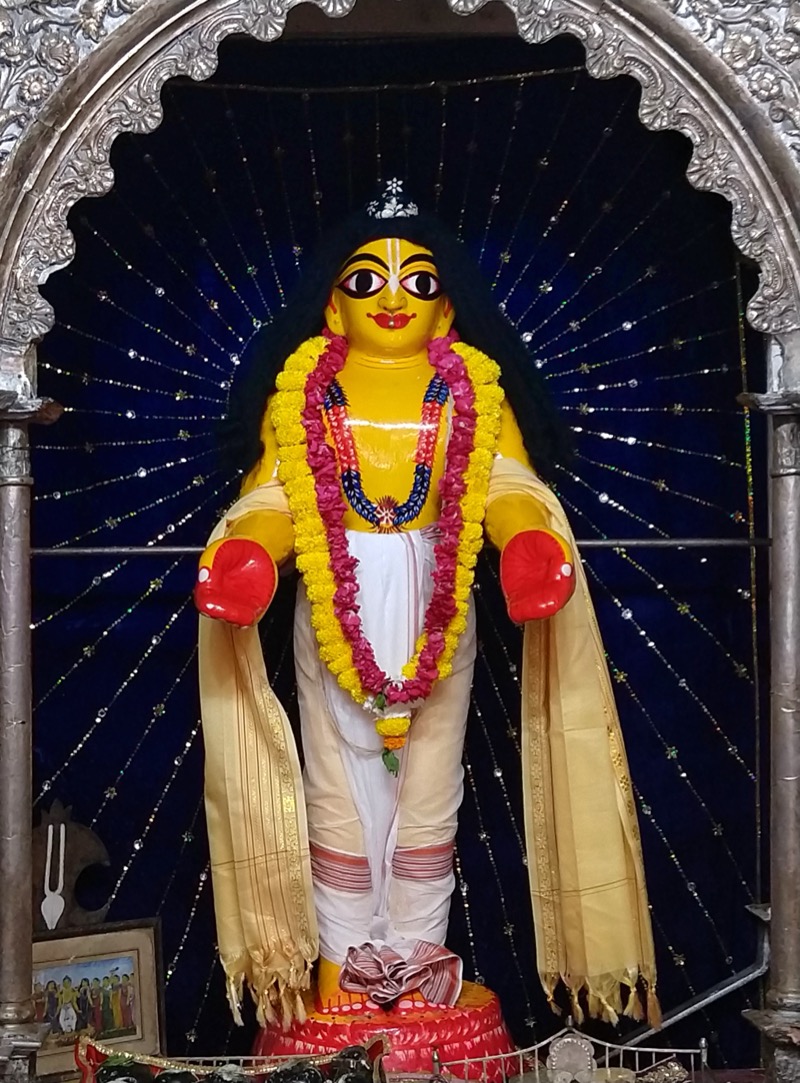
On the night of a full lunar eclipse in February 1486, the town of Navadvip in Bengal was already awake. By old custom, when the moon darkens, the faithful pour into the streets and riverbanks shouting the names of God so that the shadow devouring the moon will loosen its grip. It was into that roar of "Hari bol! Hari bol!" rising off the banks of the Ganga that a son was born to Jagannath Mishra, a gentle Vedic scholar who had come to Navadvip from Sylhet, and his wife Sachi Devi, daughter of the astrologer Nilambar Chakravarti. The family gave the boy the formal name Vishwambhar, sustainer of the universe, but Sachi, noticing the neem tree under which he had come into the world, called him Nimai, and Nimai was the name that stuck to him through a boyhood nobody in Navadvip ever forgot.
He grew up as the most maddening kind of prodigy: a boy who could outargue grown pandits in the town's famous schools of nyaya logic before he had a proper beard, and who used that same wit to steal butter, tease bathing women at the ghat with philosophical riddles, and turn his mother's kitchen upside down. Navadvip in those days considered itself the capital of Sanskrit learning in all of Bengal, and Nimai, once he opened his own school, drew students away from older, more established teachers simply by being sharper than they were. He married young, a soft-spoken girl named Lakshmipriya, who died of snakebite while he was away lecturing in East Bengal; grief-stricken, he married again, a devoted young woman named Vishnupriya, and settled into the life that Navadvip expected of him: a brilliant, slightly arrogant grammarian on his way to becoming the town's next great scholar. Nothing in that life hinted at what was coming.
What undid him was a funeral errand. When his father died, Nimai traveled to Gaya to perform the shraddha rites owed to a departed parent, and there, among the pilgrims and ascetics crowding that holy town, he fell in with a wandering monk named Ishvara Puri. Something in the old man's manner broke the scholar open. Nimai begged to be initiated, and Ishvara Puri gave him the Gopala-Krishna mantra, a string of syllables that should have meant nothing more to a Sanskrit master than any other mantra he had chanted a thousand times. Instead it undid him completely. He wept without being able to stop. He forgot to eat. On the road home to Navadvip his companions watched a proud young logician dissolve, hour by hour, into a man who could not finish a sentence about grammar without breaking into sobs over Krishna. When he reached his school and his students gathered for their usual lesson in the fine points of Sanskrit compounds, their teacher instead began teaching them to weep and chant the name of Hari. Some thought he had lost his mind. Slowly, Navadvip itself began to lose its mind along with him.
Gaudiya tradition would later read a hidden logic into this transformation, one that this very tilak text preserves in its own words: that Krishna, standing before the boundless, unrepayable love of the gopis of Vraj, found himself for once outmatched, and wondered how their fair-limbed radiance, blushing with sixteen kinds of ornament, had somehow entered his own dark form when he danced among them in the forest; so he resolved that if their color had already mixed into his shyamal hue, he might as well wear it outright, and the dark son of Yashoda became the golden son of Shachi, Krishna Chaitanya, dancing now not with gopis in a moonlit Vrindavan but with weeping devotees in the lanes of Bengal. Devotees also told, and tell still, of an old householder named Advaita Acharya who for years before Nimai's birth had stood in the Ganga each morning offering tulasi leaves and river water, calling out for Krishna to come down and rescue an age that had forgotten how to love God; when word reached him that the logician's son in Navadvip had begun weeping uncontrollably at the name of Hari, Advaita is said to have laughed and wept together, certain his long prayer had finally been answered. Alongside Chaitanya walked a broad-shouldered companion named Nityananda, whom this same tradition holds to be Balarama himself, Krishna's own elder brother, who had once been content with the wine of Vraj but now wanted nothing except to drink prema, divine love, however violently intoxicating it proved to be.
What followed in Navadvip was not quiet devotion but public uproar. Chaitanya organized bands of singers who moved through the town at night with drums and cymbals, singing the names of Krishna until whole streets emptied into the procession. Witnesses who wrote of these gatherings describe things that read like fever dreams: his golden body flushing red in waves, as though a bar of iron had been thrust into a furnace; his joints loosening and his limbs trembling until attendants had to hold him upright; tears pouring from his eyes in twin streams that devotees likened to the fountains of Radha and Krishna's own united love, as if the god and goddess of Vraj were weeping together through one human face. Onlookers who had never cared for religion found themselves swept into the singing without meaning to be. Bengal, this tilak insists, had scarcely known bhakti before Chaitanya arrived; whatever the fuller truth of that claim, his own companions certainly believed they were watching devotion get invented anew in front of them.
The noise eventually reached the ears of Chand Kazi, the Muslim magistrate charged with keeping order in Navadvip. Uneasy at gatherings he could not control, he confronted a party of singers, seized a mridanga drum, and smashed it, warning that the next kirtan would cost the singers their property. Chaitanya's response was neither violence nor submission but a bigger kirtan still. He called for every household in Navadvip to come out that same evening, and by nightfall a river of torches was moving through the town toward the Kazi's own door, drums thundering, voices raised in the name of Hari. The magistrate, watching an unstoppable tide of his own townspeople bearing down on his house in a mood of unbreakable joy rather than anger, chose to come out and meet Chaitanya rather than bar the door. What passed between the two men that night, tradition remembers as a long and respectful exchange about scripture and the nature of God, at the end of which the Kazi, moved rather than defeated, agreed that the singing would not be silenced again. It stands as one of the gentlest confrontations in the whole of Indian devotional memory: not a riot, but a procession that argued its way into a magistrate's heart.
Of all the stories told from these Navadvip years, none is loved more than that of two brothers named Jagai and Madhai, who had fallen so far into drink, violence, and theft that decent people crossed the street to avoid them. Nityananda, walking through the town one day with a companion, approached the two men and asked them simply to chant Krishna's name. Madhai, drunk and enraged at the interruption, hurled a piece of broken clay pot at him; it struck Nityananda's forehead and opened a wound that ran with blood. Nityananda did not strike back. He stood there bleeding and smiling, still asking the brothers to chant. When Chaitanya learned what had happened, he arrived in a fury that devotees describe as almost unbearable to witness, ready to destroy the two men on the spot for what they had done. It was Nityananda himself who threw himself at Chaitanya's feet and begged for their lives: let his own devotion, he said, stand as the price of their sin. Something in that plea broke both brothers open the way the Gaya mantra had once broken Nimai open. They fell weeping at Chaitanya's feet, gave up their old life completely, and spent the rest of their days chanting the very name they had once mocked. The tilak's own image, that a single wave of this prema could wash away sin equal to countless Ajamilas, the proverbial sinner of the Puranas redeemed at the last moment, finds its clearest proof in these two ruined brothers turned devotees.
At twenty-four, still a young man by any ordinary measure, Chaitanya took the vows of sannyasa from Keshava Bharati at the town of Katwa, cutting himself off from home, wife, and the possibility of ever returning to the ordinary life of Navadvip. Sachi Devi's grief at losing her son to renunciation, and Vishnupriya's decision to spend the rest of her life in solitary worship, waiting for a husband who would never come back to her, are remembered as some of the quietest and saddest threads in his story, easily lost beside the drama of his public ecstasies. From Katwa he turned toward Jagannath Puri on the Odisha coast, singing his way there through village after village, and it was Puri, not Navadvip, that would hold him for nearly the rest of his life.
When he first entered the great temple and looked upon the deity of Jagannath, he collapsed into a trance so complete that onlookers thought he had died. Sarvabhauma Bhattacharya, the kingdom's most formidable Vedanta scholar and no friend of untutored ecstasy, took the unconscious young man into his own home to observe him, half suspecting some kind of fit or disease. What began as clinical curiosity turned, over seven days of debate, into total surrender: Chaitanya answered every objection Sarvabhauma raised about the nature of the scriptures, then went further and revealed to him, in the middle of their conversation, a six-armed form combining Rama, Krishna, and the ascetic Chaitanya himself in a single body. Others in Puri would later say they had seen this with their own open eyes: that in the middle of ecstatic dance he had shown himself four-armed like Vishnu, and again six-armed, before the crowds of Jagannath Kshetra, teachings so widely witnessed that this tilak calls on that public testimony as its own proof, rather than asking anyone to take miracles on faith. Sarvabhauma, the proud logician, became one of his most devoted followers.
On the banks of the Godavari, at Sarvabhauma's own urging, Chaitanya sought out a nobleman and provincial governor named Ramananda Raya, whose understanding of the deepest, sweetest devotional moods of Radha and Krishna had no equal in the region. For ten days the two men talked without stopping, an ecstatic sannyasi and a worldly administrator, tracing the whole architecture of divine love between them, and out of that meeting came much of the theology of feeling, of rasa, that later Gaudiya teachers would spend their lives elaborating. Back in Puri, Chaitanya's remaining years fell into a private, often frightening intensity. Attendants had to watch over him at night because his ecstasies would carry him bodily out of his room; once, mistaking the moonlit waves of the Bay of Bengal for his beloved Yamuna, he ran and threw himself into the sea. His emaciated body drifted until it tangled in the net of a fisherman working the shore after dark, who thought at first he had hauled in a corpse and very nearly abandoned it before two of Chaitanya's closest companions, Swarupa Damodara and Ramananda Raya, found the fisherman and rushed to the spot; chanting Hari's name over the still body, they brought their master back from what looked, for a long moment, like death.
It was also from Puri that Chaitanya sent two brothers, Rupa and Sanatana, once powerful ministers at the Bengal court, into the forests of Vrindavan with instructions to recover its lost holy sites and set down in writing the philosophy and poetics of the devotion he had unleashed but never wrote down himself. They and four companions, remembered together as the Six Goswamis of Vrindavan, built out of that instruction the entire literary and theological foundation of Gaudiya Vaishnavism. Among Chaitanya's circle in Puri lived also Haridas Thakur, honored as Namacharya, teacher of the holy name, who sat daily beneath a tree called Siddha Bakula chanting Krishna's names some three hundred thousand times before nightfall, a discipline he had kept up even through years of persecution and public whipping in his younger life for refusing to stop chanting. When death finally came for Haridas in Puri, he asked to have Chaitanya's foot placed upon his chest, and died with his master's face the last thing he saw and his master's name, Krishna Chaitanya, the last words on his lips; Chaitanya himself carried the body to the sea and buried it in the sand with his own hands.
Chaitanya's own end, on a June day in 1534, has never been settled into one agreed story, and honesty demands saying so rather than choosing a single dramatic version and presenting it as fact. Some among the Gaudiya faithful hold that he walked into the Jagannath temple in a last, complete wave of longing and was simply absorbed into the deity, leaving no body behind to mourn. Others say he entered the nearby Tota Gopinath temple and merged into that image of Krishna instead. Still other, older Bengali accounts speak of an injury to his foot during the Ratha Yatra chariot festival that turned fatal, or of him walking into the sea a final time and not returning. No version can be checked against the others, and this account will not pretend otherwise; what can be said with confidence is only that he vanished from Puri that year, and that no single agreed record of his final hours survives him.
What he left behind more certainly is a fistful of Sanskrit verses called the Siksashtakam, the only writing anyone has ever attributed directly to his own hand, in which he asks that the holy name be chanted in a spirit humbler than a blade of grass in the road and more patient than a tree, giving honor to everyone and expecting none in return; and the maha-mantra of Hare Krishna and Hare Rama that spread out from Navadvip's lanes to Puri's temple courtyards and, centuries later, far beyond India altogether. This tilak closes its account of him by saying that his disciples and their disciples in turn became luminaries who ferried countless souls across, that whatever wickedness stood in their way was drowned as easily as the sins of a thousand Ajamilas, and that the whole earth was, in the end, filled up with bhakti. Whatever a skeptical reader makes of six arms or a vanished body, it is hard to read of Jagai and Madhai weeping at Nityananda's bleeding feet, or of Haridas dying with his teacher's foot on his heart, and not want to sit down somewhere quiet and simply say the name.
The Name Is the Practice
Chaitanya Mahaprabhu taught that in this age of Kali, the chanting of the holy names is not a preparation for spiritual life: it is spiritual life itself. The Hare Krishna Mahamantra carries within it everything a seeker needs. No special initiation, no caste qualification, no scholarly preparation is required. The Name gives itself freely to anyone who calls it sincerely. Mahaprabhu took this teaching into the streets, organizing town-wide processions of kirtan that reached every lane and every person. The Name, he showed, does not wait for us to become worthy. It works the transformation from within, cleaning what the scriptures call the dust accumulated on the mirror of the heart.
Shikshashtakam, verse 1; Chaitanya Charitamrita
Achintya Bhedabheda: One and Different, Inconceivably
The philosophy Mahaprabhu taught is called Achintya Bhedabheda: inconceivable simultaneous difference and non-difference. The individual soul and Bhagavan are neither wholly identical nor wholly separate. They share the same quality, as a ray of sunlight shares the quality of the sun, yet they are not the same in measure or nature. This relationship is achintya, inconceivable, not a problem to be solved by the mind but a truth to be entered through bhakti. The jiva is eternal, relational, and destined for loving union with the personal Bhagavan. Bhakti is not a step on the way to something else: it is the eternal condition of that relationship, fully realized.
Teachings of Lord Caitanya; Chaitanya Charitamrita, Adi-lila
Bhakti Is the Goal, Not the Method
One of the most clarifying things Mahaprabhu revealed is that prema, pure love for Krishna, is not merely the path to liberation: it is liberation itself. The highest human aspiration is not the dissolution of the self into formless awareness, but the flowering of the self into loving relationship with the personal Bhagavan. The Vrindavana Gosvamis, working from Mahaprabhu's directions, systematized this understanding in dozens of Sanskrit texts. Bhakti does not culminate in jnana; jnana, fully ripened, recognizes bhakti as its own true meaning. To love Bhagavan with your whole heart is not a beginning: it is the end that everything else was pointing toward.
Chaitanya Charitamrita, Madhya-lila 8; Bhakti-rasamrita-sindhu
The Grace That Does Not Wait for Merit
Shri Nityananda Prabhu, Mahaprabhu's closest associate, walked into the streets and brought the excluded and the criminal into the embrace of Hari Nama. The story of Jagai and Madhai is famous: two men notorious for violence and dissipation, transformed not by rejection but by insistence on grace. Nityananda absorbed their violence, continued offering love, and refused to abandon them. This is the teaching that lives in the sankirtan movement: the Name does not require a clean heart before it will enter. It enters in order to clean. Mahaprabhu and Nityananda gave what the tradition calls patita-pavana, liberation for the fallen, to those who had no conventional claim on it. The door of bhakti opens from the inside out.
Chaitanya Bhagavata; Chaitanya Charitamrita
Viraha: The Fullness Hidden in Longing
In his last years at the Gambhira in Puri, Mahaprabhu lived in the bhava of Radharani: the longing of separation from the beloved. He wept through the nights. He pressed his face against the stone walls. He would hear certain verses from Jayadeva or Chandidasa and dissolve entirely. This was not suffering in the ordinary sense. It was the most precise form of spiritual knowing available: to inhabit longing so completely that what is longed for becomes present within the longing itself. Viraha, separation, is in the Gaudiya understanding not the opposite of union but its deepest mode. The ache of love for Bhagavan is itself a form of nearness. Even in the anguish of not seeing, the one who loves is fully with the beloved.
Chaitanya Charitamrita, Antya-lila; Shikshashtakam, verses 7-8
The Five Practices That Sustain the Heart
Mahaprabhu gave a practical map for the seeker who asks how to live. He taught five practices as especially potent: associating with devotees who keep the Name alive in their hearts; chanting the holy names of the Lord; hearing the Srimad Bhagavatam, which tells the story of Bhagavan's forms and qualities and lilas; residing at or holding in memory the sacred tirthas, particularly those of Vrindavana and Navadvipa; and worshipping the deity with genuine love rather than mere ritual compliance. These are not duties imposed from outside. They are the natural movements of a heart that has tasted something real and wishes to stay close to the source of that taste.
Chaitanya Charitamrita, Madhya-lila 22
Humility as the Condition of Devotion
The third verse of the Shikshashtakam, Mahaprabhu's only written legacy, gives the inner posture required for the Name to work fully. He writes: one should be humbler than a blade of grass, more patient than a tree, ready to offer respect to all, seeking no respect for oneself. Then the Name can be chanted at all times without obstruction. This is not an ethical instruction separate from practice: it describes the actual inner condition that makes continuous remembrance of Bhagavan possible. Pride and the desire for recognition pull the mind back toward itself. Humility leaves the mind open toward the beloved. The tree gives shade without asking to be thanked. The blade of grass bends without breaking. These are the qualities of a heart that can sustain love.
Shikshashtakam, verse 3
Hindi text from OCR scan (Khemraj Shrikrishnadas Prakashan, CC0). May contain errors.