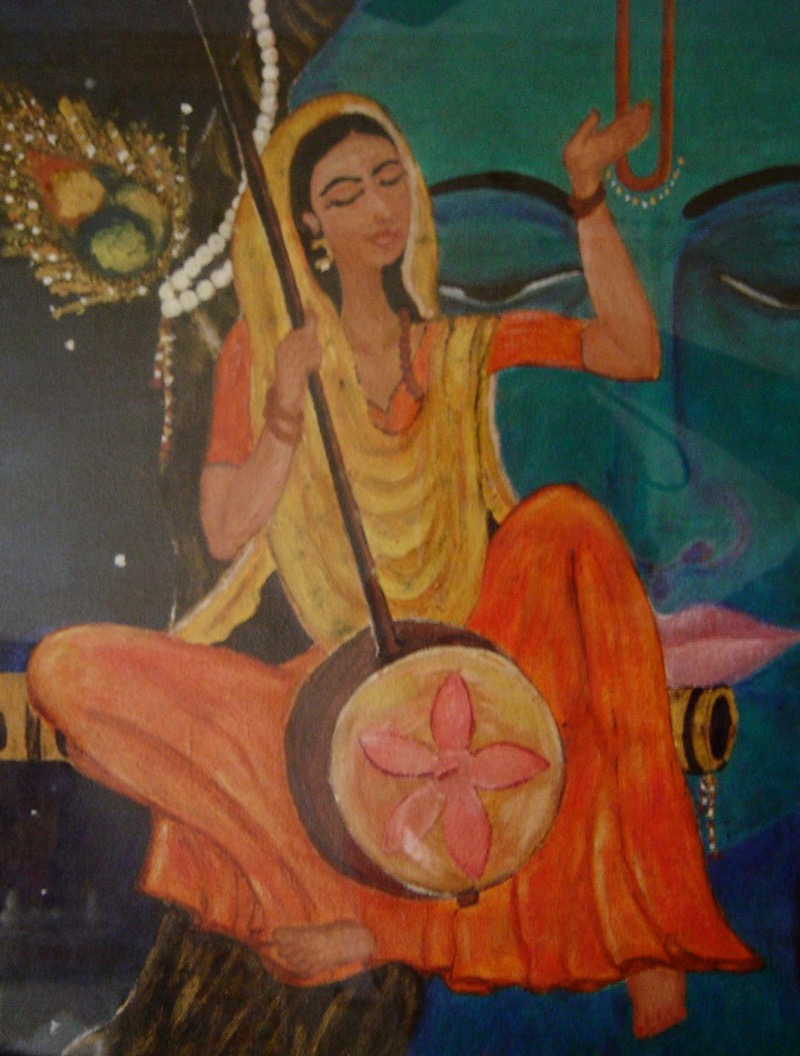
Chhappay:
As the great satis are the exemplar of sattva, so too the sattva of Sursuri remained. The most generous couple renounced their home and went to the forest. O saints, hear: a wonder occurred there; do not be disheartened. While they were seated in solitude, wicked ones came and caused distress. Then Shri Sharngapani assumed the form of Narahari (Nrisimha). The pativrata of Sursuranand's wife was protected by Nrisimha. As the mahasatis' sattva is praised, so the sattva of Sursuri remained intact.
( ३७६ ) छप्पय | ( ४६७ ) 4.7 7 महासती सत ऊपमा, त्यों सत्त सुरसुरी को रहो ॥ अति उदार देपती त्यांगि ग्रह, बन को गवने॥ अचरज
They were sitting in the deep quiet of a forest, husband and wife, with nothing left to lose in the ordinary sense, when the ordinary sense of danger came looking for them anyway. A band of violent men had wandered into that solitude, and the moment their eyes fell on the woman seated there, on Sursuri, wife of Sursuranand, something in her bearing, her extraordinary beauty, marked her out. They came at her not to rob but to seize her. There was no wall, no village elder, no sword between the couple and what was about to happen. There was only the name they had spent their whole married life repeating.
In that instant, tradition says, husband and wife threw their minds toward a single refuge: Sharngapani, the Bow-Handed Lord, Raghuvir, the hero of the House of Raghu, whom they had already given everything else in life. And the Lord did not send help. He came Himself, and He came as Narahari, the man-lion, Nrisimha, the form most people know from a different story altogether, the one where a father tries to kill his own son and is torn apart on a threshold at twilight. That same ferocity now poured itself into a forest clearing to answer a wife's terror. The wicked men were destroyed where they stood, and Sursuri's pativratya, the chastity that was the visible shape of her whole surrendered life, remained untouched. Then, before disappearing, the Lord softened. He let the couple see Him not as the roaring man-lion but in his gentler, gracious form, Raj-Madhuri, sweetness enough for a king to wear, and only after they had drunk in that sight, fulfilled and at peace, did He withdraw.
This is very nearly the entire story that survives of Sursuri in her own words, or rather in Nabhadas's words about her, and it would be dishonest to pretend otherwise: no birthplace is recorded for her, no dates, no account of her childhood or her death. What survives instead is sharper than biography. It is a single incandescent afternoon, framed on both ends of its telling by one claim, that as the great satis of old were the very embodiment of sattva, so the sat of Sursuri stood unbroken. Nabhadas is not interested in where she was born. He is interested in the fact that her integrity could not be taken from her even by force, and he wants that fact remembered for as long as the Bhaktamal is read.
To understand why that single episode mattered enough to preserve, it helps to know where Sursuri stood in her own time. She and her husband belonged to the innermost circle of Swami Ramananda, the great Vaishnava teacher who lived and taught chiefly in Kashi somewhere in the long stretch of the fourteenth and fifteenth centuries, whose dates different chroniclers place differently but whose impact nobody disputes. Ramananda gathered around him twelve disciples remembered together as the dvadash mahabhagwat, the twelve great devotees, and that circle included figures whose names would go on to reshape the religious imagination of North India: Kabir, Raidas, Dhanna, Pipa, Sena, Anantanand, Sukhanand, Bhavanand, Naraharyanand. Two women stood among these twelve. One was Padmavati. The other was Sursuri. Ramananda is remembered as the guru who refused to let birth or sex decide who could sit at his feet and be called a bhagavata, and Sursuri's presence in that list of twelve is itself a quiet, lasting record of that refusal. She was not an appendage to her husband's discipleship. She was named alongside him as one of the twelve.
Her husband, Sursuranand, was no simple householder either. Tradition credits him with putting nine searching questions to Ramananda himself, preserved in a work associated with the guru's circle called the Vaishnav-Matabja-Bhaskar, questions asking what the true mantra of a Vaishnava is, who the ishta-devata, the chosen deity, ought to be, what path actually leads toward liberation, what the supreme dharma consists of, how the different kinds of Vaishnavas are to be understood, and where such devotees properly dwell. Whether every detail of that attribution has survived scholarly scrutiny intact is less important than what it tells us about the household Sursuri lived in: this was not a home of unreflective piety. It was a home where the deepest questions of Vaishnava faith were asked out loud, argued over, and carried to the guru directly. Sursuri's own sat, then, was not naive innocence. It was the disciplined constancy of a woman who had spent years in the company of people determined to understand exactly what they were surrendering to and why.
And surrender, in the fullest and most literal sense, is what came next. Nabhadas calls them an exceedingly generous couple, and the generosity he describes was total: they gave away their household, their comforts, everything that could be called property, and left home together for the deep forest so that they could do nothing else, undistracted, but bhajan of Sitaram. It is worth pausing on the fact that this was a shared renunciation. So many stories of this kind, in this period, involve one spouse leaving and the other left behind, grieving or resisting. Here husband and wife walked into the wilderness side by side, choosing the same forest, the same austerity, the same undivided attention to the Divine Name, as one decision made in common. Whatever else is missing from her story, that fact alone tells us something rare about the marriage itself.
It was into that chosen poverty, that chosen solitude, that danger arrived. And this is worth sitting with rather than rushing past: the men who came upon them were drawn there by nothing supernatural, only by the very human fact of a beautiful woman sitting undefended in an empty place. The peril Sursuri faced was not abstract or symbolic. It was the plain, practical danger that any woman without walls around her has always faced, made worse by isolation and by having given away every ordinary means of defense. Nabhadas does not soften this. He lets the fear stand, lets the reader feel exactly how exposed the couple were, precisely so that what happens next lands with its full weight.
What happens next is a theological choice that deserves real attention, because it is not the obvious one. Nrisimha's story, as most people carry it, belongs to Prahalad: a child persecuted by his own tyrant father, saved by a form that erupts out of a pillar at dusk to keep a promise that the boy could be killed by neither day nor night, man nor beast, weapon nor bare hand. That is where devotional memory usually leaves the man-lion, frozen in one unrepeatable moment from the Puranas. The Bhaktamal will not let him stay frozen there. It brings that same ferocity forward hundreds of years and sets it loose again, this time not to save a child from a father but to save a wife's integrity from strangers in a forest. The implicit claim is bold: the Lord's forms are not museum pieces bound to a single ancient episode. They are living responses, available again wherever a devotee's refuge in Him is total and sincere. Whoever calls out to Sharngapani with nothing held back may find that the same fire that once tore through Hiranyakashyap's chest is still burning, still willing to answer.
There is a second layer of meaning worth drawing out, and it sits in that repeated word sat. In the couplet's own structure, Sursuri's ordeal is bracketed on either side by a comparison to the mahasatis of the Puranas, Arundhati, Anasuya, Lopamudra, Savitri, women whose fidelity was itself understood as a form of spiritual power, strong enough to alter fate, strong enough to command even death. Sat here is not merely a private domestic virtue to be guarded jealously as a family's honor. It is treated as something closer to cosmic truth, as inviolable as the laws that hold the world together, and inviolable truth, the text suggests, draws its own protection the way a lodestone draws iron. Sursuri's chastity survives the attack not because she or her husband found some clever means of defense, but because what she had made true about herself through years of devotion could not, in the end, be broken from outside. The danger was real. The outcome was never actually in doubt.
And then there is the tenderness at the very end of the story, easy to miss beside the violence that precedes it. The Lord does not vanish the instant the threat is gone. He lingers long enough to let the frightened couple see Him again, this time not as roaring vengeance but as Raj-Madhuri, a form gentle and sweet enough to belong to a king at rest rather than a warrior mid-battle, and only once husband and wife have been comforted, made kritartha, fulfilled, does He withdraw. That sequence, terror answered by ferocity, ferocity dissolving into tenderness, is the real shape of the story Nabhadas wanted remembered. It is worth noticing, too, that her very name, Sursuri, chimes with sursari, the old Hindi name for the Ganga herself, the river no filth is ever said to touch. Whether or not that echo was intended, readers steeped in that language would surely have heard it: a woman named for an incorruptible river, kept incorruptible by the very Lord she never stopped calling by name.
What remains of Sursuri, then, is spare by design rather than by accident of loss. No childhood, no lineage, no death is recorded, and it would be a disservice to invent them. What is recorded is a marriage built on shared questions and shared renunciation, a woman counted among only two of the twelve chief disciples of the man who broke his religious tradition open to birth and sex alike, and one afternoon in a forest when everything ordinary that might have protected her had already been given away, and protection came anyway, total and immediate, in a form fierce enough to answer any danger a devotee could ever face. For a reader tired and doubtful at the end of a long day, that is the whole of what this small, nearly forgotten story has to offer, and it may be enough: that surrender does not leave a person defenseless, it simply relocates where the defense comes from.
The Empty Hands Invite the Fullness of Prabhu
Shri Sursuri Ji and her husband Shri Sursurananda Ji gave away everything before they entered the forest. Not most things. Everything. The home, the stores of grain, every possession built across a lifetime. The Bhaktamal calls this ati udara: exceedingly generous. Most of us renounce partially. We let go of the obvious while keeping some small comfort, some certainty about tomorrow. This couple did not keep that small thing. And when they were most vulnerable in the forest, with no worldly resource to call upon, they found that the Prabhu they had been remembering in their bhajana was sufficient. The teaching is not that we must all abandon our homes. It is that the degree to which we empty our grip on the world is the degree to which the Prabhu can fill what we are holding.
Bhaktamal of Nabhadas, Chhappay 66, with tilaka of Priyadas
True Remembrance Opens a Door
When the attackers rushed toward them in the forest, Shri Sursuri Ji and Shri Sursurananda Ji had nothing to defend themselves with. They turned inward and held the name of Shri Sharngapani Raghuviraji with complete sincerity. The Bhaktamal says Prabhu appeared in that very instant. This is the tradition's teaching on what naama-smarana, divine remembrance, actually is. It is not a technique to reduce anxiety. It is not a recitation performed with half the mind elsewhere. When it is done with the whole heart, without division, it is an act that opens a door. The Prabhu who had been present all along in their bhajana, present in their renunciation, present in every step through the forest, revealed Himself through that door. He was never absent. The remembrance simply made the presence visible.
Bhaktamal of Nabhadas, Chhappay 66, with tilaka of Priyadas
Sattva: The Quiet Force That Holds Without Breaking
Nabhadas places Shri Sursuri Ji among the great mahasatis: Arundhati, Anusuya, Lopamudra, Savitri. These are not merely examples of loyalty. They are examples of sattva, of a quality of inner wholeness so complete that it becomes a spiritual force in itself. Sattva is not built quickly. It is not manufactured in a crisis. It is what accumulates through years of consistent devotion, truthful living, and the refusal to compromise what one knows to be sacred. When the crisis came for Shri Sursuri Ji, her sattva did not waver because it was not new. It had been built through the slow work of a lifetime. What the story offers is not the dramatic rescue but the question behind it: what quality of inner steadiness are we building, day by day, in the ordinary moments before any crisis arrives?
Bhaktamal of Nabhadas, Chhappay 66
The Fierce Form and the Beautiful Form Are the Same Love
After Prabhu appeared as Nrisimha and destroyed the threat, He did not simply withdraw. He appeared again, now in the Shri Rajamadhuri rupa: the form of sovereign sweetness, full of grace and loveliness. Both devotees beheld that form and their hearts were fulfilled. This movement from the fierce to the beautiful is one of the deepest teachings in the story. The Nrisimha who tears apart what threatens the devotee and the Rama who stands in luminous grace to grant what the heart has always longed for are not two different Prabhus. They are the same love expressing itself according to what the moment requires. The Prabhu who protects and the Prabhu who fulfills come from the same source. When we understand this, we stop treating divine grace as something that appears only in beautiful circumstances and recognize it equally in the forms that clear the path.
Bhaktamal of Nabhadas, Chhappay 66, with tilaka of Priyadas
The Vana Is Not a Place But a Quality of Presence
When Shri Sursuri Ji and her husband went into the vana, the forest, they were not simply going to a geographical location. In the language of bhakti, the vana is the interior country where the distractions of the world fall away and only the essential remains. Shri Rama walked through it for fourteen years. The rishis of the Upanishads retired there. It is where bhajana becomes the whole of existence, where morning and evening are marked not by work and rest but by the rising and setting of divine remembrance. Each of us can enter this vana in our own way. It is not reserved for those who physically leave their homes. Whenever we turn the full attention toward Prabhu, sit in ekanta even for a short time, and let the noise of accumulation grow quiet, we are in the vana. Shri Sursuri Ji's story shows that this interior country is not unsafe. It is the place where Prabhu is most fully present.
Bhaktamal of Nabhadas, Chhappay 66
Hindi text from OCR scan (Khemraj Shrikrishnadas Prakashan, CC0). May contain errors.