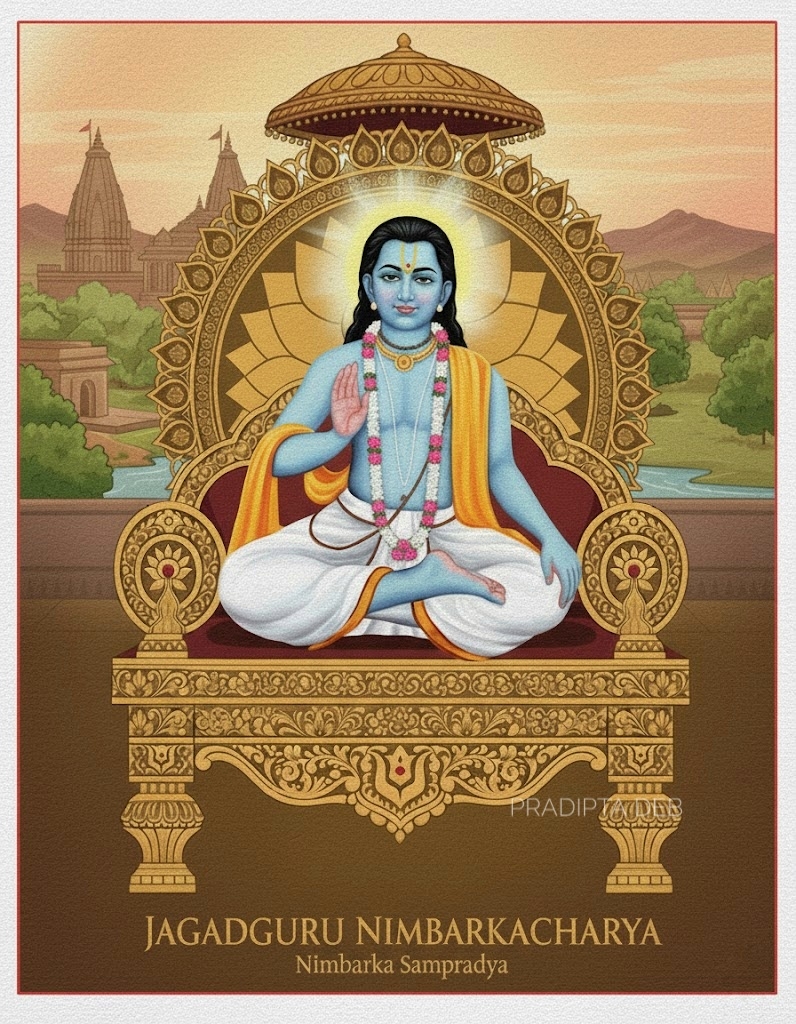
The sun was going down over a small Brahmavarta hermitage when a stranger appeared at the gate, hungry and unwilling to break his vow. He was a wandering ascetic who ate nothing after sunset, and by the time he had walked the dusty path to the door of young Niyamananda's home, only a sliver of light remained in the west. The boy of the house welcomed him with the unthinking warmth that only real devotion produces, and set about preparing a meal. But before the food was ready, the sun slipped below the horizon, and the guest, true to his discipline, rose to leave without eating. It is the kind of moment that decides what a life will mean: a hungry stranger, a broken promise of hospitality, and a boy who could not bear to let either happen.
What happened next is remembered two ways, and both versions have been carried faithfully down the centuries by people who loved this saint. In one telling, the visitor was no ordinary mendicant at all but Brahma himself, testing the boy's devotion before revealing his true form. In the other, he was a monk of unbending discipline who simply would not eat after dark, no matter who begged him. Either way, the boy stepped outside, looked toward the vanishing light, and would not accept that the sun had any right to abandon a guest at his door. He is said to have called down the radiance of the Sudarshan Chakra, the discus of Vishnu, and set it shining among the leaves of a nimba, a neem tree, beside the house. The tree lit up as if noon had returned. The guest ate his fill by that borrowed daylight, and when the meal was finished and the light was allowed to fade, he turned to the boy and gave him a new name, built from the two words the whole village had just watched fuse together: nimba, the tree, and arka, the sun. Niyamananda became Nimbarka, sometimes written Nimbaditya, the sun who rose from the neem, and he would carry that name into becoming one of the great pillars of Vaishnava devotion.
Even within his own lineage, no one agrees on when this boy was born or exactly whose son he was. One strand of memory places his family in Pratishthana, today's Paithan in Maharashtra, born to a Bhagavata devotee named Jagannath and his wife Saraswati. Another strand, just as old, sets his birth further south in the Dravida country, in a town called Vaidurya-pattana, to parents named Aruna Muni and Jayanti Devi. The centuries assigned to him swing even more wildly between different tellers of his story, some placing him only a little after the great philosopher Shankara, others placing him deep in the era when the bhakti movement was reshaping all of North India. Rather than choose a single number and pretend certainty it does not have, it may be truer to say what his own tradition has always said of him: that he was born into a household already steeped in devotion to Bhagavan, that he showed from childhood the discipline of a renunciate, and that whatever year it was, it belonged less to any king's chronicle than to the quiet accumulation of a life bent entirely toward God.
The boy who could summon sunlight for a stranger did not stay a boy for long. As a young ascetic he is remembered turning inward, worshipping Shiva with bilva leaves and seeking something beyond ritual alone: a living teacher. Tradition says that Shiva himself directed him deeper into the forest, toward four luminous brothers who never age and never stop wandering the three worlds, the Kumaras, Sanaka and Sanandana and Sanatana and Sanatkumara, the mind-born sons of Brahma who had themselves received the deepest secret of devotion from Hansa Bhagavan and had passed it to their own younger brother, the sage Narada. Through this unbroken chain, Nimbarka received the sacred Gopala mantra and something rarer still: instruction in bhava marga, the path of feeling, of loving God the way a lover loves rather than the way a philosopher argues. He would carry this gift forward as one more link in a chain that Vaishnavas still call the Sanakadi Sampradaya, the lineage of the four eternal youths.
What Nimbarka built from that initiation was a teaching so careful it has resisted easy labels ever since. He would not say, as some had, that the soul and God are utterly the same, with the world between them nothing but a passing dream. Nor would he say, as others had, that soul and God stand forever apart, strangers who can only bow to each other across an unbridgeable distance. He taught instead what came to be called Dvaitadvaita, difference and non-difference held together at once, and he reached for images anyone could feel in the body to explain it. A ray of sunlight is not the sun, and yet it is nothing apart from the sun. A wave rises from the ocean, distinct for a moment, foaming, catching light, and yet it is only ever ocean. A gem is not its own radiance, and yet you cannot pry the shining away from the stone and call what remains the same gem. The soul, he taught, stands to Bhagavan exactly so: real in its own right, never dissolved into nothingness, and yet never for one instant independent of the light it lives by. It is a teaching that lets a devotee keep both the ache of longing and the comfort of belonging, without surrendering either one for the sake of tidiness.
But Nimbarka is remembered, perhaps even more than for his philosophy, for what he did with Radha. Before him, many devotional lines had already turned toward Krishna as the supreme Lord. Nimbarka went further: he taught that Krishna could not be truly approached at all except through Radha, that she was not a consort added on beside the divine but the very hladini shakti, the bliss-bearing power of God without which God's own sweetness could never pour outward into the world. He taught his followers to take shelter in her name before anything else, and to this day the sampradaya's own maha-mantra puts her first: Radhe Krishna, Radhe Krishna, Krishna Krishna, Radhe Radhe. In the streets and temples of Braj, where devotees of his line still greet one another with nothing but her name, Radhe Radhe, that ordering is his legacy, a small grammatical fact that carries an entire theology inside it: that the road to the beloved runs first through his Beloved.
He settled at last at a place called Nimgaon, near Govardhan in the Braj country, the very land Krishna himself had once walked as a cowherd, and there he lived out his years as a teacher surrounded by disciples who wrote down and defended what he had only spoken in brief, dense verses. His foremost student, Srinivasacharya, is remembered as the one Nimbarka asked to unfold his terse commentary on the Brahma Sutras, the Vedanta Parijata Saurabha, into a fuller exposition; the result, the Vedanta Kaustubha, became the doctrinal backbone the whole sampradaya would stand on after its founder was gone. It is a small, moving detail: a guru who wrote in riddles trusting a disciple to make them plain for everyone who would come after.
Among the stories his followers still tell of him, one goes further than history can verify but closer to the heart than history usually reaches. It says that after his forest initiation, Radha and Krishna themselves appeared before Nimbarka in a single blazing form, neither one nor two, and that this form was the golden figure later ages would know as Gauranga, Chaitanya Mahaprabhu, still centuries from being born. Nimbarka was told to guard the vision in silence and simply go on teaching devotion until the day that form walked the earth in flesh. Whether this is a memory or a hope dressed as a memory, it says plainly what generations of devotees have felt looking backward across the centuries between these two saints: that the worship of Radha and Krishna together, which Nimbarka gave shape to, and the ecstatic worship of Chaitanya that would sweep through Bengal and Braj generations later, feel like two notes of a single, unbroken song.
The verse tradition that remembers Nimbarka does not treat him as a solitary figure but as one of four. It tells that just as Bhagavan once descended in twenty-four different forms in ages past, so in this age, the Kali Yuga, when the world's hold on dharma is at its weakest, Bhagavan chose to come again, not as one avatara this time but scattered across four teachers, each opening a gate into bhakti for people who could no longer find their own way there. Ramanuja walked the path that belongs to Lakshmi. Vishnuswami walked the path that belongs to Shiva. Madhvacharya walked the path that belongs to Brahma. And Nimbarka walked the path of the four eternal Kumaras, carrying forward what Hansa Bhagavan had first spoken and Narada had first carried into the world. Four sampradayas, four rivers from one source, and this hermitage boy who once refused to let a guest go hungry became the mouth of one of them.
His sampradaya did not end with him. Centuries later the teacher Harivyasa Devacharya would renew it and send disciples out in twelve directions to keep it alive, and poets like Sri Bhatta would compose the daily pastimes of Radha and Krishna in the language of ordinary people rather than scholars. Today the lineage's principal seat stands at Salemabad in Rajasthan, and its devotees still fill Vrindavan, Barsana, and Govardhan with the same two syllables Nimbarka gave pride of place eight centuries or more ago: Radhe, Radhe. Somewhere in that chant is still the boy standing in his doorway at dusk, unwilling to let the dark decide who eats and who goes hungry, calling down a borrowed sun rather than break a promise. It is worth remembering, the next time evening falls and someone knocks, that hospitality of that kind was once counted a doorway to God.
The Sun Within the Neem
Nimbarka's name is itself a teaching. When a Jain pandit came to Nimbagrama to debate, the afternoon passed in deep and honest philosophical exchange. The sun set. The guest, bound by his vow, would accept no food after sundown. But Nimbarka could not bear to send a hungry guest away. He reached inward, to the luminous reserve that decades of japa and worship of the divine couple had built within him, and cast a sustained radiance through the neem trees. The grove glowed. The pandit ate. From this miracle came the name Nimba-Arka, the sun in the neem, Nimbaditya. The teaching is not that saints can produce miracles. The teaching is that sincere devotion to Radha-Krishna fills the inner life with a genuine light, a light that does not borrow from outside but flows outward from within, warming whatever world it touches.
Bhaktamal of Nabhadas, tikaEn commentary; Wikipedia, Nimbarka
Dvaitadvaita: Difference and Non-Difference Together
Nimbarka taught Svabhavika Bhedabheda, natural difference-in-non-difference. The jiva, the individual soul, and the jagat, the world of matter, are both genuinely real. They are not illusions to be dissolved as in Advaita, nor are they eternally and completely separate from Brahman as in the Dvaita school. They exist as the natural transformation and expression of Brahman, the way waves are truly distinct from the ocean and yet are nothing but the ocean's own water. The jiva is simultaneously different from Krishna and not separate from Him. This is not a compromise position. It is the position that preserves both the possibility of genuine longing, which requires real distance, and the possibility of genuine union, which requires real intimacy. Both are true at once. This is why the path of devotion is both possible and necessary: the devotee is real, the Beloved is real, and the love between them is real.
Nimbarka Sampradaya Wikipedia; Encyclopedia MDPI entry on Nimbarka Sampradaya
Yugala Upasana: Worshipping Radha and Krishna Together
Before Nimbarka organized it into doctrine, the joint worship of Radha and Krishna as an inseparable divine couple existed only in the lived practice of the Gopis of Vrindavana. Narada Muni, recognizing in the young Niyamananda a soul fully ripe for initiation, transmitted to him the eighteen-syllabled Gopala Mantra from the Gopalatapini Upanishad and the philosophy of Yugala upasana: the devotional worship of Radha-Krishna together as the supreme form of Brahman. This was, according to tradition, the first time this understanding was given the structure of a sampradaya and carried into the world. The central insight is that Radha and Krishna are never to be approached separately. She is not an appendage to His worship. Their union is the very nature of the Absolute. To approach one is always to approach both. Nimbarka placed this truth at the foundation of an entire living tradition.
Bhaktamal tikaEn commentary; Nimbarka Sampradaya, encyclopedia.pub
The Kumara Lineage: When the Teaching Began
The lineage Nimbarka carried does not begin in historical time. According to tradition, the Hamsa Avatara, the Swan form of Bhagavan Himself, gave the Gopala Mantra to the four Kumaras: Sanaka, Sanandana, Sanatana, and Sanatkumara. These four eternal boy-sages, forever young in their renunciation, passed the teaching to Narada Muni, and Narada brought it to Nimbarka. The Kumara Sampradaya, also called the Hamsa Sampradaya or the Sanakadi Sampradaya, is regarded by many as the oldest of the four great Vaishnava sampradayas. Its roots reach behind all recorded history into the first exchange between the Absolute and those who love it most completely. When Nimbarka received initiation, he was not joining a human lineage. He was stepping into a current that had been flowing since before the world was named.
Bhaktamal tikaEn commentary; Nimbarka Sampradaya Wikipedia; Kumara Sampradaya, HandWiki
Prapatti: The Practice of Complete Self-Surrender
For Nimbarka, the culminating act of the spiritual life is prapatti: total self-surrender to the divine couple. Philosophy can clarify the nature of the soul and the nature of Brahman. Jnana, genuine spiritual knowledge, can confirm that the jiva and Brahman exist in a relationship of simultaneous difference and non-difference. But this understanding, however luminous, is not itself the destination. The destination is the complete offering of oneself into the hands of Radha-Krishna, without reservation, without negotiation, without holding back any corner of the self as private property. The Dasha Shloki, Nimbarka's ten verses that compress an entire universe of devotional teaching, points steadily in this direction: not toward philosophical mastery as an end, but toward the place where the philosopher sets down every argument and simply surrenders. This is the fragrance that gives his Vedanta Parijata Saurabha its name: the heavenly flower of Vedanta, which blooms only in surrender.
Bhaktamal tikaEn commentary; Dvaitadvaita philosophy, pparihar.com; Dashashloki, archive.org
Hindi text from OCR scan (Khemraj Shrikrishnadas Prakashan, CC0). May contain errors.