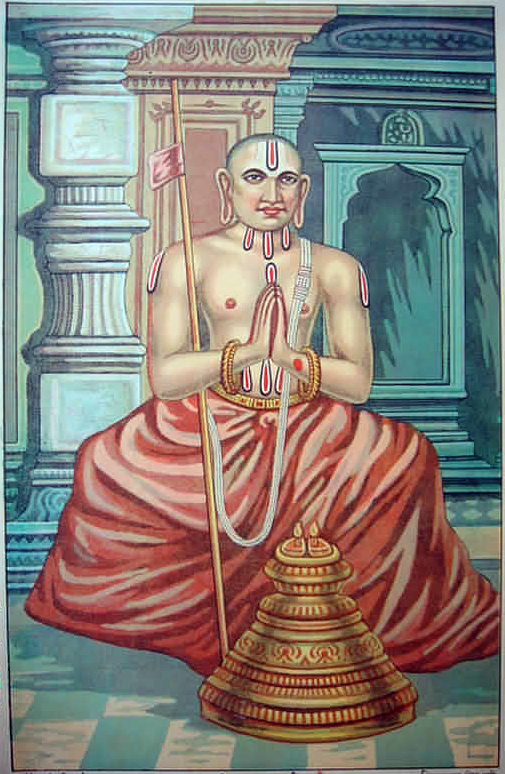
On an island in the Ganga called Rudradvipa, in the tract of holy ground that would one day be known as Navadvip, a small company of ascetics had been dancing since before dawn. Their feet raised dust from the sand; their voices had gone hoarse; and at the center of the circle a lone teacher sat reciting verses of scripture in a voice pitched somewhere between grief and joy. This was Vishnu Swami, and the men around him were his disciples, hundreds of them by the tradition's own reckoning, men who had left behind households and titles to follow a teacher whose only credential was the unbearable sweetness with which he spoke of Krishna. As the kirtan reached its pitch, a stranger walked into the clearing: ash smeared on his limbs, a crescent caught in his matted hair, a trident over one shoulder. It was Shiva, Rudra himself, drawn by the sound of a devotion so undivided that even the god of renunciation could not stay away from it. He stood and listened, and when the singing quieted he asked Vishnu Swami for a boon that startled everyone present: let this order of sannyasis, this discipline of loving surrender he had just witnessed, be known by his own name. Let it be called the Rudra Sampradaya. Vishnu Swami's answer, as the tradition remembers it, was to fold his hands and demur that the glory belonged to Krishna alone, not to any name of his own choosing, human or divine; but he could not refuse Shiva's request, and so a lineage born in praise of Vishnu came to carry the name of Vishnu's greatest devotee among the gods. It is a strange way to found a religious order, by accident, in the middle of a dance, because a passerby could not help but ask for something. And it is exactly the kind of story that survives about Vishnu Swami: vivid in its center, almost featureless at its edges, a man who is unmistakably present in the moment his tradition remembers him for, and almost entirely absent everywhere else.
That absence is not a modern problem of missing archives; it goes back centuries. No verse of Nabhadas's Bhaktamal survives intact for Vishnu Swami; the single line of Priyadas's tilak that has come down in legible form is a fragment three words long, likening him, it seems, to a nav, a boat, glossed in the old commentator's hand with the more familiar word jahaz, a ship. It is a small, damaged inheritance, but it is not a meaningless one. Boats and ships are among the oldest images in Indian devotion for the guru and for the holy company of saints: something built by hands, ordinary and wooden and unremarkable to look at, that nonetheless carries a soul across a sea it could never swim on its own. Whatever else has been lost of the verse written about him, the tradition, at the very least, remembered him as a vessel: not the shore, not the destination, but the sturdy, uncomplaining thing that gets you there.
Historians who go looking for the man himself run into the same fog that swallowed his verse. No writing of Vishnu Swami's has survived in his own hand or under uncontested attribution to him; his direct disciples are not reliably named; and even the line of teachers he is supposed to have founded broke and had to be reconstituted more than once. Scholars who try to pin down when he lived arrive at wildly different centuries depending on which strand of memory they follow. Some place him as early as the third century before the Common Era, a young man named Devatanu born into a family of royal priests in the Pandyan country of the far south, raised on the old Vedic teachings at a time when the Buddha's teaching had drawn much of the region's devotion away from temple worship, and trained from boyhood to answer that challenge. Others find a Vishnu Swami active centuries later, around the eighth or ninth century, reviving a lineage that had gone quiet, raising temples to Krishna in Kanchi and in Dwaraka, drawing scholars who had followed Shankara's path of pure non-dualism back toward a worship of God with form and feeling. And still others locate him later still, in the thirteenth century, a teacher of Shuddhadvaita whose spiritual line would, a few generations on, produce a minister's son named Lakshmana Bhatta and, through him, a boy who would grow up to be Vallabhacharya. Whether this is the memory of one very long-lived line of teachers who kept passing an office and a name to a successor, or three distinct men folded together by centuries of storytelling into a single figure, nobody now can say with certainty, and it would be dishonest to pretend otherwise. What can be said is that the tradition itself was never troubled by the uncertainty; it was not trying to write a biography. It was trying to name the source of a river, and rivers do not always have a single, findable spring.
What that river carried is easier to trace than the man who opened it. Vishnu Swami is remembered as the architect of Shuddhadvaita, pure non-dualism, and the word pure was chosen with some care against a rival it was answering. Where Shankara had taught that the visible world is maya, an illusion laid like a veil over the one changeless Brahman, Vishnu Swami taught that the world is not illusion at all: it is Krishna's own lila, his creative play, real and full-blooded because its source is real and full-blooded. Nothing that comes from a pure origin can itself be impure. The soul is not Brahman in disguise waiting to wake up from a dream; it is a spark, real, eternal, and utterly dependent on Krishna the way light is dependent on fire. Liberation is not the dissolving of a mistaken self into a featureless absolute but the soul's uninterrupted nearness to a Lord it never stopped belonging to, a love completed rather than a distinction erased.
At the heart of that theology stood a fierce and startling image: Narasimha, the man-lion, torn out of a stone pillar by his own devotee's faith to disembowel the tyrant Hiranyakashipu with his bare claws. Vishnu Swami, by every account that survives of his theology, held Narasimha to be the supreme form of God, and the choice tells you something about what kind of devotion he was teaching. Narasimha is not a form that keeps the rules. He appears at twilight, neither day nor night; on a threshold, neither inside the house nor outside it; in a body that is neither man nor beast; wielding neither weapon of war nor tool of the hand. He exists entirely to break the calculations of a world that thought it had covered every angle, because Prahlada, his child devotee, had asked for nothing calculated at all: only to be near his Lord, whatever the cost. That, for Vishnu Swami, was the shape devotion itself should take. Not a transaction weighed out in rites correctly performed and merits correctly earned, but something closer to that pillar splitting open: absolute, un-hedged, willing to look like madness to anyone counting the odds.
This is why his tradition remembers him as a teacher of raga-bhakti rather than vidhi-bhakti, devotion that rises unbidden out of longing rather than devotion assembled out of rules obediently kept. Vidhi-bhakti asks what is prescribed and performs it faithfully; raga-bhakti asks nothing and simply runs toward its beloved the way a child runs toward a parent home from a long journey, without calculating the correct number of steps. It was this distinction, remembered centuries later, that made Chaitanya Mahaprabhu look back toward Vishnu Swami's lineage when he was shaping his own movement of ecstatic love in Bengal: from each of the four sampradayas that Vaishnavas had come to regard as authentic, Chaitanya is said to have taken two defining gifts, and from the Rudra Sampradaya of Vishnu Swami he took precisely this pairing, exclusive dependence on Krishna and the path of raga, spontaneous love, over the path of regulated duty. A teacher whose own words had nearly vanished from the earth was still, generations later, quietly furnishing the emotional architecture of the most influential devotional movement Bengal would ever produce.
Vishnu Swami is also remembered, more prosaically but no less significantly, as an organizer of monastic life. He is credited with introducing tridandi sannyasa, the vow of renunciation marked by a triple staff rather than the single staff of other orders, a small physical detail meant to hold the renunciant's body, speech, and mind under one disciplined intention rather than any one of them alone. He is remembered, too, as the first to establish the ashtottara-shata-nami system, the hundred and eight formal titles by which a sannyasi could be named at initiation, a system so influential that other, later orders are said to have adopted it as their own. Around him, tradition places seven hundred such renunciates, an order large enough to need this kind of scaffolding, evidence that whatever else has been lost, what he built in his own lifetime was not a solitary hermit's practice but a functioning, populated way of life.
The clearest proof that something durable passed through him, though, is not the organization but the company he kept in memory. Among the teachers claimed by his lineage was Sridhara Swami, whose commentary on the Bhagavata Purana became, in time, the single most authoritative reading of that scripture in the devotional world; without it, generations of readers said, the Bhagavatam's inner meaning would have stayed locked. When Chaitanya Mahaprabhu traveled to Kashi and was drawn into debate by Prakashananda Saraswati, a formidable teacher of Shankara's school surrounded by thousands of scholarly followers who dismissed devotional readings of scripture as a lesser, sentimental path, Chaitanya answered them by opening the Bhagavatam through Sridhara Swami's own commentary, verse after verse, until the room that had come to refute him instead fell in behind him. Chaitanya would later say, in words his followers never stopped repeating, that Sridhara Swami was guru of the whole world, because it was through his commentary that anyone could hope to understand the Bhagavatam at all. That debt, passed down through Vishnu Swami's line to a commentator most readers of the Bhagavatam have never heard named, is one of the clearest fingerprints his tradition left on the wider history of bhakti.
The other fingerprint is more visible still, because it is alive today. Vallabhacharya, born at the end of the fifteenth century into a family that traced its spiritual descent to Vishnu Swami's line, carried the banner of Shuddhadvaita into what became Pushtimarg, the path of grace, built around the worship of Krishna as Purushottam, the Lord who saves not because the devotee has earned it but because his own overflowing love, his pushti, chooses to fall on whomever it will. Pushtimarg is, by the account of scholars who have traced these lineages, the one branch of Vishnu Swami's sampradaya still flourishing after all these centuries, its seva of Shrinathji still performed daily in Nathdwara in Rajasthan, its congregations still singing the same devotion to a Krishna who is not distant and abstract but wholly, playfully, intimately present. A teacher about whom almost nothing certain can be written left behind a religious civilization that has outlived every empire that rose and fell across the centuries in between.
What, then, is left to say about the man himself, when so much of what might be said dissolves the moment you reach for it. Perhaps only this: that he seems to have wanted it that way. A teacher who asks for a boon and, when a god offers to immortalize him, gives away even that, insisting the sampradaya wear another's name rather than his own, is not a man building a monument to himself. Vishnu Swami's near-invisibility in the historical record and his enormous, undeniable presence in the devotional one may not be a contradiction at all. He seems to have believed that the vessel doesn't matter, only the crossing; that the boat is not the point, only the far shore is. What he is remembered to have handed forward, generation after generation, through Sridhara Swami's pen and Vallabhacharya's temple and Chaitanya's ecstatic company, was never a doctrine to be memorized so much as a permission: to stop calculating, to stop asking whether you have kept enough rules to deserve God's attention, and simply to run toward Krishna the way Prahlada ran, the way the gopis ran, trusting that the pillar will split open if it has to. A tired reader at the end of a long day, coming to this fragment of a story eight hundred years after the man who inspired it last drew breath, is being offered the same small, sturdy boat Priyadas's damaged verse once described: nothing showy, nothing that asks to be worshiped in its own right, only something built to carry whoever climbs aboard a little further toward the shore they were already longing for.
The World Is Not Impure
Vishnu Swami founded his philosophy on a radical act of trust: the created world is not a veil over truth, not an illusion to be escaped, not a stain on the face of the Absolute. In Shuddha Advaita, pure non-dualism, the universe is real because God is real, and nothing God creates can fall outside of Him. Matter, form, color, sound, the scent of marigold in a temple courtyard: all of it arises within the Lord and is never separate from Him. Therefore nothing is impure. The spiritual path is not a long retreat from the world but a growing recognition that the world itself is pervaded by the divine. This vision does not license laziness or indulgence; it demands a far more attentive love, because every face and every moment is the Lord's own creation, held within His being at every instant.
Shuddha Advaita philosophy of the Rudra Sampradaya
Shiva as the Servant of Vishnu
The name of the Rudra Sampradaya holds a teaching that is easy to miss. The tradition is Vaishnava through and through, devoted to Bhagavan Vishnu and to the lila of Krishna in Vrindavana. And yet it takes its name from Rudra, the Shiva who stands at the head of its human lineage. The story of Premananda Muni receiving mantra-upadesha from Shiva Ji by the Lord's own command contains the whole of it: Shiva, the greatest yogi, the lord of destruction and renunciation, obeys the Lord Vishnu without hesitation. The greatest Shaiva is himself the first Vaishnava. Where many see division, Vishnu Swami's lineage sees a single act of devotion flowing through different forms. The highest non-dualism is not the dissolution of difference but the recognition that every great soul, whatever their path, is ultimately a servant of the one Lord.
Origin story of the Rudra Sampradaya, as preserved in the Bhaktamal tradition
The Divine Play Is the Goal
In many schools of Vedanta, liberation means the falling away of individuality into a vast undifferentiated silence. For Vishnu Swami, liberation is something warmer and more alive. The goal of human life is to enter into the lila, the eternal play, of Krishna in Braj: to see the Lord as the divine child, to stand in Vrindavana as one of His beloved, to participate forever in the delight that is the very nature of the divine. Shuddha Advaita holds that the soul at its fullness does not dissolve. It loves. It serves. It rejoices. The child-form of God that stood at the center of the tradition's dhyana practice points toward this: God as the one who plays, the one who laughs, the one who draws every heart toward Him not through awe alone but through irresistible sweetness. The path is not toward emptiness but toward an ever-deepening fullness of bhakti.
Shuddha Advaita: the centrality of Krishna lila and the Bhagavata Purana
Grace Does Not Measure Before It Gives
The tradition preserves one image of Vishnu Swami that speaks more than any philosophical treatise. When the Lord of the Universe at Puri, Shri Jagannatha Ji, understood what this saint had realized about divine grace, He caused four doorways to be opened in His mandira: one for each direction, so that devotees coming from every part of human life could enter and receive darshan. The Lord opened the architecture of His own house to honor one saint's understanding. That understanding was simple: the grace of God is not rationed. It does not ask for qualification before it gives. It is as wide as the horizon, as indiscriminate as rain. The four open doors are not a social reform in the modern sense; they are a theological statement carved in stone. If the Lord is truly all-pervading, truly present in all beings, then no sincere heart can be a stranger at His threshold.
Bhaktamal tika on Vishnu Swami
The Flame Outlasts the Lamp
Vishnu Swami's own writings are lost. His dates remain uncertain. What survives is the living tradition he carried: forty-seven teachers before him had kept the flame of Premananda Muni's love alive, heart to heart, and he received that flame and passed it forward. Centuries after his time, Vallabhacharya was born into the world the Rudra Sampradaya had shaped, and through him the Shuddha Advaita vision became one of the great rivers of Vaishnava devotion, flowing through the Pushti Marg and the worship of Shri Nathji across Braj and beyond. This is the lesson of parampara: what a guru transmits is not reducible to texts or dates. It is a quality of love, a way of seeing, a confidence in the Lord's grace that passes from one burning heart to the next. The lamp may be forgotten; the light continues.
Rudra Sampradaya lineage history; Vallabha Sampradaya as its flowering
Hindi text from OCR scan (Khemraj Shrikrishnadas Prakashan, CC0). May contain errors.