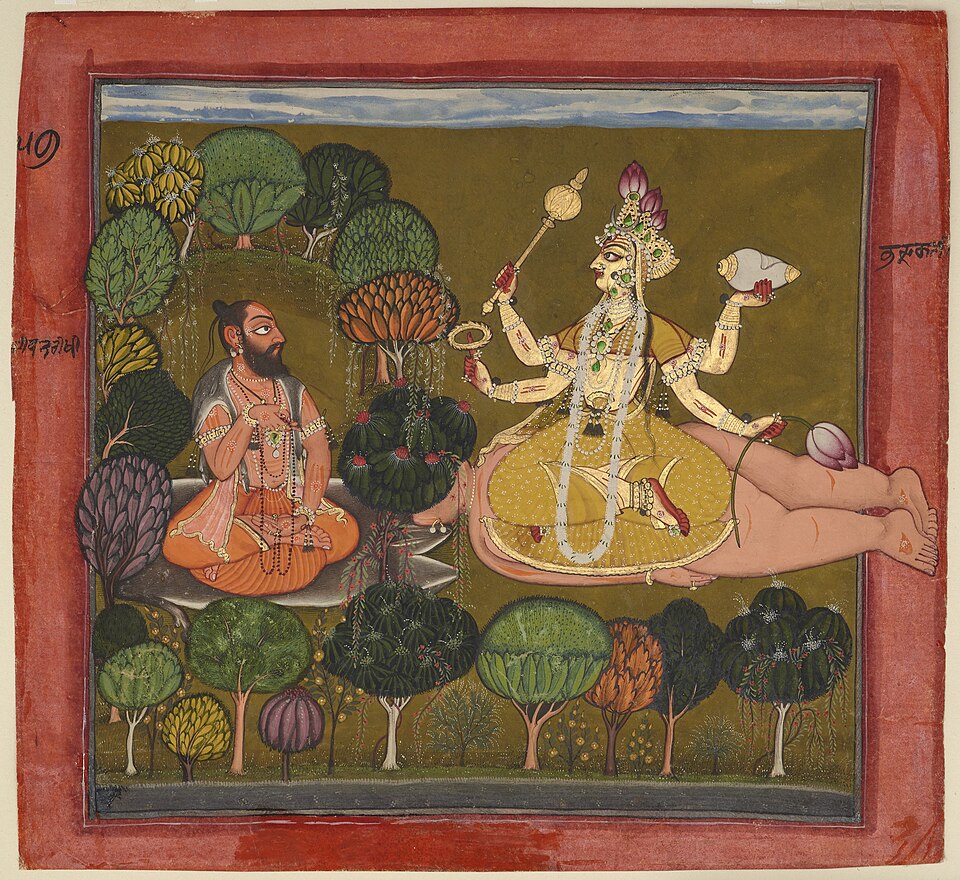
Picture a single point of awareness afloat on water that has no shore, no color you could name, and no bottom any plumb line could ever sound. Every star has gone dark. Every mountain and river and threshing floor and burial ground that ever existed on earth has been swallowed whole. The Vedas themselves, along with the rishis who once sang them into being, have folded back into the breath of the god who contains them, sleeping now through the long night between one creation and the next. And somewhere in the middle of that total dark, one soul is still awake: an old muni named Markandeya, tossed by black water with nothing to hold onto but his own unbroken remembrance of Hari.
He swims. He does not know for how long, because time itself has gone under with everything else. Seasons pass, or what feel like seasons; he grows hungry, then beyond hunger; he grows afraid, then beyond fear, into a kind of naked attention that has nothing left to distract it. Then, far off on the black water, he sees a single point of light. It resolves, as he swims closer, into a leaf: one small, curled leaf of the banyan tree, riding the flood like a raft. On it lies a child, glowing softly, sucking his own toe, utterly at ease in the middle of the end of the world. Before Markandeya can decide whether to be afraid of this impossible infant, the child breathes in, almost playfully, and the old sage is drawn helplessly toward that open mouth and swept inside.
Inside, he finds the universe. Not a vision of it, not a report of it, but the thing itself: oceans and continents, kingdoms rising and falling, gods being born and dying, and his own small hermitage among the thousands of hermitages of the thousands of hermits who ever sat in penance, all of it folded into a sleeping infant the way an entire forest is folded into a single seed. Then, as suddenly as it began, he is expelled, and finds himself back on the bank of his own familiar river, in his own body, in ordinary daylight, as though no time had passed at all. What had felt like an age of wandering had taken less than the space of one breath outside. This is the encounter the tradition calls seeing Maya: not hearing about the play of appearance and dissolution, but being carried through it, drowned in it, and set gently back on the shore of the world by the very power that had unmade it.
Markandeya's whole life is built from encounters of this kind, each one a different angle on the same terrifying mercy. He was born, the old stories say, to a childless couple, his father having gone to Shiva and been offered a choice: a virtuous son who would live only sixteen years, or a witless one who would live long. The father chose virtue over length, and the boy grew up knowing the exact hour of his own death. On the day it came, he was found in worship, his arms wrapped around a Shiva lingam, and when Yama's noose came down to claim him it fell around the lingam as well as the boy's neck. Shiva burst from the stone in fury and struck down death itself, and only relented when the other gods pleaded that the order of the world required Yama to live. In the settlement that followed, Markandeya was allowed to remain sixteen forever, immortal, one of the chiranjivis, the ones who do not die when others die. He had already looked death in the face once, at the very door of his own end, before he was ever asked to swim through the death of the entire universe.
It is this figure, or someone very like him, whom Nabhadas seems to have set into his garland of devotees under the name Mayadas, servant of Maya, one who has been given Maya, and the old commentary attached to the verse is disarmingly honest about how little certain ground there is to stand on here. Some say, it admits, that Mayadas is indeed the name of one particular devotee, but no trace of such a person can be found anywhere. Many others hold that Mayadas is not a personal name at all but a title, and that it points to either Shri Lomashji or Shri Markandeyaji, because both of these great souls beheld Maya directly. The commentary does not choose between them. It simply says: see the story of this mahatma, and lets the reader decide which mahatma is meant.
If it is Lomasha rather than Markandeya, the flavor of the vision is entirely different, though the teaching underneath it is the same. Lomasha's very name means the hairy one, and the old accounts explain the name with a single, staggering image: once every kalpa, once every single day and night of Brahma, a period so vast that a mortal lifetime does not register in it as even a tick of a clock, one hair falls from his body. He was already ancient beyond telling when the events of the Mahabharata took place, and he carries in his own body, hair by hair, the memory of Indras beyond counting who have risen to the throne of heaven and fallen from it again into dust, or into lower and stranger births, while Lomasha simply continues, watching. Where Markandeya was pulled bodily into one overwhelming flood and spat back out, Lomasha stands permanently at a height from which entire floods, entire dissolutions of the universe, are ordinary weather. He has seen so many kalpas end that impermanence is not a doctrine to him; it is simply what time is made of.
It was Lomasha who came to the Pandavas in their forest exile, arriving at Yudhishthira's hermitage as a guest bearing no wealth but stories, and it was Lomasha who accompanied the grieving king from one holy crossing to the next through years of humiliation and loss. Kings do not easily accept comfort, especially from someone who cannot restore what they have lost, so Lomasha did not try to talk Yudhishthira out of his grief. Instead he told him about Rama, about Agastya, about the strange boy-sage Rishyashringa, and, among the rest, about the day a young Brahmin boy walked into Indra's newly finished, endlessly expanding palace and showed the king of heaven a column of ants marching across the floor. Each of those ants, the boy said, had once been an Indra exactly like the one standing before him, lord of the same heaven, wearing the same crown, and each had fallen, through the turning of karma, into the body of an insect. Indra's pride went out of him like air from a punctured drum. It is not hard to hear, underneath a story about a marching line of insects, the same lesson Markandeya learned inside the mouth of a child on a leaf: that thrones, kingdoms, and bodies are guest houses, and Maya is the innkeeper who changes the guests without ever changing the building.
What makes it possible for a single epithet, Mayadas, to point at either of these two elders is that both were given, by grace and not by cleverness, a direct look at how completely provisional the visible world is, and in neither case did that look produce despair, cynicism, or a cold withdrawal from feeling. Markandeya, set back down on his riverbank still trembling from the flood, did not become a nihilist; he doubled his devotion to Vishnu and eventually received, from Shiva and Parvati together, both his eternal youth and the authorship of a Purana in which the Goddess herself is exalted. Lomasha, carrying more collapsed kalpas in his own body than any mind can hold, did not turn bitter or aloof; he spent his impossible lifespan walking beside a grieving king, telling him stories, easing him toward the fight he still had to fight. This is the real weight of the word das folded into Mayadas. Seeing Maya, in this tradition, is not a philosopher's achievement to be worn as a badge of superior understanding. Properly received, it produces a servant: someone who, having watched the entire architecture of status and permanence buckle and vanish, has nothing left to do with that knowledge except serve.
There is something almost too fitting in the fact that the entry meant to honor the one who saw through the veil is the one entry where the veil has closed back over the name itself. No independent record survives, in anything this research has turned up, of a devotee separately and biographically known as Mayadas, distinct from these two ancient rishis; the old commentary says so plainly, admitting that the person's trace cannot be found, rather than inventing one to fill the gap. It would be easy to read that admission as a failure of the text. It reads instead like an accidental teaching, offered by the very thing it describes. Maya, after all, is precisely the power that obscures origins, blurs the line between one revered elder and another, and leaves even careful compilers of a four-hundred-year-old garland of names writing, in effect, we are not sure, look and judge for yourself. The entry that is supposed to be about the one who saw Maya is itself faintly veiled by Maya. That is not a coincidence a devotee should shrug past; it is worth sitting with.
So take the name as it comes, Mayadas, servant of the one who has looked straight at the illusion and lived, whether the elder behind it swam through the flood on the strength of remembering Hari's name, or has simply outlasted flood after flood by virtue of a life stretched past the measure of Brahma's own days. You do not need to resolve which rishi is meant to receive what the entry is actually offering. Everyone who has lived even a little while has already been given a small, cruder version of the same vision: the sudden vanishing of a person who was certain to always be there, the collapse of a fortune or a health or a certainty that seemed as solid as stone, the moment the floor of ordinary life gives way for an instant and something vast and formless shows itself underneath. What Markandeya and Lomasha teach, together, under this one uncertain name, is what to do in the instant after the flood recedes and you find yourself, astonished, still breathing on the bank: not to curse the water, and not to pretend it never came, but to become, from that day, a das, a servant, of the one whose single breath makes the flood rise and whose single breath makes it fall again.
Maya Reveals the Lord, Not Just the Illusion
The name Mayadash points to a category of devotee who has been granted the terrible privilege of seeing behind the curtain of creation. Sage Lomash watched entire universes rise, flourish, and dissolve, each dissolution marked by the quiet fall of a single hair from his body. Sage Markandeya was pulled into the belly of an infant on a banyan leaf and beheld all the worlds alive within that tiny form. Both witnesses emerged not with pride but with trembling. The vision of Maya does not lead to mastery; it leads to surrender. When creation itself is seen as the Lord's play, what remains is not philosophy but bhakti.
Bhaktamal, Shri Mayadash Ji entry; commentary by Priyadas
The Philosopher Draws Conclusions; the Bhakta Falls at the Lord's Feet
There is a distinction between one who observes Maya and draws intellectual conclusions and one who observes Maya and falls prostrate before the one who wields it. Lomash did not hoard his cosmic knowledge to elevate himself above other sages. Markandeya did not emerge from the Lord's belly boasting of what he had witnessed. Both responded with stuti, with praise, with deepened devotion. Seeing is not the same as realizing. Realization in the devotional sense means that every glimpse of the infinite reinforces one thing: the smallness of the self and the greatness of the Lord. In that smallness, the devotee finds the Lord himself.
Bhaktamal, Shri Mayadash Ji entry; commentary by Priyadas
Impermanence Is Not a Doctrine; It Is a Living Experience
Lomash carries the record of cosmic dissolution in his own body. The gaps in the circle of hair on his chest are not symbols; they are the actual evidence of ages. Each fallen hair marks the end of one Brahma's full lifespan, with all the Indras and all the worlds that belonged to that age. When Indra saw those gaps, he understood his own impermanence not through scripture but through direct sight. The Bhaktamal teaches that wisdom about the transience of the world must become personal, felt in the body and the breath, not merely recited. Only when impermanence is truly witnessed does the devotee turn toward the one thing that does not dissolve.
Bhaktamal, Shri Mayadash Ji entry; commentary by Priyadas
The Sudden Vision and the Long Witnessing Both Arrive at the Same Shore
Lomash witnesses Maya slowly, across immeasurable spans of time, as universe after universe quietly dismantles itself around him. Markandeya witnesses it in a single overwhelming moment: the world vanishes, the ocean appears, the infant breathes him in and breathes him out. One is the long witnessing; the other is the sudden revelation. Yet both sages are left with the same knowledge: that every world and every age rests within the Lord's play and can be withdrawn at his pleasure. The Bhaktamal groups them together under one heading to say: the path taken matters less than the destination. Wherever devotion leads, it arrives at the feet of the Lord.
Bhaktamal, Shri Mayadash Ji entry; commentary by Priyadas
To Be Erased by Maya and Rebuilt by Grace
Maya is the great eraser, the power that makes us forget what is real and cling to what is passing. A servant of Maya, in the devotional sense, is not one enslaved to illusion but one who has been thoroughly undone by it and then reconstituted by the Lord's grace. Markandeya drifted alone in the vast waters of pralaya, stripped of every familiar form, before the Lord revealed himself. Lomash has watched every attachment of every age dissolve, hair by hair. What both share is that they were not strong enough to survive on their own. The Lord chose to let them see. That chosenness is itself the grace. The bhakta stands witness not because of his own strength but because the Lord sustains him within the vision.
Bhaktamal, Shri Mayadash Ji entry; commentary by Priyadas
Hindi text from OCR scan (Khemraj Shrikrishnadas Prakashan, CC0). May contain errors.