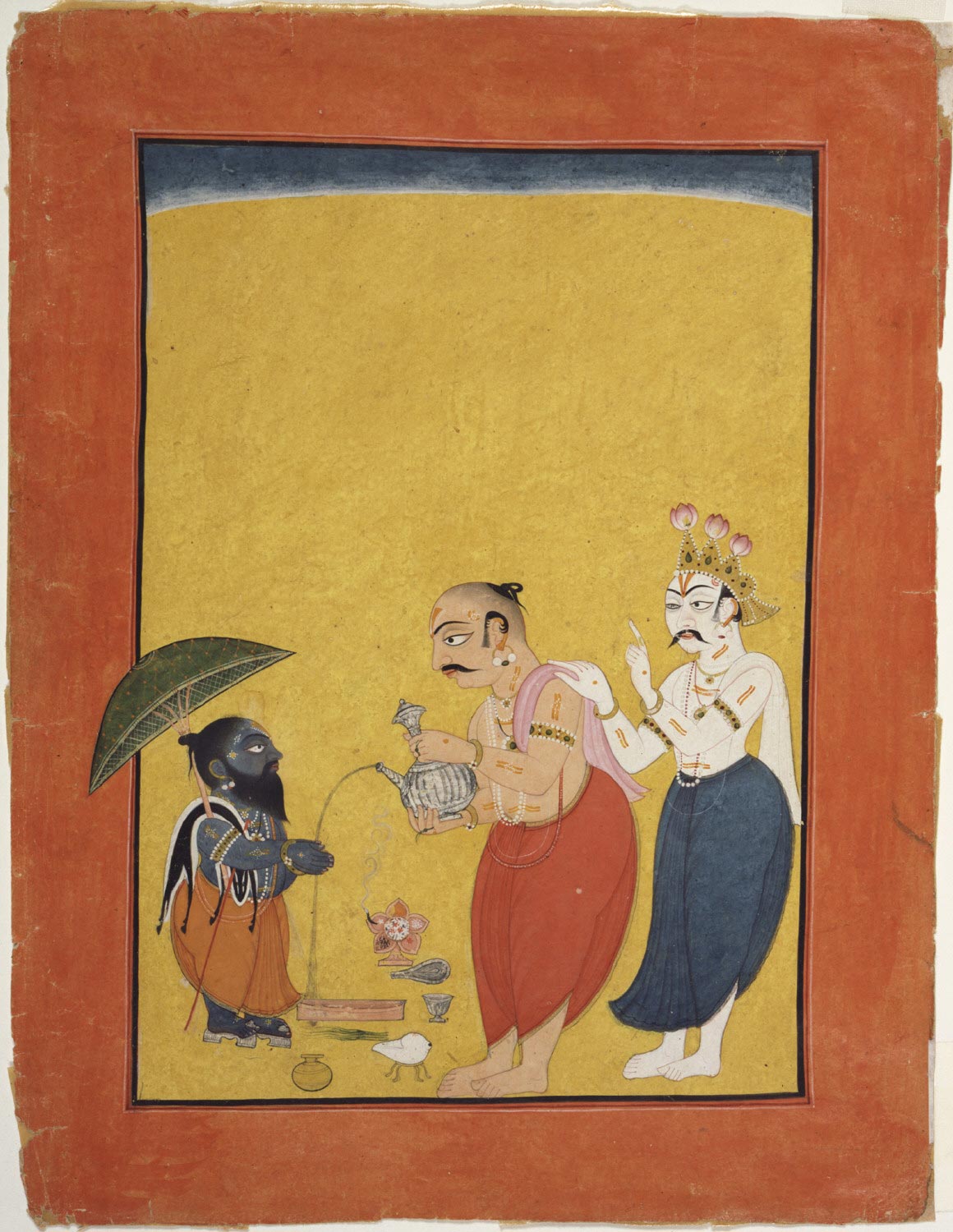
On the fertile southern bank of the river Narmada, under a sky thick with the smoke of a thousand oblations, King Bali of the asuras was completing the greatest sacrifice of his reign: a hundred ashwamedha yajnas, the horse sacrifices by which an emperor announces to heaven and earth alike that no throne stands higher than his own. Priests chanted around fires that had not gone cold in weeks. Elephants stood caparisoned at the gates, and ministers of every rank waited to be noticed. Into this glittering assembly, past the guards and the officiants, walked a boy no taller than a child's shadow: a dwarf brahmin wrapped in a deerskin, carrying a bamboo staff, a water pot, and a palm-leaf umbrella, his forehead marked with sacred ash, his eyes carrying a light that made even the grandest men in the hall fall quiet.
This was no ordinary day for Bali to find himself so exposed. He was, by then, master of the three worlds, heaven, earth, and the region beneath. He had taken that dominion from Indra himself, not by treachery but through a fearsome rite called the Vishvajit yajna, said to have furnished him with an unbreakable chariot, a bow, and armor drawn straight out of the sacrificial fire, and through a discipline so unbroken that even his enemies respected him before they feared him. He carried a lineage the Puranas remember with something close to wonder: his grandfather was Prahlada, the boy who had been hurled from cliffs and set inside blazing pyres by his own father Hiranyakashipu for refusing to give up the name of Vishnu, and who came out of every trial still singing it; his father was Virochana, another asura king remembered for the same unshakeable devotion. Bali had grown up inside that family's peculiar arithmetic, in which a promise mattered more than a kingdom, and in which an asura who kept his word and gave without limit could outrank any god who merely ruled. He built his own reign on that lesson. By the time of the great sacrifice on the Narmada, it was said that no one who came to Bali's gate, deva or asura, sage or beggar, had ever been sent away with an empty hand.
So when the small brahmin appeared inside the yajna enclosure, Bali did what he always did. He rose from his seat, welcomed the boy as an honored guest, and washed his feet with his own hands, water that in a few moments would become more sacred than any river on earth. Then, with the practiced warmth of a king who genuinely loved to give, he asked what gift the boy desired. Land, cattle, gold, an entire province: whatever he named would be granted before the sentence was even finished.
"I want very little," the boy said. "Only as much ground as I can cover in three of my own paces."
Somewhere just behind the throne, Bali's guru Shukracharya went cold. In the strange radiance pouring off this dwarf he had already recognized the outline of Vishnu, arrived, he suspected, to unmake everything his royal disciple had built. He hurried to Bali's side and hissed the truth into his ear: this is no ordinary brahmin child, this is Hari himself, and if you pour the water that seals this gift you will lose all three worlds before the sun sets tonight. Refuse him.
Bali did not refuse. Loudly enough for the front rows of his own court to hear, he answered that if it truly was Vishnu standing there with an open palm, then his whole life, his throne, his celebrated generosity, had only ever been rehearsal for this one moment, and he would not spoil it now to keep a few provinces. There was nothing more shameful, he said, than a king who broke his word once he understood the size of the gift he had promised. Furious at being overruled by his own student, Shukracharya cursed him on the spot, that a man who abandons his guru's counsel would lose everything he owned. Then, determined that the vow should never be sealed at all, he shrank himself down and lodged, unseen, inside the narrow spout of the ritual water vessel, choking off the flow. Bali, sensing that the water would not pour, took a single blade of kusha grass and pushed it through the spout to clear the blockage. Tradition says the grass found his hidden guru's eye instead, and that this is the reason Shukracharya is remembered ever after as blind in one eye, the price, the story suggests, of standing between a devotee and his God. The water flowed. The gift was sealed.
The boy did not wait to be thanked. Where a moment before there had stood a child small enough for a courtier to lift with one arm, there now rose a form that filled the sky, the form the scriptures call Trivikrama, he who takes three strides. One foot came down and covered the whole earth. The second rose and swallowed the heavens, brushing so close to the outer shell of the universe that it tore a small opening in it, through which the pure water of the causal ocean came pouring in; Brahma is said to have caught that trickle in his own water pot and let it fall to the world below as the river Ganga, called Vishnupadi ever after because she is born from the foot of Vishnu.
Then the towering Lord turned back to Bali and asked, almost gently, where he might set down his third step, since there was no longer a hand's width of earth, sky, or netherworld left unclaimed. Every minister and priest in that hall must have understood, in the silence that followed, exactly what was being asked of their emperor. Bali did not weep, and he did not beg to keep even one house of the kingdom he had built. He bowed his head and told the Lord standing over him to place the last step there, on the very crown of the king who a moment earlier had ruled everything there was to rule. Vishnu's foot came down on Bali's head and pressed him, not into ruin, but downward through the earth into Patala, the world beneath the world.
What followed is the part of the story the Bhagavata Purana lingers over with open tenderness. Vishnu did not leave Bali in darkness, or alone. His queen Vindhyavali, remembered as the mother of his many children, among them Banasura, who generations later would cross paths with Krishna's own family, went down with her husband rather than remain above without him. Vishnu granted the fallen king a realm named Sutala, more resplendent, the text insists, than the heaven Bali had lost, free of hunger, age, and grief, and built and provisioned by the divine architect Vishvakarman himself. He named Bali immortal, one of a small company of chiranjivis permitted to live on through every age until the world ends, and promised him something even the devas could not claim outright: that in a future age, the Savarni Manvantara, when the reign of the present Indra has run its course, it is Bali who will rise to sit on that throne. And in the strand of the story kept most tenderly in Kerala, the one that gives the land its best-loved festival, Vishnu is said to have granted one further mercy, that once each year Bali be allowed to climb up out of the netherworld and walk for a single day among the people of his old kingdom, to see with his own eyes that they had not forgotten him. Ten days of flowers laid in spiral patterns on every doorstep, of feasting and boat races, are kept each autumn even now as Onam: not a mourning for a dethroned king, but a homecoming.
There is a further, very human coda that the tradition could not resist adding. Having handed over the whole of creation and asked for almost nothing in return, Bali made one small request of the Lord who had just measured him and found him larger than his own lost kingdom: stay with me. Vishnu agreed to remain at the gates of Sutala as Bali's own doorkeeper, which meant that Vaikuntha now sat empty of its Lord, and Lakshmi found herself without her husband. So she came down, the story goes, disguised as a wandering brahmin woman with nowhere to sleep, and asked shelter of Bali, who gave it without a single question, because that was the only way he knew how to answer anyone who asked him for anything. On the full moon of the month of Shravana she tied a plain thread around his wrist, the gesture of a sister to a brother, and when he asked what she wanted in exchange she told him who she was and why she had come. Bali, laughing, is said to have released Vishnu from his post so that the Lord could go home to his wife, on the single condition that he keep returning to visit him. Some trace the custom of Raksha Bandhan, the tying of the protective thread, to that afternoon in the netherworld, and in parts of India the festival is still remembered by the older name Baleva, Bali's own evening.
The Bhagavatam places Bali among a tiny circle it calls the twelve mahajanas, the great souls whose lives alone are teaching enough for the rest of creation to study: Brahma is there, and Narada, and Shiva, and Bali's own grandfather Prahlada, and Bhishma, who chose to lie on a bed of arrows for as long as it took rather than release his life before Krishna's face was in front of him, and Bali, the asura emperor who gave away three worlds to a dwarf rather than break a promise. What every teller of this story from Nabhadas onward has found impossible to stop retelling is not the size of what Bali lost. It is the size of what he refused to lose: his satya, the plain truth of a vow once given, and his willingness to recognize the hand of God the instant it opened toward him, even disguised as a beggar asking for almost nothing. He is not remembered as a warning about pride brought low. He is remembered as a king still worshipped at his own festival, still waited on by the very God who conquered him, because he understood something thrones rarely teach, that the only wealth worth keeping is the wealth you have already promised away with your whole heart. Even now, the story says, he waits below the earth for the one day a year when the doors of Sutala are allowed to open, and he can climb back up into the light his people have never stopped keeping ready for him.
The Word Once Given Is Sacred
Bali belonged to a lineage where no promise was ever broken. When Vamana asked for three paces of land, Bali gave his word and poured the water of sankalpa. His guru Shukracharya warned him, his counselors warned him, the logic of self-preservation cried out against it. Bali heard all of this and still refused to retract. He said: telling lies, or failing to honor a promise once spoken, is the most sinful act a person can commit. Even the earth, he said, can bear any weight except the weight of a liar. For Bali, satya was not a virtue among many virtues. It was the ground beneath all other virtues. If you give your word and it means nothing the moment it becomes costly, then nothing you say or offer or pray can be trusted, least of all by yourself.
Bhagavata Purana 8.20, Bhaktamal tikaEn
True Generosity Has No Exceptions
Bali had made a vow at his sacrificial fire: whoever comes and asks, receives. He did not add conditions. He did not say, except when the loss is too great, or except when my guru objects, or except when the asker turns out to be God in disguise. He said: whoever comes and asks, receives. When Vamana arrived, small and bright-eyed and seemingly harmless, the same rule applied. Bali was not more generous because he recognized the divine. He was generous because that was who he was, before any recognition, before any reward. The seeker asks: how much of my giving is really giving, and how much is giving only what costs me nothing? Bali's answer is unsparing. Dana that has a ceiling is not dana. It is commerce wearing the robes of generosity.
Bhaktamal tikaEn; Bhagavata Purana 8.19
When God Comes to Your Door, Do Not Calculate
Shukracharya told Bali plainly: this is Vishnu Himself in disguise. He has come to take everything from you. Refuse him. There is no sin in protecting what is yours from divine trickery. Bali listened and then said something that stopped time. He said: if the Lord Himself has come to my door asking for alms, this is the greatest day of my life. What kind of man would I be if I turned Bhagavan away because I was afraid of losing my kingdom? Bali understood something that cannot be argued into a person. It can only be lived. The moment of encounter with the divine is not a negotiation. It is not the time for calculation or caution. It is the time to open the hands completely and let fall whatever they were holding.
Bhaktamal tikaEn; Exalted Qualities of Bali Maharaja, ISKCON Bangalore
Devotion Stands Above Even the Guru's Command
In the Vedic tradition, the guru's word is not lightly set aside. The guru is the living gateway to dharma, and disobedience carries real spiritual weight. Bali knew this. He loved and honored Shukracharya. But when his guru's counsel contradicted what he understood to be the will of Bhagavan, Bali chose Bhagavan. He gave Shukracharya nine reasons why the gift must be made. He spoke with care and with respect. But he did not waver. The teaching embedded in this moment is precise: the guru exists to lead the seeker toward God. If ever a moment comes when following the guru would mean turning away from God, then the guru's own deepest intention is served by the disciple who moves toward the Lord. Bali did not defy Shukracharya out of arrogance. He fulfilled the guru's real purpose by transcending the guru's particular instruction.
Bhagavata Purana 8.20; Quora analysis of Bali's defiance of Shukracharya
Offer the Head When Nothing Else Remains
Two steps. The cosmos was covered. Every grain of earth, every sky, every world Bali had ever known or conquered was beneath Trivikrama's feet. Vamana looked down and asked: you promised three paces. Where shall I place the third? The question was not cruel. It was the final invitation. Bali could have said nothing. He could have stayed silent in defeat. Instead, he bowed his head and said: place it here. This is the gesture the entire Bhaktamal honors. Not the hundred yagnas. Not the conquest of Svarga. The bowed head. Because what Bali gave in that moment was not a kingdom. It was the last fortress of the self: the sense that there is something I am, something that belongs to me, something that cannot be surrendered. He gave that. And in giving it, he received what no kingdom could contain.
Bhaktamal tikaEn; Bhagavata Purana 8.21
The Lord Is Bound by Complete Surrender
After taking the three worlds, Bhagavan had what He came for. The Devas had their realms restored. The cosmic order was satisfied. But the Lord did not leave. He stationed Himself at the gate of Sutala as Bali's doorkeeper, and there He remains. The scriptures say He guards that threshold nityashah, eternally. What does this teach? It teaches that there is a surrender so complete, so free of bargaining, so empty of any residue of self-interest, that the Lord is left with no way out. He cannot simply take the gift and go. He has been caught by love. Bali did not plan this. He did not think: if I give everything, God must stay. He simply gave, with nothing held back. And the Lord, who is free of all bondage, found Himself unable to leave.
Bhaktamal tikaEn; Bhagavata Purana 8.22-23
Power Purified by Devotion Becomes Service
Bali was not a meek or passive figure. He conquered the three worlds. He drove Indra from his throne. He sustained the greatest sacrificial fires the Daitya lineage had ever seen. He was, by every measure, a man of extraordinary worldly power. And yet the Bhaktamal places him among the bhaktas, not among the conquerors. Why? Because his power was never for power's own sake. He governed justly. His subjects were fed. Dharma was upheld without favoritism. When the moment of final choice came, he set down every ounce of that power without a backward glance. The teaching for the seeker is not that power is wrong, or that ambition is impure. It is that power held lightly, power placed in service rather than in self-aggrandizement, power that can be released the instant God calls for it, that is power purified. And purified power, in the end, is just another name for surrender.
Bhaktamal tikaEn; Mahabali Wikipedia; harikrishnan.org analysis
Hindi text from OCR scan (Khemraj Shrikrishnadas Prakashan, CC0). May contain errors.